
Brands
Brands are learning to speak two languages at once
From Starbucks to Emcure, companies are ditching uniform tone in favour of tailored messaging for millennials and Gen Z, and it is working


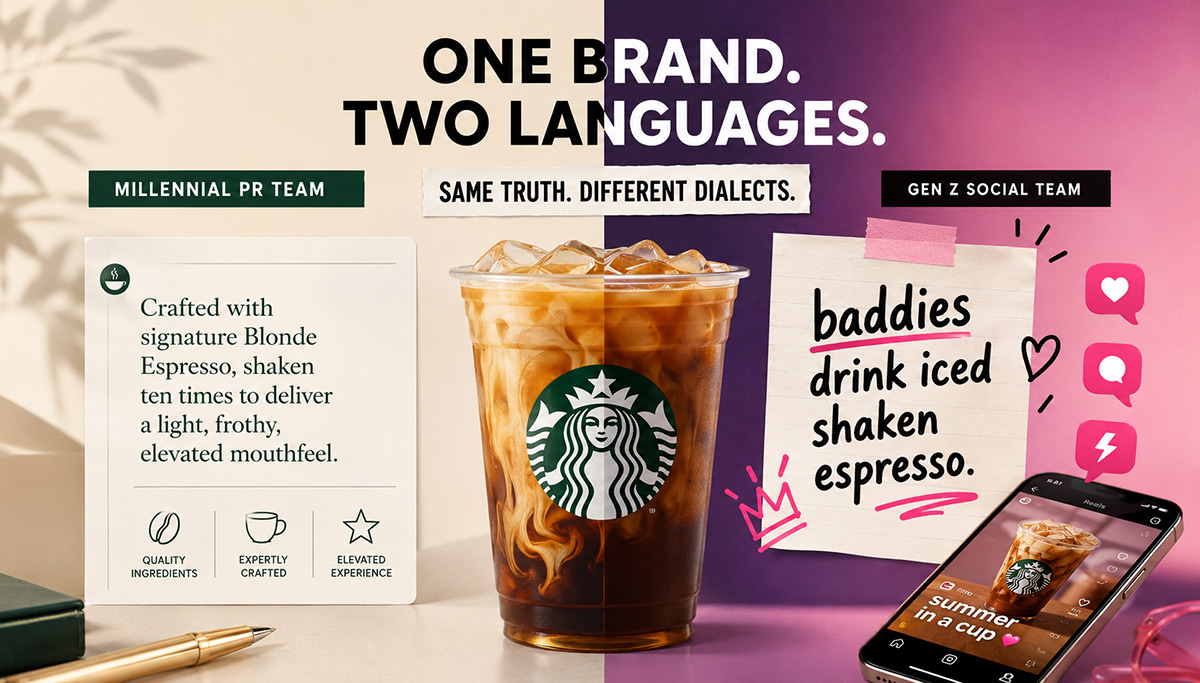
MUMBAI: One column says a coffee is “crafted with signature Blonde Espresso, shaken ten times to deliver a light, frothy, elevated mouthfeel.” The other says: “baddies drink iced shaken espresso.” Same product. Same brand. Completely different universe.
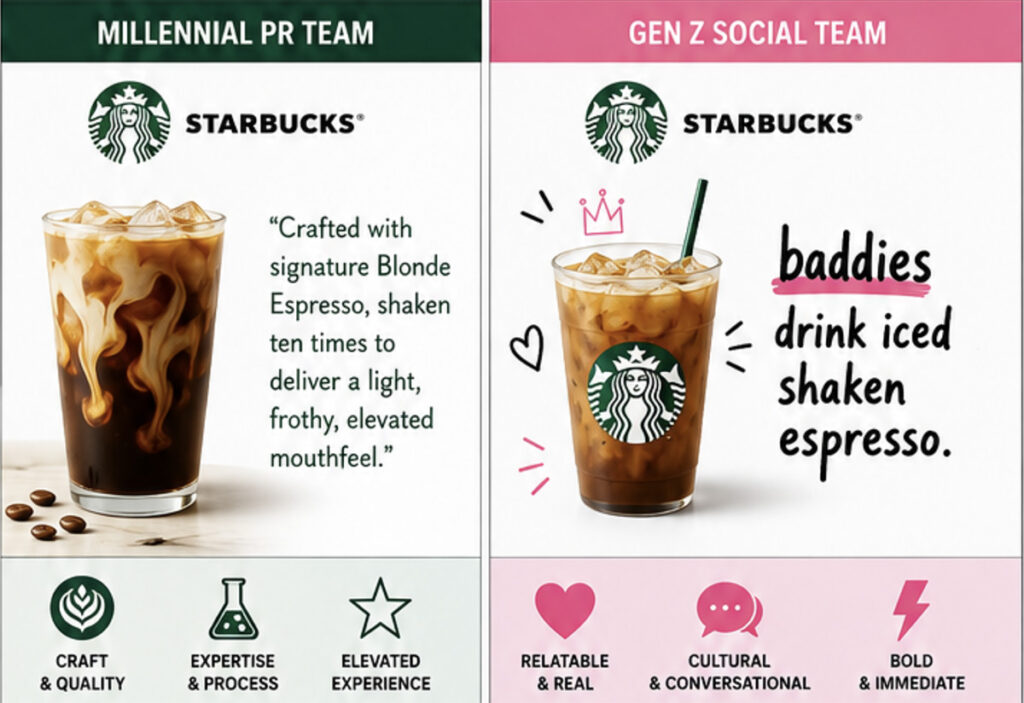
A social media trend sweeping Instagram is forcing a rethink of one of marketing’s most sacred rules. Brands are posting side-by-side comparisons of how their “millennial PR team” versus their “Gen Z social team” would describe the exact same product, and the results are exposing just how dramatically the grammar of brand communication has shifted. The millennial version leans on craft, structured storytelling and technical proof points. The Gen Z version strips everything down to its immediate, emotionally loaded cultural essence. The format looks like an office in-joke. It is, in fact, a strategic pivot.
For decades, the orthodoxy held that a brand must speak in one uniform tone across all channels or risk losing coherence. That logic is crumbling. Brands are discovering they can hold on to their core product truth while radically overhauling their vocabulary, cadence and emotional register depending on who they are talking to. And the shift goes deeper than tone. Media buyers and brand managers have long segmented audiences by demographics: age, geography, income. What this trend signals is something more fundamental. Call it dialect segmentation. The modern consumer no longer chooses a brand purely for its functional value; they choose it based on how fluently it speaks their digital language. They can spot instantly when a legacy team is trying too hard, and they are merciless when it does.
Starbucks India, Pepsi, Tide, McDonald’s India, Garnier, Clinique and Bioderma have all leaned into the format. The fact that it has now crossed into healthcare makes it harder to dismiss as a stunt.
Emcure Pharmaceuticals recently used the format to drive awareness around iron deficiency anaemia in women. The millennial copy noted that the condition “can lead to fatigue, reduced cognitive performance, and decreased immunity.” The Gen Z translation: “Constant fatigue? Big red flag. Get your Hb checked, bestie.” In a category where communication has historically been clinical, cautious and impenetrably dull, that is a small revolution.
Naveen Soni, director of corporate communications at Emcure, says the response has been largely positive. “The meme game is a powerful way of reaching out to all demographics, sparking playful conversations,” he says. “This can be well complemented by expert-led communications that remain critical for building credibility, depth and trust. One cannot replace the other, and both can beautifully sit together for a 360-degree messaging.”
Yet while the trend looks effortless on an Instagram grid, executing it inside a large organisation is anything but. Corporate communication departments have historically run on long approval lead times, risk-mitigation protocols and strict legal sign-offs. For a regulated brand in healthcare or a legacy FMCG player, allowing a social media manager to type “baddies” or “big red flag” requires a significant degree of institutional trust, and a willingness to rewrite the rulebook. The brands succeeding in this space are actively dismantling multi-layered approval pipelines, granting younger creators the autonomy to speak natively without running every word through a boardroom filter first. That internal culture shift is, in many ways, the harder problem to solve than the creative one.
This is not a conversion play. It is a battle for top-of-mind recall in a digital ecosystem so cluttered that attention has become the scarcest resource of all. Speaking to an audience in its own dialect is not a dilution of brand values; it is a signal that the brand is listening, self-aware and culturally alive. The millennial column builds long-term authority and institutional trust. The Gen Z column ignites the comments section. A brand sharp enough to do both does not have an identity crisis. It has a strategy.
Crucially, the millennial PR voice is not being killed off. It is migrating. While the Gen Z register dominates Instagram reels and TikTok, the craft-led, technically rigorous proof points find a highly receptive audience on LinkedIn and in business publications. The modern 360-degree campaign does not flatten the brand voice; it coordinates it across platforms, ensuring the corporate boardroom feels respected on professional networks while the community feels seen on social feeds. Same soul, different dialect, different postcode.
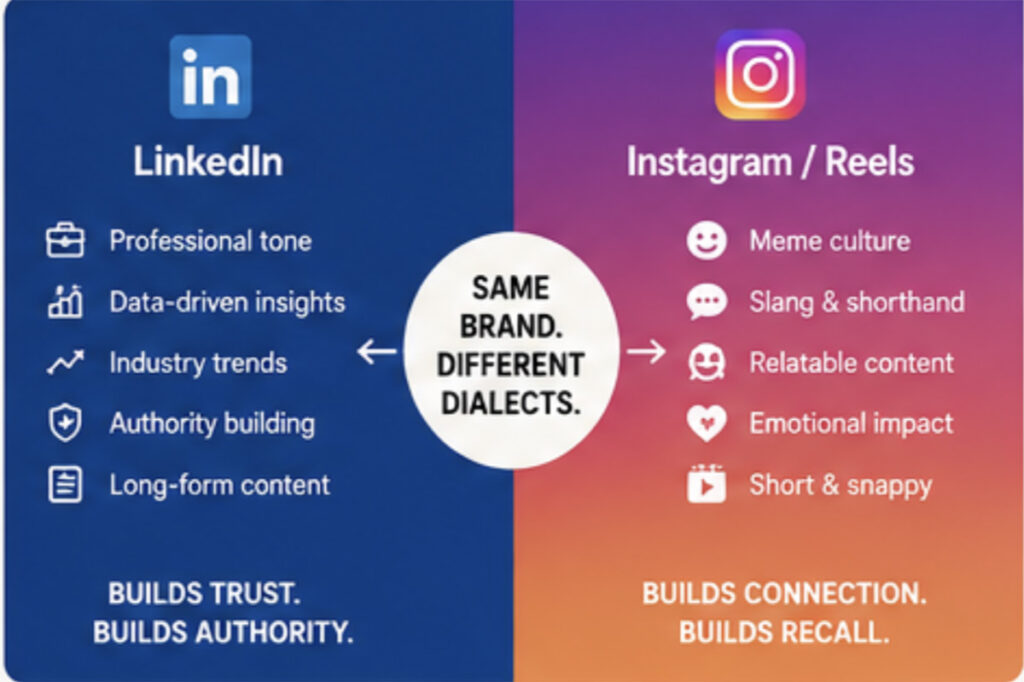
The brands winning the internet right now are not fracturing their corporate identities. They are proving that a single source of truth can be sophisticated enough for a boardroom and lethal enough for a scroll. That is not a contradiction. That is the whole point.






