
Brand Wizards Roundtable
Beyond reach: Marketers decode what it takes to build Gen Z communities
From earning loyalty and embracing micro-communities to staying authentic and relevant, marketers at Indian Television.com’s Brand Wizards Roundtable discuss the evolving playbook for engaging Gen Z.


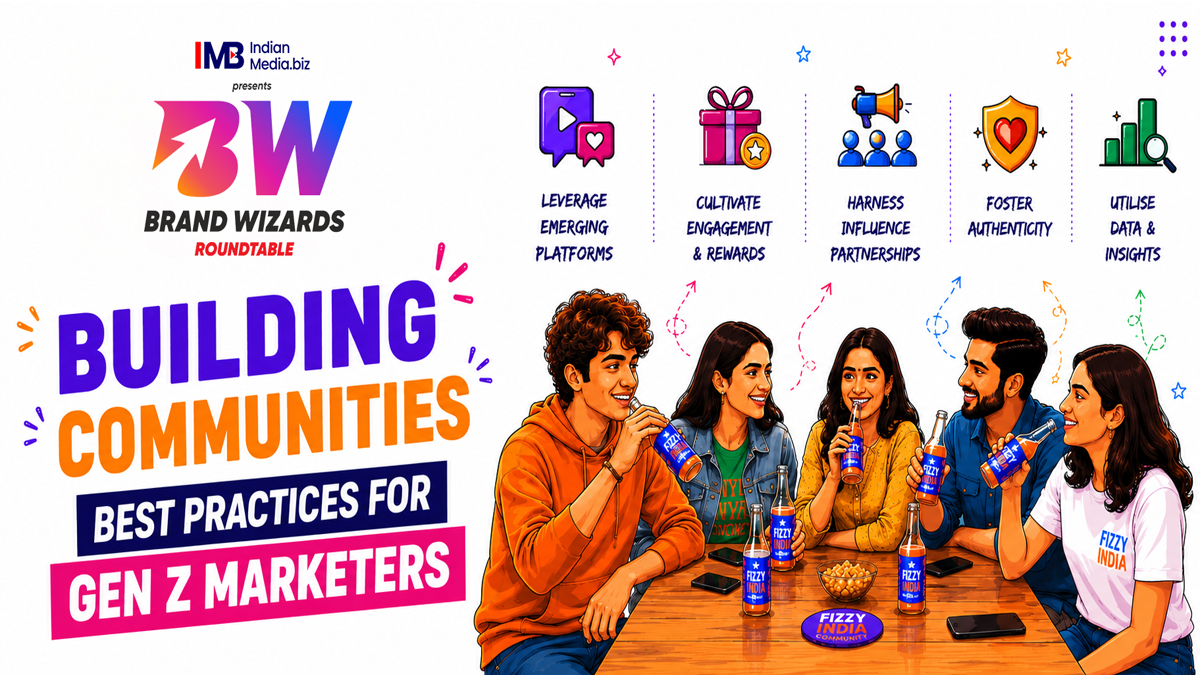
MUMBAI: Gen Z is no longer simply an audience for brands to reach. It is an audience that marketers increasingly need to understand, participate in and build alongside.
That was one of the central takeaways from Indian Television.com’s Brand Wizards Roundtable, themed ‘Building Communities: Best Practices for Gen Z Marketers’, moderated by Anil Wanvari, Founder and Editor-in-Chief, IndianTelevision.com.
The discussion brought together marketers and business leaders from fitness, fintech, fashion, real estate, furniture, food and hospitality, and architectural surfaces to examine what it takes to build meaningful communities among India’s Gen Z consumers.
The panel featured Ajay Singh, Business Head, HRX; Ayush Kumar, VP Marketing, Appreciate; CJ Mathews, VP – Marketing, Ashar Group; Kapil Bhatia, Founder & CEO, UNIREC; Kulbhushan Atkar, Chief Revenue Officer, Pepperfry; Namita Mitla, Head of Marketing, Hunger Inc Hospitality; Parth Parmar, Director, Paré Innovations; and Shiv Bhasin, Sr. General Manager – Marketing (West & South India), Wow! Momo.
The conversation began with a fundamental question: is Gen Z loyal to brands, or is it loyal to experiences?
The consensus was that the two are closely connected, but brand loyalty can no longer be taken for granted. Namita Mitla pointed out that Gen Z requires brands to continuously re-earn its loyalty, while Ajay Singh noted that the sheer number of choices available to consumers makes experimentation and switching easier.
For brands, therefore, delivering one good experience is no longer enough.
From audiences to communities
For Mitla, the idea of community extends beyond simply getting consumers to interact with a brand. Speaking about Bombay Sweetshop, she said the brand is trying to recreate the role that traditional sweet shops and neighbourhood spaces once played — places where communities naturally came together.
The ambition, she explained, is to create a community that can exist even when the brand itself is not present.
Singh approached the idea from the fitness category, where community has always been fundamental. He pointed to the emergence of running groups, fitness IPs and events that have made fitness more accessible to younger consumers.
His argument was that brands should not dictate how communities should behave. Instead, they should find ways to participate in what consumers are already doing.
Singh cited HRX’s collaboration around a high-protein milk launch with Country Delight. Instead of simply asking consumers to promote the product, the brand integrated it into existing running communities through high-protein matcha. The idea was to make the brand relevant to an activity the community was already participating in.
The rise of the micro-community
The discussion also highlighted how India’s diversity is forcing marketers to rethink the idea of a single, homogenous Gen Z audience.
Kulbhushan Atkar said discoverability has fundamentally changed. A Gen Z consumer in one city can now experience trends and brands from Mumbai, London or New York through social media. At the same time, the proliferation of brands has lowered the cost of switching.
This has pushed brands towards increasingly granular targeting.
Atkar argued that marketers need to move from thinking about broad markets to understanding micro-markets — not simply Mumbai, for instance, but Andheri, Thane or Kalyan.
Parth Parmar similarly spoke about adapting communication to regional markets. For Paré Innovations, local-language content and participation in events relevant to architects, engineers and designers help the brand integrate into existing communities rather than interrupt them.
Shiv Bhasin brought the perspective of a national QSR brand. For Wow! Momo, he said, the product itself cannot be constantly changed from market to market. Instead, the brand adapts through local language and local influencers.
He also highlighted the importance of creating awareness when entering smaller markets, using the scale of the brand to generate intrigue and then using accessible price points to encourage sampling.
Authenticity remains non-negotiable
The panel also examined how Gen Z consumes branded content and the growing role of AI.
Ayush Kumar argued that while the fundamentals of marketing — pricing, branding, trust, availability and distribution — remain unchanged, the way consumers discover information has shifted dramatically.
Instead of relying only on established media platforms, Gen Z consumers increasingly use influencers, social platforms and multiple sources to research products and make decisions. For brands such as Appreciate, this makes collaboration with both credible information platforms and entertaining regional creators an important part of the marketing mix.
When the conversation moved to AI-generated content, the panel largely agreed that AI can improve speed and efficiency, but it cannot simply replace the human element.
Kapil Bhatia argued that while AI can be useful for lower-stakes content and routine tasks, major campaigns still require human intervention. He also emphasised that social media has a longstanding demand for humanised content.
Namita Mitla similarly said Gen Z continues to value authenticity and that the presence of a human behind the content remains important. AI, she suggested, can help brands execute faster, but it cannot replace the creativity and human intervention required for certain kinds of content.
Building relevance, not just reach
The discussion eventually came back to the fundamental question of what makes Gen Z engage with a brand.
For Pepperfry, Atkar pointed to two different sides of the same Gen Z consumer: the pragmatist and the aspirational consumer. Someone may be highly price-conscious while buying a functional product, but may simultaneously be willing to spend on something that expresses their personality or creates a particular vibe in their home.
For Hunger Inc Hospitality, Mitla’s approach is to meet consumers where they already are and understand the communities surrounding its physical spaces. She cited examples of film screenings, screenwriting workshops, tattoo-related activities and improv nights being used to connect with different local communities around the group’s outlets.
The roundtable made one point particularly clear: building a Gen Z community is not about simply creating more content or chasing every trend.
It is about understanding the consumer’s existing behaviour, finding the right cultural and community entry points, remaining relevant without being intrusive, and continuously earning the right to participate in their world.
For marketers, the challenge is therefore shifting from asking ‘How do we reach Gen Z?’ to a more difficult question: ‘Why would Gen Z want us to be part of its community?’






