
Television
Online video, CTV and AI to drive India’s $15.4 billion screen economy: Vivek Couto
Online video leads growth as streaming, connected TV, retail media and AI reshape the market


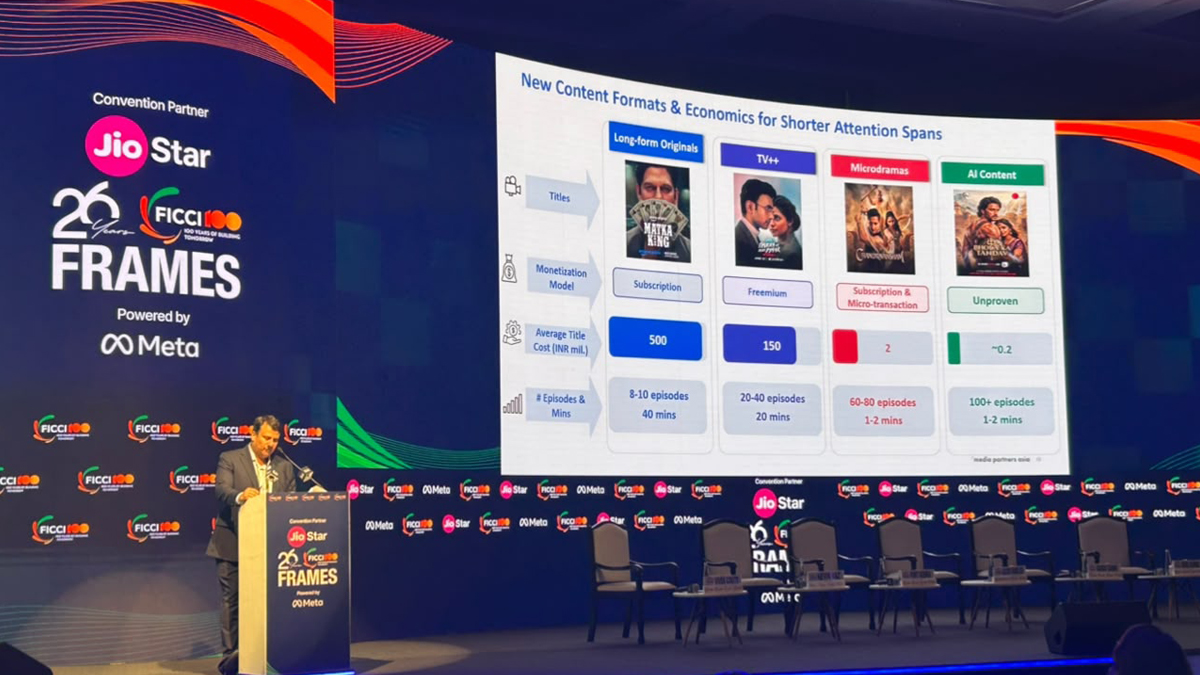
MUMBAI: India’s screen economy is entering a new innings, with online video, connected TV, retail media and artificial intelligence set to drive the next phase of growth, according to Vivek Couto.
Speaking at FICCI Frames 2026 in Mumbai on Tuesday, Media Partners Asia co-founder, CEO and executive director Vivek Couto said India’s screen economy is currently worth around $12.5 billion and is expected to reach about $15.4 billion over the next five years.
Couto said the market has grown from around $9.5 billion in 2021, but the more significant change has been in the composition of that economy. Television has declined from about $7 billion to $4.8 billion, while online video has nearly tripled from $2 billion to $6 billion.
Most of the projected growth over the next five years is expected to come from online video, underlining the continuing shift in how Indians consume and pay for screen content.
Couto pointed to India’s relatively low screen spending compared with other major markets as evidence of the industry’s potential.
At more than $12 billion, India’s screen economy is already comparable in size with South Korea, despite India’s much larger population. However, screen spending accounts for only around 0.3 per cent of India’s GDP, compared with roughly 0.8 to 1 per cent in the US, Japan and South Korea.
On a per-capita basis, India spends around $8 on screen content and services, compared with nearly $900 in the US.
Rather than viewing the gap as a weakness, Couto described it as a runway for future expansion. He expects India’s screen economy to grow at around 5 per cent annually over the next five years, compared with about 2 per cent for China, Japan and South Korea.
A key turning point came around four years ago when broadband reached more individuals in India than television. Since then, the gap has continued to widen, changing the economics of the media business.
The shift to streaming is also increasingly translating into money.
Couto said online video advertising overtook linear television advertising in 2024 and has tripled since 2021. Subscription revenues have followed a similar trajectory, albeit with some delay.
Within the $6 billion online video market, subscription video on demand, or SVOD, accounts for about $1.5 billion, while advertising-supported video on demand, or AVOD, contributes roughly $4 billion.
Premium long-form video distributed through advertising-supported platforms has emerged as a particularly important category. Couto estimated this segment at around $3 billion, putting it on par with user-generated content for the first time.
The growth is being supported by a combination of reach, increased content supply and a larger pool of premium advertising inventory.
By 2029, Couto expects online video to become a roughly $10 billion market, with premium video accounting for about half of it.
The changing economics of consumption are also influencing content investment.
Couto said overall content investment has remained broadly flat at around $5 billion over the past few years. However, online video content investment has almost tripled since 2021 to about $2.6 billion and overtook television last year.
The balance between entertainment and sports has also shifted significantly. Entertainment now accounts for around 57 per cent of content investment, down from about 75 per cent a few years ago, with sports taking a larger share amid major rights cycles and renewals.
Television investment has remained broadly flat, while much of the incremental growth in entertainment spending is coming from streaming platforms and emerging formats such as micro-dramas.
Couto identified two major questions for the next phase of the market: how upcoming sports rights cycles will reshape investment and how quickly artificial intelligence will be adopted across production workflows.
India’s highly diverse audience base will remain central to how the screen economy develops.
Couto said the NCCS A segment, comprising more than 80 million households, represents the core premium video opportunity. These households typically have connected devices and broadband access and are more likely to pay for SVOD services or subscribe directly through telecom operators.
NCCS B and C households represent much larger, value-conscious segments with significant television reach. At the lower end of the pyramid, NCCS C and below remain important for user-generated content and Free Dish.
The economics of premium streaming content have so far made it difficult for many platforms to penetrate deeply into hyper-local markets. However, Couto suggested that AI could potentially change those economics by lowering production and localisation costs.
The decline of traditional pay television is another defining trend.
Couto said India’s legacy pay-TV subscriber base has fallen from around 125 million before the pandemic to approximately 80 million today.
The pressure is coming from both ends of the market. Free Dish continues to provide a low-cost alternative at the mass end, while online video and connected TV are attracting viewers further up the pyramid.
At the same time, broadband and connected TV adoption is expanding. Hybrid TV homes have already reached around 30 million to 32 million, further widening the gap with traditional linear pay-TV households.
India now has approximately 65 million active connected TV households, creating a rapidly expanding advertising opportunity. Connected TV advertising is estimated at around $850 million today and, according to Couto, could match traditional television advertising by next year.
Couto also highlighted the growing importance of non-fiction formats, pointing to shows such as Bigg Boss and The Traitors as examples of content that can create a broader, multi-screen viewing experience.
Non-fiction has the potential to aggregate audiences across platforms through gamification, shoulder content and 24/7 streaming, extending engagement well beyond the main programme.
The next evolution could also come from hybrid business models and new content formats. While long-form originals remain at the top of the content pyramid, Couto expects categories such as TV++ to become increasingly significant as streaming platforms seek to reach wider audiences.
Another major opportunity lies outside traditional video advertising.
Couto said non-video digital search and display have accounted for more than 70 per cent of new advertising dollars over the past five years, with retail media emerging as a major driver.
In India, retail media has grown from around $300 million in 2020 to approximately $2.1 billion today.
The attraction for advertisers is its ability to connect media with the consumer journey, from discovery through to purchase. As a result, retail media is increasingly bringing advertising and commerce closer together.
Online video could become an important part of that convergence, particularly as streaming platforms explore ways to connect content, commerce and advertising.
Couto described artificial intelligence as the next major wave of change, extending well beyond content production.
The technology is already creating efficiencies in areas such as localisation and production, while its potential is also spreading into marketing, technology, product development, discovery and audience retention.
AI could also expand the creative possibilities available to media companies through immersive formats and new tools for intellectual property development.
While many of these applications remain at an early stage, Couto said their eventual impact could extend across the entire media and entertainment value chain.
Couto concluded that India’s enormous audience base remains both its defining strength and its central commercial challenge.
India has the world’s largest audience but one of the smallest wallets, making the next stage of the screen economy less about simply reaching more people and more about monetising that reach efficiently.
Streaming has moved ahead of television in several key areas, although television remains an important part of the ecosystem. The next opportunity, he said, lies in capturing more value across the consumer journey.
At the same time, flat overall content investment is being accompanied by a changing mix of formats, with micro-dramas and AI potentially broadening the content economy.
The convergence of screen and commerce could turn online video from a medium primarily built around reach into one that delivers greater relevance and measurable value to advertisers. Alongside that, AI could reshape the economics of production, localisation, discovery, marketing and user experience.
For India’s screen economy, then, the next chapter is not simply about finding more viewers. It is about turning that enormous audience into sustainable value.






