
VBS 2026
90 per cent of gen z discover sports on social media: Executives outline next-gen fan experience at VBS ’26
Panel explores how tech will transform sports consumption and fan engagement in the near future


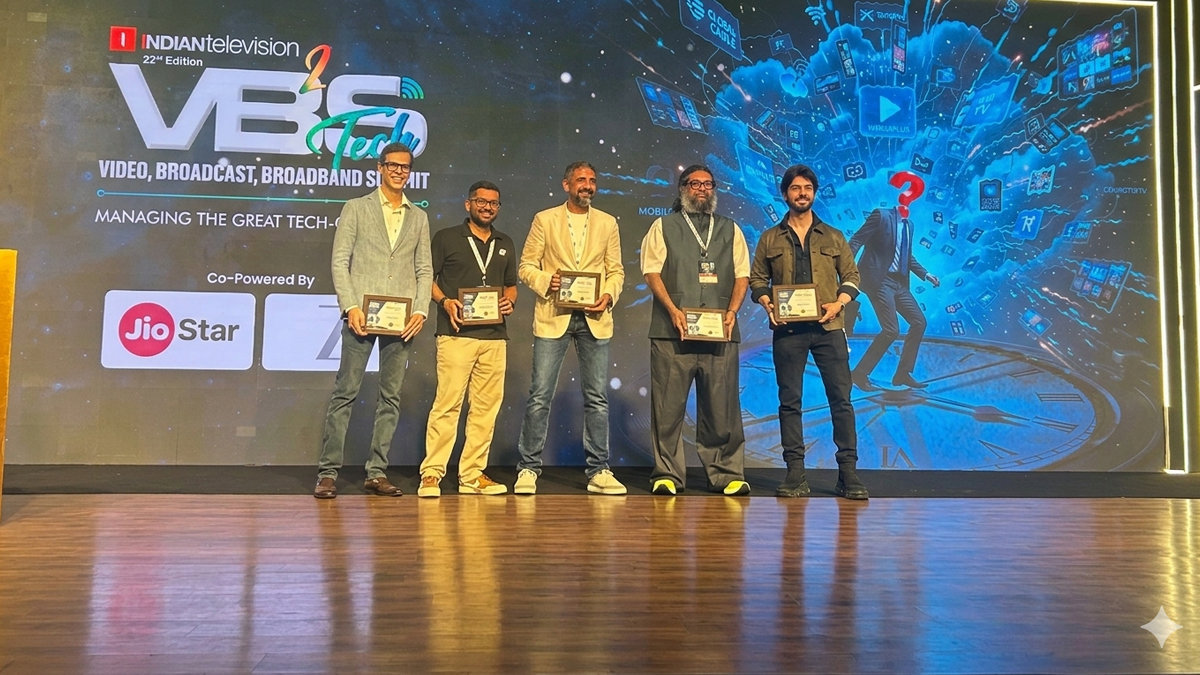
MUMBAI: Industry leaders argued at VBS 2026 that the future of sports fandom will be defined less by television broadcasts and more by personalised, interactive and AI-driven experiences.
Speaking at a panel titled The Next-Gen Sports Fan Experience, executives from across the sports, technology and streaming ecosystem said advances in artificial intelligence, cloud computing and high-speed connectivity are fundamentally reshaping how fans discover, consume and engage with live sport.
The session was moderated by WPP & WPP Media India creative technology lead Niraj Ruparel.
Sony Sports Networks India head – content acquisition, licensing, programming strategy and insights, sports Shishir Gupta said the traditional single-screen broadcast model is rapidly giving way to fragmented, multi-device viewing.
Even though many Indian homes still rely on a single television set, audiences increasingly use second screens to follow matches, highlights and commentary simultaneously.
“Sports still brings people together because it is live,” Gupta said. “But viewers now want bite-sized content, highlights and updates when they want them and increasingly in personalised formats.”
He added that the next phase of sports viewing will combine immersive technologies such as augmented and virtual reality with enhanced stadium experiences, allowing fans to access real-time statistics, data overlays and digital services throughout the venue.
Sportz Interactive chief executive Siddharth Raman argued that fan engagement is shifting from passive viewing to interactive participation. Real-time performance ranking systems such as the Upstox Cricket Index and Boost Stamina Meter illustrated how real-time data can transform sports storytelling, he said.
The Upstox initiative, launched during the Indian Premier League, treated cricketers as “stocks”, with values fluctuating based on match performance to help audiences understand stock-market concepts.
Meanwhile, the Boost Stamina Meter analysed movement data, including distance covered by fielders, running speeds and player activity, to generate a stamina score for each player.
Raman said this data-driven storytelling represents the early stages of a broader shift where fans increasingly curate the content they watch.
“In the future, fans may simply prompt a platform to show every boundary hit by Virat Kohli in a particular match,” he said. “The power to orchestrate the content will lie with the viewer.”
Moderator Niraj Ruparel also pointed to experiments combining gaming, sponsorship and AI to deepen fan engagement.
Drawing on campaigns delivered by WPP teams, he highlighted how brands are increasingly creating immersive fan experiences rather than relying on traditional advertising formats. One example he cited was Coca Cola VR Cricket, where fans across India could wear VR headsets and step into a virtual cricket experience, allowing them to play and engage with the sport in an entirely new way at scale. He also pointed to how brands seamlessly integrate into live sporting ecosystems through technology, such as when the Google Pixel Phone integrated into buggy cams to capture and broadcast match moments from new perspectives.
He noted that as connectivity improves and 5G expands, sports environments are becoming increasingly immersive, enabling deeper engagement between fans, brands and live sporting moments. Ruparel also discussed an early prototype he is building using Google Gemini that explores how telephony AI could democratise access to sports commentary. The concept allows fans to dial a number, choose their preferred language and receive live match commentary directly through voice. Such a system could potentially enable fans across device types and connectivity levels—from feature phone users on low-bandwidth networks to smartphone users on 5G—to access sports experiences in their own language and format, while also allowing brands to seamlessly integrate contextual communication within the commentary.
He said the broader opportunity lies in designing technology experiences that reach India’s diverse and massive sports fan base across different devices, connectivity levels and regions. This ensures that sport continues to unite the country while becoming more accessible, immersive and participatory for everyone.
OTTplay chief executive and co-founder Avinash Mudaliar, highlighted the challenge of serving India’s vastly different digital audiences.
The platform aggregates more than 30 streaming services, including sports offerings from platforms such as Disney plus Hotstar and SonyLIV, alongside hundreds of live television channels.
Mudaliar noted that the company’s user base ranges from urban consumers with 5G connections and VR headsets to viewers in smaller towns using low-bandwidth networks and inexpensive smartphones.
To address network variability, OTTplay deploys adaptive bit-rate streaming that automatically converts video feeds into audio when connectivity drops, allowing fans to continue following live events even with limited bandwidth.
The platform also emphasises regional content, which accounts for roughly 60 per cent of its consumption.
“Our focus is the user in smaller towns with a modest device and limited connectivity,” Mudaliar said. “That viewer is equally part of the sports economy.”
Amagi senior vice president for Asia-Pacific Jay Ganesan, argued that sports production itself must evolve.
Historically, sports content has been produced primarily for broadcast television, with digital adaptations layered on afterwards.
The future, he suggested, will reverse that logic.
“We must start producing sports content for multiple experiences from the beginning,” Ganesan said. “Different fans want different views —languages, players, data layers — and each of these experiences carries its own monetisation model.”
Cloud-based production and artificial intelligence will make such personalisation economically viable by enabling automated content generation, localisation and highlight creation at scale.
Across the panel, speakers identified several technologies that could redefine sports engagement in the coming decade. Gupta pointed to virtual reality viewing and digitally enhanced stadiums. Raman highlighted large language models acting as AI copilots for sports fans, helping them navigate content and insights in real time. Ganesan emphasised cloud infrastructure combined with AI to create scalable, personalised viewing experiences.
Mudaliar argued that sports platforms must also address community behaviour, particularly among younger audiences. Nearly 90 per cent of Gen Z viewers discover sports through social media platforms before deciding whether to watch full matches, he said.
“The next challenge is converting those social communities into long-form viewers,” Mudaliar added.
The panel discussion also highlighted the unusual dynamics of India’s digital ecosystem.
While more than 200 million users now access high-speed 5G networks capable of streaming high-definition video and immersive experiences, roughly 350 million people still rely on basic 2G connectivity.
This disparity forces sports broadcasters and technology companies to design services that work simultaneously across vastly different infrastructure environments. Yet the panel agreed that the convergence of AI, high-speed networks and cloud distribution is rapidly expanding the possibilities for sports engagement.






