iWorld
Netflix schools rivals as streamers ace June TV viewership charts
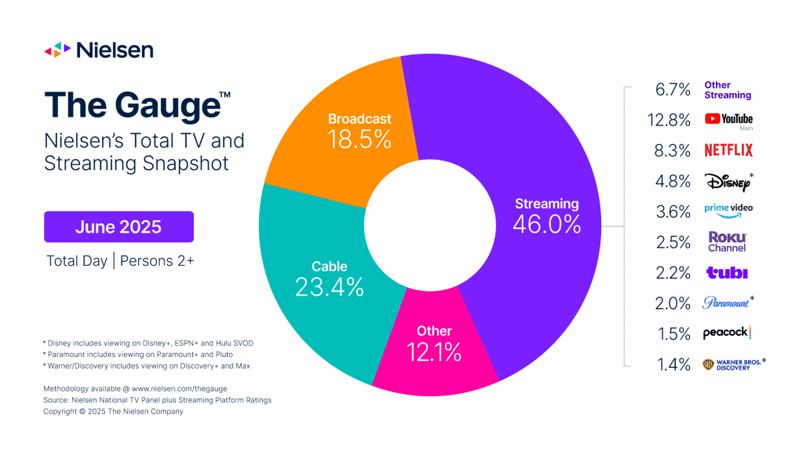
MUMBAI: Class is in session and Netflix is teaching everyone a lesson in domination. In Nielsen’s 50th The Gauge report for June 2025, streaming flexed its muscle once again, accounting for a record 46.0 per cent of total TV usage in the US. Leading the binge brigade was Netflix, which saw a 13.5 per cent surge in viewership over May, grabbing an 8.3 per cent share of total television minutes. That’s 0.8 points up month-on-month and enough to account for 42 per cent of streaming’s total gain in June.
The platform’s winning streak was powered by its usual bag of tricks: original series Ginny & Georgia was crowned the most-streamed title of the month with a jaw-dropping 8.7 billion viewing minutes, while acquired shows Animal Kingdom and Blindspot together clocked 11.4 billion minutes. And just to put a cherry on top, Squid Game Season 3 dropped in the final three days of the month and still managed nearly a billion viewing minutes per day.
Peacock wasn’t far behind on the podium, notching a 13.4 per cent usage rise fuelled largely by the new season of Love Island USA, which bagged 4.4 billion viewing minutes and ranked fourth overall. The streamer finished June with a 1.5 per cent TV share, up from 1.2 per cent in May.
Much of the streaming spike can be chalked up to school being out. Kids and teens (aged 6–17) increased their TV usage by 27 per cent in June, with streaming accounting for 66 per cent of their total watch time. Netflix and Peacock saw viewership from this age group climb 32 per cent and 37 per cent, respectively.
This cohort also powered up consoles and cable boxes, leading to a 41 per cent jump in the “Other” category home to video games and set-top box viewing far above the overall 14 per cent gain in that segment.
Meanwhile, traditional TV continued its summer slump. Broadcast viewership dipped 5 per cent to an all-time low share of 18.5 per cent, slipping below the 20 per cent mark for the first time. Cable remained mostly flat but still ceded 0.7 share points to end at 23.4 per cent. Combined, cable and broadcast dropped from 44.2 per cent in May to 41.9 per cent in June.
That said, the NBA Finals threw broadcasters a lifeline, ABC aired all seven of the month’s most-watched telecasts, including the NBA Trophy Presentation. On cable, Conference Finals on ESPN and TNT scored big, while news and special programming like Fox News’ Army 250 Parade and CNN’s Goodnight and Good Luck helped shore up ratings.
With summer holidays in full swing and streamers rolling out irresistible content, one thing is clear: viewers are switching channels literally and figuratively. And if June is any indication, traditional TV might need more than just a timeout to catch up.

iWorld
Talk to your telly: JioHotstar’s new AI voice feature reads your mood to suggest shows
The streaming giant ditches the scroll for a “conversational” AI that understands moods, cricket and Hinglish
MUMBAI: The era of the endless scroll may finally be over. JioHotstar has officially flicked the switch on its “Conversational Voice Discovery” (CVD) feature, a high-tech overhaul designed to turn the hunt for a Friday night film into a natural chat. Developed in a landmark partnership with OpenAI, the tool moves beyond clunky keyword searches, allowing users to find content by describing their mood, context or even the most bizarre viewing scenarios.

The feature is vision of Uday Shankar, vice chairman of JioStar, whose goal is to eliminate “content overload” by replacing the tedious, traditional scroll with natural dialogue. By leveraging ChatGPT’s ability to grasp context and cultural nuance, the new mobile interface allows users to bypass menus entirely, turning search into a seamless conversation.
The launch, which rolled out across India this month, sees a ChatGPT-powered interface integrated directly into the heart of the app. Instead of typing “action movie” into a sterile search bar, viewers can now speak to their devices as if they were asking a well-read friend for a tip. For now, the feature is exclusive to the mobile app, with a rollout for Connected TV (CTV) expected in later phases.
Beyond the keyword
The CVD feature is built on what JioStar calls “Multilingual Cognitive Search.” It is designed to interpret nuance rather than just matching text. If you tell the app, “I’ve had a long day, give me something mindless and funny,” it won’t just look for those words in a title; it will sift through 300,000 hours of library content to find a light-hearted sitcom or a stand-up special that fits the vibe.
The tech is natively multilingual, catering to India’s diverse linguistic landscape. Users can switch effortlessly between languages—asking for “Koi light-hearted comedy dikhao” (show me some light-hearted comedy) or requesting a “Thriller hai but zyada dark nahi chahiye” (a thriller that isn’t too dark).
Real-time curiosity and live sports
Perhaps the most ambitious aspect of the rollout is its integration with live sports. During a high-stakes cricket match, the AI acts as a digital companion. Fans can ask, “Who is the top scorer right now?” or “Show me that last wicket again,” and the system will pull the relevant data or clips instantly. It even attempts to explain the “why” behind the crowd’s energy, responding to prompts like, “Why is everyone reacting like that?” by contextualizing on-field events.
A shift in streaming strategy
The move is part of a broader reimagining of the entertainment experience following the massive merger between JioCinema and Disney+ Hotstar. Uday Shankar noted that the goal is to make premium entertainment “truly accessible” by embedding AI at the core of the user journey. By anticipating culture and context, the platform hopes to kill off “decision fatigue.”
For OpenAI, the partnership represents a major play in the Indian market. Fidji Simo, the head of applications at OpenAI, said the goal was to turn a “one-way” passive consumption experience into a “deeply personal conversation.”
As the feature goes live for millions of subscribers, the message from Bombay House is clear: the remote control is becoming obsolete. Whether you’re looking for a show that “feels like a rainy Sunday afternoon” or a crime series with a “strong female lead but not too violent,” all you have to do is ask.