TCHxVAM2026
Haq makers decode the art of turning silence into cinematic power at TCH x VAM 2026
At TCH x VAM 2026, Haq creators unpacked politics, performance and pain


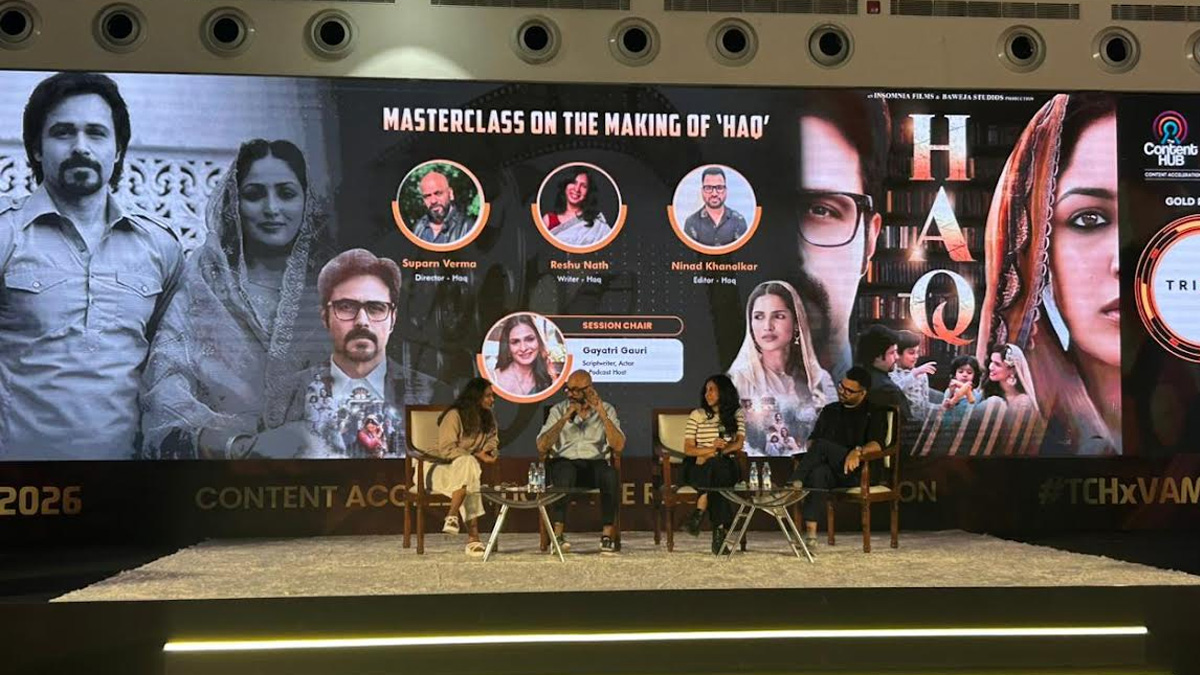
MUMBAI: At a time when streaming films are battling for eyeballs by the minute, Haq proved that silence, subtlety and emotional precision can still cut through the noise. At The Content Hub x VFX & More Summit 2026, the masterclass on the making of Haq turned into a deep dive into storytelling choices, layered performances and the delicate art of handling politically charged material without turning it into a shouting match.
The session brought together Suparn Verma director of Haq; Reshu Nath writer of Haq; and Ninad Khanolkar editor of Haq, for an in-depth conversation on the craft of storytelling and the making of the project. The discussion was chaired by Gayatri Gauri, scriptwriter, actor and podcast host.
Rather than framing Haq as a courtroom drama or a political commentary, the creators explained how the film was consciously shaped as an intimate relationship story. Inspired by the landmark Shah Bano case, the film fictionalised key details to focus less on public spectacle and more on the emotional fractures inside a marriage. The aim was not to recreate history scene by scene, but to build an emotionally truthful world around a woman reclaiming agency within an unequal relationship.
That emotional lens became the film’s guiding principle. The creators revealed how they deliberately avoided large-scale political staging or chaotic public imagery, instead keeping the camera closely tied to the protagonist’s perspective. The outside world existed only as an echo around her life, never overpowering it. The result was a film where the power dynamics inside a marriage carried as much political weight as anything happening inside a courtroom.
The discussion repeatedly circled back to one core philosophy: nuance over noise. The team spoke about resisting simplistic hero-versus-villain storytelling. The husband in Haq was intentionally written not as a caricatured antagonist, but as a deeply human and emotionally contradictory man whose entitlement arrived wrapped in charm, vulnerability and self-belief. Every character, they explained, was written with empathy, ensuring nobody existed merely as a spokesperson for ideology.
That balance extended into the legal and religious dimensions of the film as well. Extensive research went into personal law, cultural history and interpretations of faith, but the creators stressed that the storytelling never aimed to become preachy. Instead, the emotional truths within the marriage naturally carried the larger conversations forward.
The masterclass also unpacked the structural mechanics behind the film. Romance, the team explained, became something of a Trojan horse. Audiences were drawn in through an intimate love story before gradually confronting larger questions about gender, control and autonomy. Even recurring visual motifs, including flowers and moments of silence, were carefully designed to mirror the emotional evolution of the couple.
Casting played an equally crucial role in grounding the film’s realism. Yami Gautam was brought into the process early and encouraged to build the character through restraint, gradually allowing her voice and confidence to emerge across the narrative. Meanwhile, Emraan Hashmi leaned into a more controlled and understated performance style, particularly during courtroom scenes, avoiding the theatrical grandstanding often associated with legal dramas on screen.
The conversation became especially fascinating when it shifted to editing. The creators revealed that the first cut of the film ran close to four hours before being sculpted into a tighter emotional experience. Much of that process involved stripping away excess dialogue and trusting pauses, glances and silence to carry the emotional weight.
Maintaining the protagonist’s resilience became central during post-production. The team wanted to avoid turning the film into a victim narrative, instead preserving emotional strength even during its most devastating moments. Tight transitions across decades, careful pacing and restrained emotional release were all used to keep the story immersive without feeling heavy-handed.
One standout portion of the session focused on the now widely discussed divorce sequence. The creators broke down how camera placement, lensing, sound design and performance rhythm were carefully orchestrated to emotionally blindside viewers. What begins like a scene of reconciliation slowly transforms into emotional collapse, with visual choices mirroring the protagonist’s shifting mental state in real time.
Throughout the session, the creators underlined how Haq was built less as a political statement and more as a human story about power, faith, gender and emotional survival. That approach, they noted, is perhaps why the film has resonated so strongly with audiences across generations and geographies.
In an era obsessed with spectacle and noise, the making of Haq offered a timely reminder that sometimes the sharpest storytelling does not scream for attention. It simply holds up a mirror and lets the silence do the talking.