iWorld
Media’s next growth wave to hinge on IP, intent, commerce and global reach
FICCI Frames 2026 panel explores how media companies are adapting to infinite content


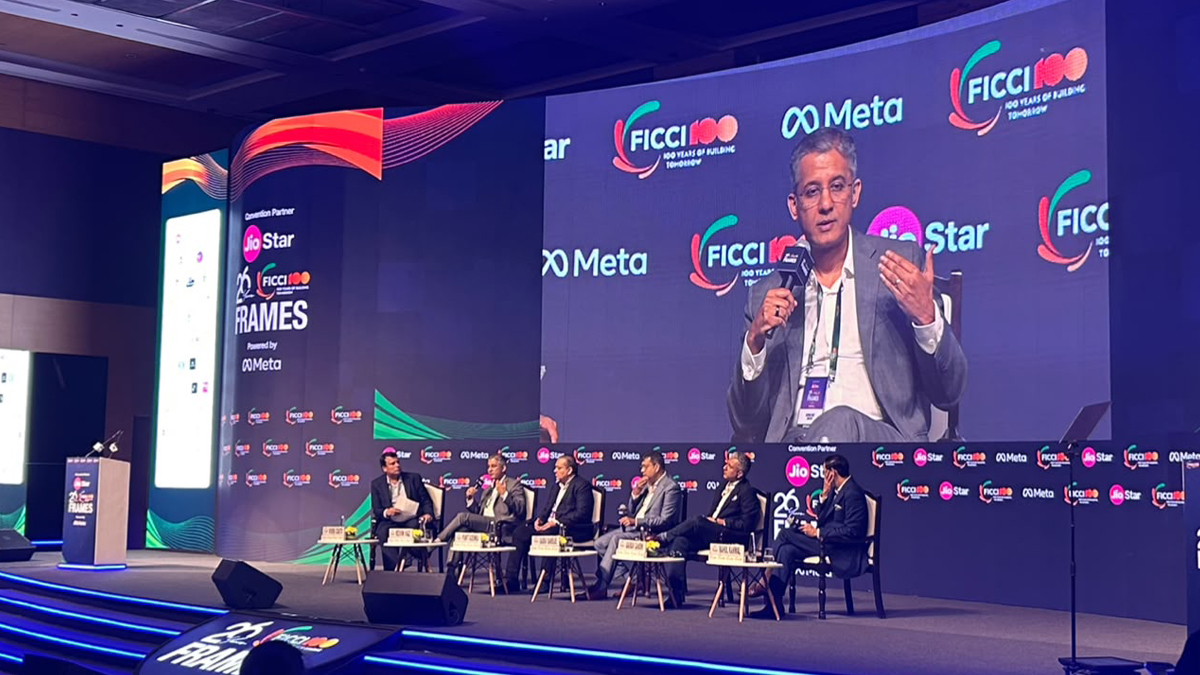
MUMBAI: In the attention economy, getting eyeballs is only half the story. The harder part is keeping them, understanding what audiences want and turning that engagement into sustainable value.
That was the broad theme at a CEO panel on reinventing media for the age of infinite content at FICCI Frames 2026, where leaders from across entertainment and news examined how the industry’s growth model is changing.
Moderated by Vivek Couto, the session brought together Kevin Vaz, Punit Goenka, Gaurav Gandhi, Gaurav Banerjee and Rahul Kanwal.
The discussion highlighted a fundamental shift in where media companies are putting their money. Five years ago, investment was heavily centred on reach, sports rights, large films, distribution and technology aimed at expanding audiences. The focus is now broadening towards technology, data, artificial intelligence, original intellectual property, communities and deeper audience engagement.
At the centre of that change is the transition from a traditional TV-versus-digital view of the industry towards an attention economy. With audiences spread across smartphones, connected TVs, social platforms and other screens, simply accumulating reach is no longer enough. Media businesses increasingly need to combine content, technology and data to identify the right audience and deliver experiences that hold attention.
The panel also explored what could come after the traditional advertising and subscription-led revenue models.
Advertising remains vulnerable to economic cycles and an increasingly crowded landscape of ways for brands to reach consumers. Subscription businesses, meanwhile, have expanded through models including AVOD, TVOD and SVOD, but are also operating in an environment where consumers have more choices than ever.
This is pushing the industry towards monetising intent rather than attention alone.
Streaming platforms are increasingly being viewed not simply as places to watch content, but as environments where audiences can interact, share, participate and transact. Commerce, therefore, could become a more important part of the media business, with viewers potentially able to order food, groceries or other products without leaving the screen.
Gamification is another emerging opportunity, particularly through interactive shows, game formats and experiences that allow audiences to participate rather than passively watch. The combination of content, social interaction, rewards and transactions could create additional revenue streams around existing audiences.
Another major thread was the growing importance of intellectual property.
The industry’s earlier emphasis on acquiring major sports rights and blockbuster movies is increasingly being complemented by efforts to build original IP that can generate value over a longer period. The ambition is to create franchises that can extend across shows, films, games, merchandise, live experiences and other formats rather than treating individual programmes as one-off products.
This also changes the way a hit is measured.
Traditional metrics such as reach, ratings and subscriptions remain relevant, but they are being supplemented by measures of attention, cultural impact, conversation, repeat engagement and the ability of an idea to travel across formats and markets.
The ability of a property to become part of popular culture can give it a longer life and create opportunities beyond its original screen format.
The panel also put the spotlight on India’s opportunity to take its stories beyond the domestic market.
The global success of Spanish, Turkish and Korean content has demonstrated that audiences are increasingly willing to engage with stories rooted in different cultures and languages. Indian content, similarly, has an opportunity to travel beyond the diaspora and reach audiences with no direct connection to India.
Regional content is particularly significant in this context. Stories created in Indian languages can potentially find audiences through dubbing, subtitling and cross-language discovery, turning international distribution from an incremental opportunity into a core part of the content strategy.
The discussion also pointed to the growth potential within India itself. With a large population but relatively low media monetisation per consumer compared with several developed markets, the industry’s opportunity is not restricted to finding entirely new audiences. Deeper engagement and better monetisation of existing audiences could also expand the value of the market.
As the volume of content continues to rise, the challenge is increasingly about differentiation.
Simply producing more content does not guarantee visibility. Media organisations need stronger editorial and creative propositions, distinctive IP and communities that return regularly. In news, for instance, the opportunity lies in building ecosystems around topics and audiences rather than relying solely on individual stories or search trends.
That means content quality, context and relevance become increasingly important as audiences navigate an overwhelming number of choices.
The panel also underlined the importance of authenticity. As artificially generated and increasingly abundant content enters the ecosystem, distinctive human storytelling and ideas that create genuine emotional or cultural connections could become more valuable.
The relationship between content and technology is also being redefined.
Media companies are increasingly using technology not simply to distribute content, but to determine how, when and where stories reach audiences. Artificial intelligence, data and recommendation systems can help tailor experiences to individual users, while the proliferation of screens allows the same underlying story to reach audiences in different ways.
This does not make storytelling less important. Instead, technology is becoming the infrastructure through which storytelling is discovered, personalised and consumed.
The wider message from the discussion was clear: in an age where content can be produced and distributed at unprecedented scale, the competitive advantage will increasingly come from knowing what audiences value, building properties that can travel across platforms and finding more ways to turn engagement into lasting relationships and revenue.