Sports
India is world’s second-largest content consumer of the FIFA World Cup, and the tournament has not even begun
Taboola data showing 9.7 million pageviews in 90 days puts India ahead of Brazil, France and Germany, raising serious questions for broadcasters and advertisers


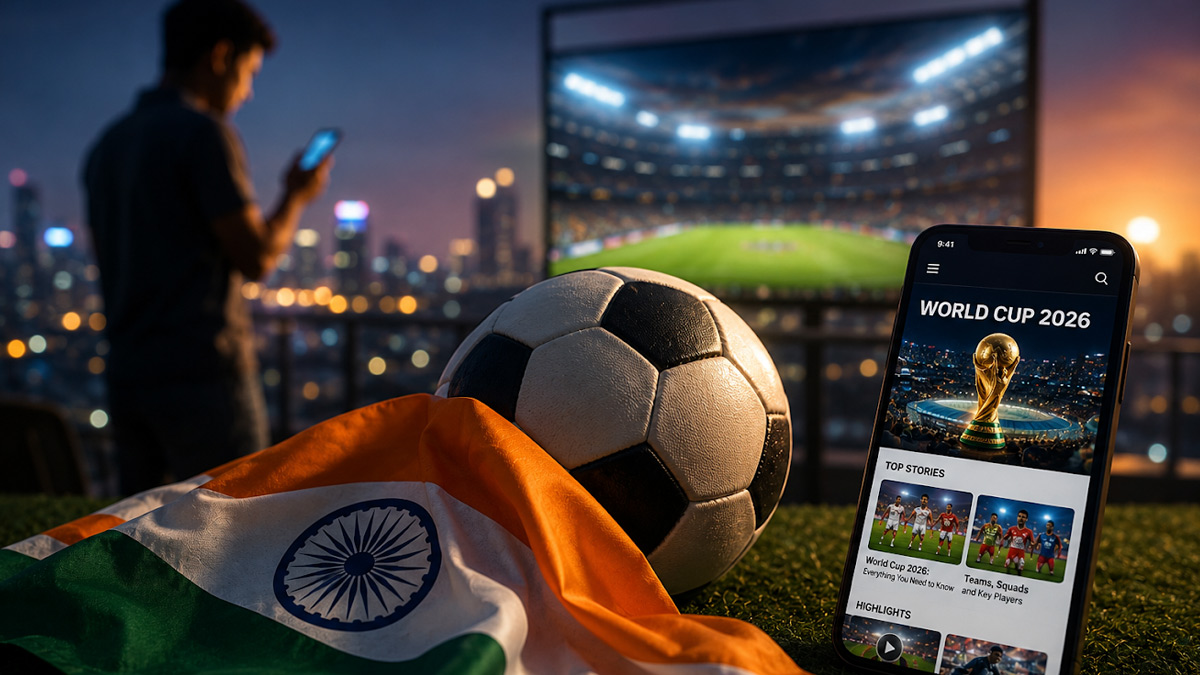
MUMBAI: India will not kick a ball at the FIFA World Cup when it begins on June 11, 2026. The country sits outside the top 100 in the FIFA rankings and has never qualified for the tournament. And yet, in the 90 days leading up to kickoff, Indian audiences have generated 9.7 million pageviews of World Cup-related content on the open web, making India the second-most engaged market on the planet, behind only the United States.
The data comes from Taboola, a global performance advertising platform that tracks audience behaviour across open-web publishers worldwide. The numbers are not just surprising; they are, by any conventional measure of football fandom, extraordinary. India’s 9.7 million pre-tournament pageviews comfortably outpaced Brazil’s 8.5 million, France’s 6.4 million, Spain’s 1.5 million and Germany’s 542,000. A nation with no team in the tournament, no prime-time broadcast window, and no historical claim to football’s upper tier is consuming the World Cup more hungrily than countries for whom the sport is a matter of deep national identity.
The 9.7 million figure is best understood as a pre-kickoff hype wave, not a live-match viewership number. It has been driven, in large part, by the conclusion of the European club season: the Champions League final, the Premier League run-in, La Liga’s climax, bleeding directly into World Cup squad announcements and pre-tournament build-up. Indian fans who follow club football obsessively throughout the year have pivoted seamlessly to tournament content, and the open web has been their primary destination.
The paradox sharpens considerably when set against the traditional broadcast market. The 2026 World Cup is being hosted across the United States, Canada and Mexico, and for Indian audiences, the scheduling is brutal. Matches will kick off between 10pm and 4:30am IST, with the most significant fixtures clustered in the dead of night. This is the structural challenge that the industry has quietly begun calling “the Midnight Problem.”
The contrast with recent tournaments is stark. When Qatar hosted in 2022, the geography worked in India’s favour: 44 matches aired before midnight IST, and Viacom18’s JioCinema delivered 40 billion minutes of digital consumption across the tournament. Russia 2018 saw 63 matches air at civilised hours. North America 2026 offers no such comfort. More than 87 per cent of the 104 matches will air after 10pm IST, and for traditional television networks whose advertising rate cards are built around prime-time consolidated reach, the inventory calculus simply does not work.
But the audience has not disappeared. It has migrated, and it has done so in a direction that the open web is uniquely positioned to serve. Because live matches air in the middle of the Indian night, the peak consumption window has shifted to the following morning. Indian professionals wake up, reach for their phones, and spend the first hours of their working day consuming post-match analysis, tactical breakdowns, player statistics, video highlights and community commentary. Device-level news feeds, lock-screen placements, OEM news surfaces and local digital publishers have become the primary arena for a fandom that cannot structure its sleep schedule around a tournament in North America.
This behavioural pattern is not uniform across India. The 9.7 million pageview surge is anchored, structurally, by the country’s traditional football belts: West Bengal, Kerala, Goa and the northeastern states, where club loyalties run deep and the sport has genuine grassroots traction. But it is increasingly supplemented by a newer, premium audience in Mumbai, Delhi and Bengaluru: urban Gen Z and millennial consumers who have built fierce loyalties to the English Premier League, La Liga and individual global icons. Cristiano Ronaldo, Lionel Messi, Kylian Mbappé and Neymar are not merely footballers to this cohort; they are cultural figures whose World Cup narratives generate content consumption that rivals anything cricket produces outside the Indian Premier League.
The scale of this urban fandom has structural implications that the advertising industry has been slow to absorb. Past major tournaments have demonstrated that non-cricket sports can pull over 110 million viewers in India when television and digital are combined, according to industry data from BARC India and TAM AdEx. Football at a major tournament is not a niche proposition. It is a mass-market event with a distinctly premium demographic skew, which is precisely what makes the current moment interesting for advertisers willing to look beyond cricket.
Cricket inventory in India commands premiums that make serious football advertising budgets look almost quaint by comparison. The Indian Premier League, the men’s ODI World Cup, and bilateral series involving India are priced at a level that puts them beyond the reach of all but the largest spenders. Football, by contrast, delivers what advertisers most want: an elite, urban, tech-savvy consumer base with high disposable income and genuine passion for the content, at a fraction of the cost. The relevant categories are obvious: consumer technology, automobiles, lifestyle, apparel and beverages. The relevant moment is now, in the morning-after window when post-match content floods the open web and attention is high and uncontested.
For OTT platforms and open-web publishers, the tournament represents an opportunity that the scheduling crisis for linear television has inadvertently created. Daytime catch-up content, morning highlight packages and live text commentary are precisely the formats that digital platforms are built to deliver, and precisely the formats that Indian fans, shut out of live prime-time viewing by geography and time zones, are most actively seeking.
India’s sporting identity is diversifying faster than its broadcast infrastructure can keep up. A generation raised on the Premier League and La Liga has decided that the World Cup is their tournament too, regardless of whether their national team is in it. The open web has filled the gap that linear television cannot. And the 9.7 million pageviews accumulated before a single match has been played suggest that when the tournament finally kicks off on June 11, the numbers are going to get considerably larger.
A nation that cannot qualify for the World Cup has quietly become one of its biggest audiences. The advertising industry, for the most part, has not yet noticed. That window will not stay open for long.