Sports
Football fever grips America’s under-40s, says Nielsen
Gen Z and millennials are dragging the sport past hockey and gridiron in the race for North American hearts, ahead of the FIFA World Cup 2026


MUMBAI: Soccer has stopped being America’s also-ran sport and started being its fastest mover. North America now counts 136 million fans, up a brisk 10.9 per cent in five years, and the engine behind that surge is unmistakably young: 76 per cent of soccer fans in the United States are millennials or Gen Z, according to a new report from Nielsen, the audience-measurement giant. The findings land just as the continent gears up to co-host the FIFA World Cup 2026™.
Titled “The Fans Behind The Game: FIFA World Cup 2026™ Edition,” the report trawls trended data across the United States, Canada and Mexico to map who is watching, why, and how. The picture it paints is of a sport on the move, dragging a younger, richer and more female crowd along with it.
“Nielsen’s new report illustrates the profound and measurable surge in popularity of soccer in North America, reinforcing the decision to host the FIFA World Cup 2026™ across the continent,” a FIFA spokesperson said. “The research findings also underscore the success of the efforts that have taken place to grow the game and expand the sport’s global reach.”
A nation catching the bug
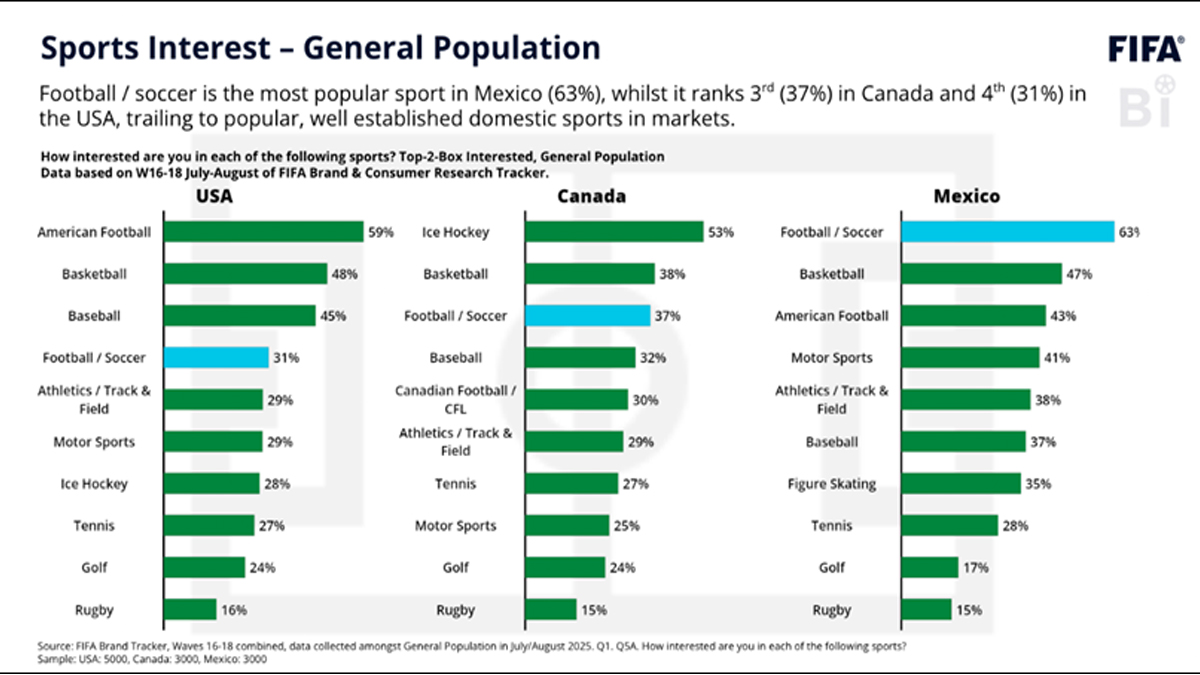
America, it turns out, is no longer a soccer backwater. The country now boasts the world’s fourth largest soccer fanbase, 62.5 million strong, and 64 per cent of fans reckon their appetite for the game will keep growing. Globally soccer remains king, and in Mexico it reigns outright: 63 per cent of Mexicans call it their favourite sport, with the average fan following it for some 14 years. The US and Canada are tougher terrain, where soccer ranks fourth (31 per cent) and third (37 per cent) respectively, still chasing ice hockey and American football for attention.
Roughly a quarter of North American soccer fans only joined the party in the last five years. And 68 per cent say their enthusiasm has sharpened in just the past three, as World Cup fever has built.
Younger, richer, and more female
The typical American soccer fan is 33 years old and noticeably more affluent than the general population. Women make up 43 per cent of North American soccer fans, comfortably ahead of Europe’s 36 per cent, a gap Nielsen flags as a defining regional quirk. For many, the game is more than entertainment: 29 per cent cite personal enjoyment as soccer’s biggest pull, while 14 per cent point to social connection, 12 per cent to family bonding and tradition, and 11 per cent to fitness and health.
Screens, streams, and short clips
Viewing habits track closely with Europe: 72 per cent watch matches on television, with streaming (47 per cent) and social media (also 47 per cent) close behind. Mexicans are the most likely to gather round a live broadcast (51 per cent), typically with the family and friends who first hooked them on the sport. Canadians, by contrast, are scroll and skim types, with 33 per cent favouring short form highlights and social clips over the full 90 minutes.
Billions on the board
The numbers behind the buzz are eye watering. The FIFA Club World Cup™, staged across major American cities from June 14th to July 13th 2025, generated a Gross Output of $17.1 billion and added $9.6 billion to US GDP. The tournament created 105,000 full time equivalent jobs and $5.8 billion in labour income, and is projected to hand governments $1.9 billion in direct and indirect taxes.
With those figures on the table and a World Cup on the horizon, North America’s soccer boom looks less like a passing craze and more like a generational changing of the guard. Gen Z and millennials are not just watching the game, they are rewriting who the game belongs to. The full report, “The Fans Behind The Game: FIFA World Cup 2026™ Edition,” is available at Nielsen.com.