
Sports
FICCI FRAMES 2026 explores the future of personalised sports viewing
JioStar and OpenAI discuss 1.2 billion screen reach, regional feeds and fan engagement


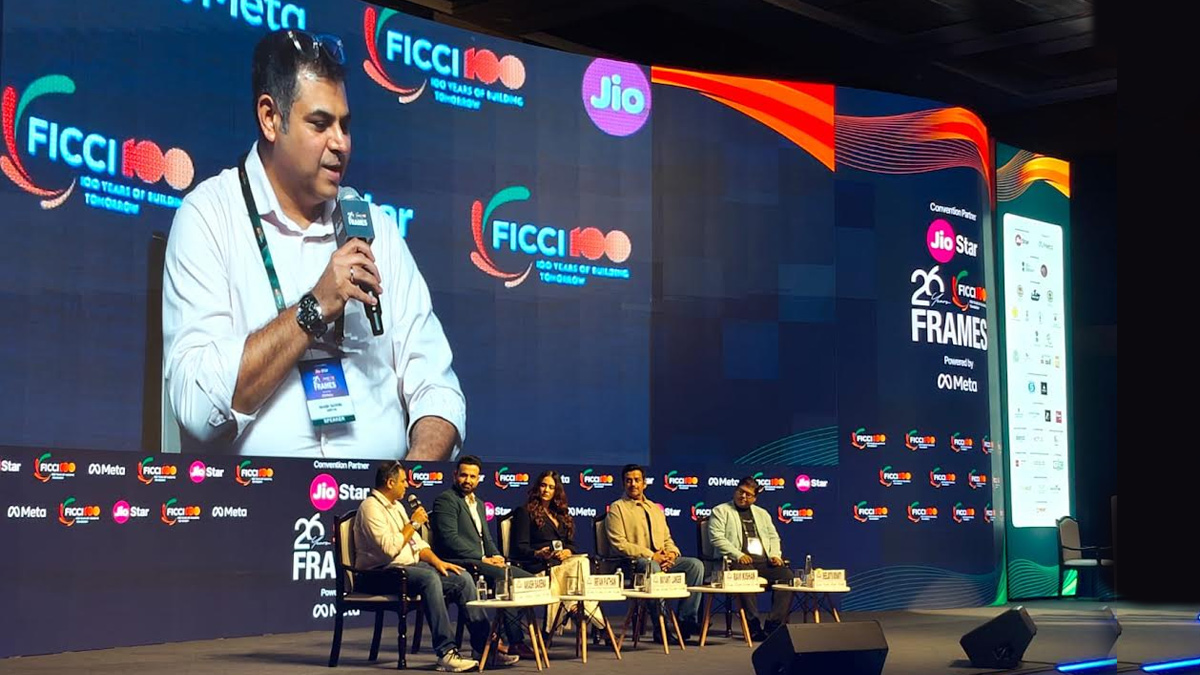
MUMBAI: Cricket may be one game, but in India it can speak a dozen languages at once. At FICCI FRAMES 2026, the session ‘Lighting Up a Billion Screens’ explored how the TATA IPL 2026 reached 1.2 billion screens and why scale alone may be only the opening over in the next phase of sports broadcasting.
The discussion brought together Sports Journalist and Broadcaster Mayanti Langer as moderator, actor and Member of Parliament Ravi Kishan, former Indian cricketer Irfan Pathan, Akash Saxena, Chief Technology Officer, JioStar, and Sheeladitya Mohanty, Head of Marketing, OpenAI India.
The conversation focused on a sports-viewing ecosystem that is moving beyond a single broadcast feed. Television, streaming, mobile, regional languages, personalised discovery and conversational technology are increasingly being woven together to create different versions of the same live sporting moment for different audiences.
The 1.2 billion-screen milestone during TATA IPL 2026 illustrated the scale of that opportunity. But the panel’s discussion suggested that reaching an enormous audience is only half the job. The bigger challenge is making those billions of viewing moments feel personal.
The transformation becomes particularly visible when a single IPL match is broadcast simultaneously across multiple feeds.
What appears to viewers as a seamless live broadcast involves a considerable amount of work behind the scenes. Regional feeds require their own commentary, production inputs and storytelling approaches, while the same match has to remain synchronised across languages and platforms.
Pathan spoke about the striking scale of JioStar’s studio operations, where separate spaces and teams cater to languages including Hindi, English, Telugu, Tamil, Marathi and Gujarati.
He recalled seeing multiple language feeds being produced simultaneously even under difficult circumstances, including a situation involving electricity and studio issues. The final broadcast, however, continued without viewers necessarily knowing about the chaos behind the scenes.
That ability to hide the complexity from the audience is perhaps the most important part of the exercise. Viewers are not meant to think about the machinery powering the broadcast. They are meant to feel that the match was made specifically for them.
The discussion went beyond simply translating an English or Hindi commentary feed into another language.
JioStar’s approach, as explained during the session, is to treat each language as its own storytelling environment.
The platform began with five languages in 2019 and has since expanded to 12, with the stated ambition of building for ‘Bharat’ rather than treating regional audiences as an afterthought.
That distinction matters.
A Bhojpuri viewer, for example, does not necessarily want the same commentary translated word for word from another language. They may want local references, familiar expressions, regional humour and a style that feels native to the community watching.
The result is a shift from localisation as translation to localisation as storytelling.
Ravi Kishan’s experience with Bhojpuri commentary offered one of the more vivid examples of how that strategy works.
Cricket commentary traditionally draws heavily on technical vocabulary, bowling lengths, batting technique, pitch conditions and tactical decisions. But Kishan’s approach was to place those moments in a much more familiar cultural landscape.
A shot travelling towards a particular part of the field could be described through references to towns, villages, local crossings, food stalls and familiar neighbourhood characters.
The result was a cricket broadcast that did not merely tell viewers what happened on the field. It made the action feel as though it was happening somewhere close to home.
Kishan described Bhojpuri as a language understood or spoken by around 250 million people in India and recalled the response to the regional feed, including messages from viewers asking for cricketing shots to be sent over their own villages.
That response illustrates why hyper-localisation can be more powerful than a simple language switch.
The ball remains the same ball. The match remains the same match. But the emotional address changes.
For viewers, personalised sports content can look almost effortless. Behind it sits a substantial technology operation.
Saxena explained that the objective is to reduce friction for audiences rather than make them repeatedly navigate menus, select languages or search using unfamiliar terms.
Once a viewer chooses a language such as Bhojpuri, the platform can remember that preference rather than asking them to make the same selection every time they return.
That may sound like a small interface change, but at the scale of live sports it becomes a major part of the viewing experience.
The broader ambition is to build what the discussion described as a digital fanbase or digital stadium — a ‘Chaupal’ that brings together viewers from different regions and language communities.
Technology, in this model, is not meant to be the star of the show. It is the infrastructure that allows different audiences to experience the same sporting event in ways that feel natural to them.
One of the most significant developments discussed was the use of conversational voice technology to change how fans discover sports content.
The partnership between JioStar and OpenAI was highlighted as an example of this shift, with conversational voice discovery rolled out during the IPL at large scale.
The system was made available to 400 million mobile users, allowing fans to ask what they wanted to watch rather than navigating through conventional menus and search terms.
For a sports fan, that could mean asking for IPL highlights featuring a favourite player and receiving the relevant content in the viewer’s preferred language.
It changes the relationship between the viewer and the platform.
Instead of the audience learning how the platform is organised, the platform begins to understand how the audience naturally asks for what it wants.
The bigger idea behind this technology is that personalisation does not have to destroy the shared nature of live sport.
Millions of people can be watching the same match, while each viewer experiences a slightly different version of it.
One fan may want detailed tactical analysis. Another may want highlights of a particular player. Someone else may prefer commentary in their mother tongue. Another viewer may want a more entertaining or culturally familiar presentation.
The sporting event remains common to all of them, but the route into that event becomes increasingly personal.
That creates what the panel described as an individual definition of a personal moment within a shared sporting moment.
It is a subtle but important change in the economics and technology of sports broadcasting.
The industry is no longer asking only how many people watched a match. It can increasingly ask how each person watched it.
The scale of localisation extends beyond simply offering a handful of language options.
The discussion pointed to more than 13 feeds and 12 languages, with each language feed involving bespoke production choices rather than simply replacing one commentary track with another.
Different feeds can focus on different players, angles, storylines and heroes depending on the audience.
That makes regional broadcasting a creative exercise as much as a technical one.
The backend has to ensure that these variations still arrive at the viewer in real time. Cricket offers very little room for error: a wicket can fall, a catch can be taken or a boundary can be hit in the blink of an eye.
The production teams therefore have to coordinate commentary, scripts, cameras, technology and transmission almost simultaneously.
The speed of the game makes the scale of the operation even more striking.
Commentators and production teams have to maintain energy for the duration of a match, which can stretch across three, four or even five hours.
Every moment needs to be captured, interpreted and delivered without losing the excitement of the live event.
Pathan described the behind-the-scenes work involved in maintaining multiple feeds while also ensuring that viewers experience a smooth broadcast.
The viewer, ideally, should never notice the complexity.
If a feed switches seamlessly, a language preference remains intact and a requested highlight appears immediately, the technology has done its job.
The panel also positioned accessibility and representation as important parts of the move towards personalised viewing.
The discussion referred to Indian Sign Language as an example of how sports broadcasting can be designed to reach audiences who may have previously had fewer ways to engage with major live sporting events.
That approach extends the definition of reach.
A billion screens are impressive, but the more meaningful question is how many different communities feel that those screens are meant for them.
Regional languages, local storytelling, voice discovery and accessible formats all broaden the idea of who a sports broadcast is designed to serve.
Although the TATA IPL provided the clearest example, the principles discussed have implications beyond cricket.
The same technology can potentially reshape how audiences experience other sports by allowing viewers to find content through natural language, receive personalised recommendations and engage with games through their preferred linguistic and cultural lens.
Pathan also stressed the importance of encouraging audiences to follow sports beyond cricket, underlining the wider opportunity for personalised sports content to help other disciplines build stronger connections with Indian viewers.
The more flexible the technology becomes, the less dependent sports viewing may be on a single standardised broadcast model.
The ‘Lighting Up a Billion Screens’ session ultimately showed that scale is no longer the final destination for sports broadcasting.
Reaching 1.2 billion screens during TATA IPL 2026 demonstrates what large-scale distribution can achieve. But the next challenge is to make that scale meaningful at an individual level.
That means remembering a viewer’s language, understanding what they want to watch, allowing them to ask for content naturally and creating feeds that reflect regional cultures rather than merely translating a national broadcast.
It also means using technology to remove friction rather than add another layer of complexity.
The future of sports viewing, as explored at FICCI FRAMES 2026, may therefore be less about putting one match on more screens and more about making one match feel different to every viewer.
The billion-screen milestone may have lit up the country. The next step is making sure every one of those screens feels like it was switched on specifically for the fan watching it.






