News Headline
TV Brand Fest 2021: GEC space remains unchallenged in building mass reach, say marketers

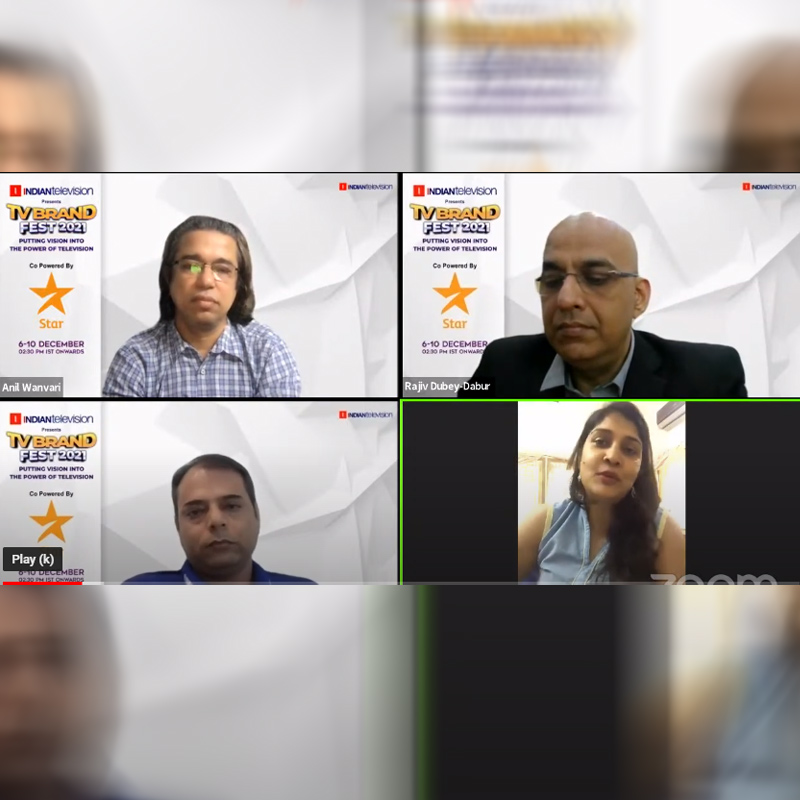
Mumbai: On day three of the TV Brand Fest 2021, media and marketing heads of prominent organisations discussed the merits and challenges of fiction and nonfiction content as a vehicle for brand messaging. The five-day event being organised by Indiantelevision.com is co-powered by Star India.
The panel consisted of Dabur head of media Rajiv Dubey, Yamaha Motor India head – marketing Vijay Kaul, and Dr Reddy’s Laboratories marketing head – OTC, emerging markets Prachi Mohapatra. The session was moderated by Indiantelevision.com Group founder CEO and editor-in-chief Anil Wanvari.
The discussion began with trying to understand the relevance of GECs which remain unchallenged despite the existence of a plethora of niches. Last year they had almost 50 per cent genre share as far as weekly viewing minutes were concerned, and therefore, any brand looking for a mass reach cannot afford to miss out on them.

“GECs are cost effective, and they give high reach for businesses like us who want to communicate to the masses repeatedly. Niche channels, on the other hand, are not consistent performers,” said Dabur’s Dubey.
EMBED: Panel image
Sharing her experience of using GECs, Mohapatra added, “They are a great way to build trust for your brand. GECs work extremely well when you have to change the brand imagery and also with tactical campaigns where the objective is to reach out to the right kind of consumers in a time-bound manner.”
Even though the auto category uses quite a balanced mix of fiction and non-fiction content, GECs are a staple in the media plan for mass or unisex products such as scooters. Elaborating further, Kaul stated, “GECs are the right choice for mature brands with a country-wide footprint. That’s where we expect a lot of sales volumes. When the idea is to launch a new brand, the media plan depends on the sales target being huge as in case of unisex or mass commuter brands.”
Mohapatra shared a similar opinion on the kind of products (based on the life cycle stage) that are best-suited for fiction content. “GEC are trust builders with a huge reach, and hence apt for mature brands as well as brand extensions. Taking a new brand/product directly to GECs is not feasible due to the high costs involved,” she observed.
For Dabur though fiction/GECs is the medium of choice for all kinds of brands barring a few like a men’s hair removal crème. This is because of the female-centric nature of content.
This insight from Dubey steered the conversation towards the importance of the content (message) and brand ethos being in sync with each other. While ratings and minimisation of duplication are Dabur’s primary concerns, Yamaha’s Kaul asserted that “in the automobile segment it becomes necessary to evaluate the nature of content because one is looking at a long association with a brand/product whose ticket value is huge.”
Non-fiction content on niche channels has thus been integral to Yamaha’s media plans. Sharing the example of Yamaha YZF R15, the brand that was built on one niche sport brand – MotoGP – alone, Kaul added, “MotoGP complemented the (high) price (Rs. 1.8Lakh) and the DNA of the brand perfectly. We went for live programming as well as repeats with bundled deals on EuroSports, never using any GEC for it.”
He cited another example, that of Yamaha Fascino Miss Diva Universe where the “fashionable scooter was embedded in the fashion property one year before its launch.” “Longevity is key here; one can’t have big-ticket integrations for six months, it needs at least four-five years for the association to build.”
Concurring with Kaul, Mohapatra noted, “With such high-decibel programs consistency is extremely important, otherwise even as you work on creating the brand image, recall fades out very quickly.”
As regards non-fiction on GECs such as ‘KBC’, and ‘Bigg Boss’. the panel believes that it brings in a fresh set of viewers, and a large number of eyeballs at the same time. It also offers more scope and solutions in terms of brand integrations and product placements. “Used in combination with fiction, weekend non-fiction properties are a great source of incremental reach,” stated Dubey.







NEW DELHI: Hamdard Laboratories gathered a cross-section of India’s achievers in New Delhi on Friday, handing out the Hakeem Abdul Hameed Excellence Awards to figures who have left their mark across healthcare, education, sport, public service and the arts.
The ceremony, attended by minister of state for defence Sanjay Seth and senior officials from the ministry of Ayush, celebrated individuals whose work blends professional success with a sense of public purpose. It was as much a roll call of achievement as it was a reminder that influence is not measured only in profits or podiums, but in people reached and lives improved.
Among the headline awardees was Alakh Pandey, founder and chief executive of PhysicsWallah, recognised for turning affordable digital learning into a mass movement. On the sporting front, Arjuna Awardee and kabaddi player Sakshi Puniya was honoured for her contribution to the game and for pushing women’s participation onto bigger stages.
The cultural spotlight fell on veteran lyricist and poet Santosh Anand, whose songs have echoed across generations of Hindi cinema. At 97, Anand accepted the honour with characteristic humility, reflecting on a life shaped by perseverance and hope.
Healthcare honours spanned both modern and traditional systems. Manoj N. Nesari was recognised for strengthening Ayurveda’s place in national and global health frameworks. Padma shri Mohammed Abdul Waheed was honoured for his research-backed work in Unani medicine, while padma shri Mohsin Wali received recognition for his long-standing contribution to patient-centred care.
Education and social development also featured prominently. Padma shri Zahir Ishaq Kazi was honoured for decades of work in education, while former Meghalaya superintendent of Police T. C. Chacko was recognised for public service. Goonj founder Anshu Gupta received an award for his dignity-centred rural development initiatives, and the Hunar Shakti Foundation was honoured for empowering women and young girls through skill development.
The Lifetime Achievement Award went to former IAS officer Shailaja Chandra for her long career in public healthcare and governance, particularly in the traditional systems under Ayush.
Speaking at the event, Hamdard chairman Abdul Majeed said the awards were a tribute to those who combine excellence with empathy. “These awardees reflect Hakeem Sahib’s belief that healthcare, education and public service must ultimately serve humanity,” he said.
Minister Seth struck a forward-looking note, saying India’s young population gives the country a unique opportunity to become a global destination for learning, health and wellness by 2047.
The ceremony also featured the trailer launch of Unani Ki Kahaani, an upcoming documentary starring actor Jim Sarbh, set to premiere on Discovery on 11 February.
Instituted in memory of Unani scholar and educationist Hakeem Abdul Hameed, the awards have grown into a national platform that celebrates those building a more inclusive and resilient India. For one evening at least, the spotlight was not just on success, but on service with substance.






