Brands
Your brand’s next customer is a bot, and it does not watch ads
AI has already made marketing cheaper and faster. The bigger shock is still to come. Brands will have to win over machines that shop on our behalf, and pay the platforms that own them for the privilege.


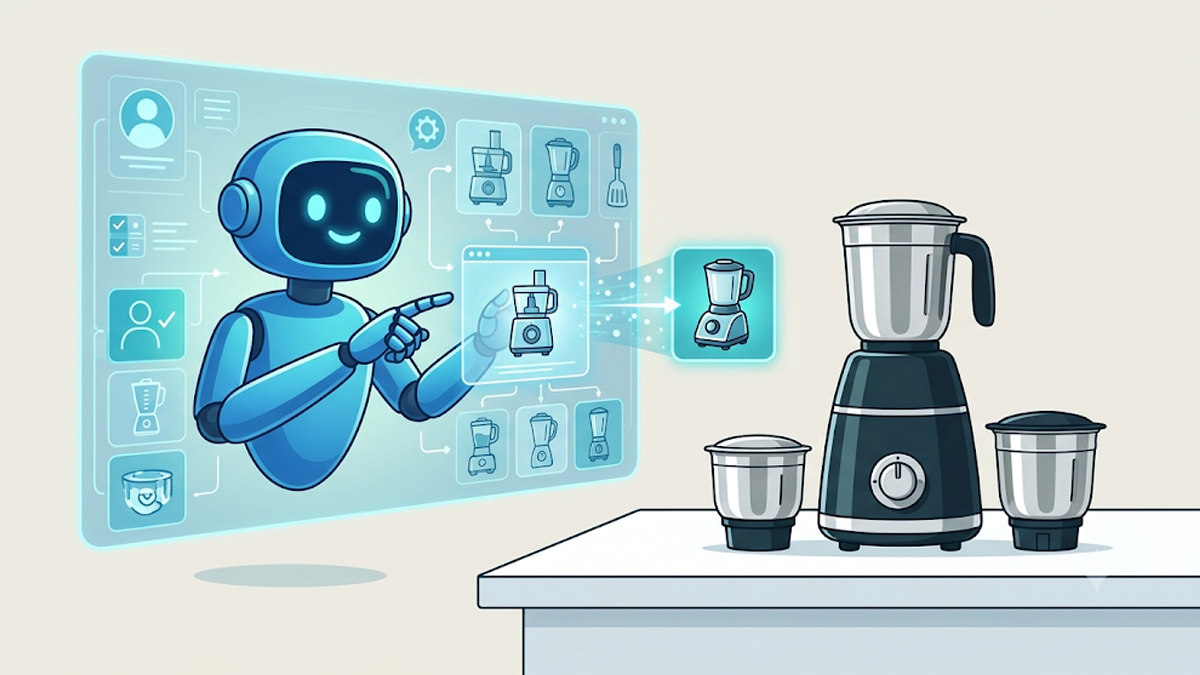
MUMBAI: A shopper in Indore types a question into ChatGPT. Which mixer-grinder should I buy under Rs 5,000? Back come a few names, a line on each and a link to buy.
No TV spot was seen. No shelf was browsed and no salesman was consulted. A brand that spent 40 years and a few hundred crore building its name either made that shortlist or it did not.
That shopper is not rare. OpenAI says ChatGPT has more than 100 million weekly users in India. Adobe found that 65 per cent of Indian consumers already use AI to find product recommendations. For brands, the ground has started to move.
Start with first principles. A brand is a shortcut. It saves the shopper the time of checking every option, and it cuts the risk of buying a dud. Pick the familiar red pack and you need not read 40 labels or worry that the new one will ruin your clothes. Shoppers pay a premium for that comfort, and that premium is what brand owners have spent a century of advertising building.
AI attacks both halves of that bargain. A machine can read 4,000 reviews in a second, compare every label and work out the price per gram. The search cost drops to nearly zero. The risk drops too, because the bot has read every complaint ever posted.
So the value of a brand will not fall evenly. Where little is at stake, as with toilet cleaner, salt or a phone charger, the shortcut matters less once a bot does the checking. Where a wrong choice hurts, as with baby food, medicines, insurance or a wedding sari, people will still lean on names they trust, and may lean harder in a world flooded with fakes and AI-made noise. Call it the commodity zone and the trust zone. Every brand manager should work out, honestly, which one their product lives in.
The first thing AI did for brands was make content cheap. Very cheap.
Unilever, using 3D digital twins of its products, says it now makes some content twice as fast at half the cost. Zee5 cut the cost of editing trailers by 95 per cent, with a 16-hour job now done in under an hour. Tira Beauty used AI to rewrite hundreds of thousands of product descriptions and got a 50 per cent jump in organic clicks. Bata India went the whole hog this August, moving all its creative production in-house onto AI and saving over $1 million a year in agency fees.
Marketing bosses are putting real money behind it. Gartner’s 2026 survey of chief marketing officers found they now spend 15.3 per cent of their budgets on AI. Yet only 30 per cent say their teams are ready to use it at scale. Most brands have bought the tools well before fixing the plumbing underneath.
Here is the catch nobody puts in the press release. When something gets cheap, people make far more of it, and each piece is worth less. When every brand can churn out a thousand ads a day, ads stop being scarce. Attention and trust become the scarce goods. Cheap content was supposed to be the prize. It has turned out to be table stakes, and the savings will largely be competed away.
Consumers have noticed. Last December Valentino put out an AI-made video for its DeVain handbag, with bodies melting into one another and limbs forming the logo. Social media called it disturbing and lazy. For a fashion house that sells hand craftsmanship at a fat premium, the ad said the opposite of what the brand stands for.
The numbers back up the outrage. A DoubleVerify study this year found 42 per cent of consumers in Europe, the Middle East and Africa would think less of a brand whose AI ads look shoddy or uncanny. In Britain the figure was 49 per cent. Polished AI work drew far less ire. People are not objecting to the machine. They are objecting to the shortcut.
Indians are no softer. In the Adobe survey, 61 per cent said they would stop engaging with a brand if they found they were talking to AI when they expected a human. The Advertising Standards Council of India (ASCI) has issued rules on labelling synthetic content in ads, which take effect at the end of December. A brand that skimps on quality will soon have to put a label on it too.
Note how this ties back to the trust zone. The brands with most to lose from cheap-looking AI are the very ones whose premium rests on trust and craft. Use AI to make the 500 product shots for the marketplace listing. Keep the humans for the work that carries the brand.
The second change runs deeper. AI is changing where people discover brands in the first place.
For two decades the route was predictable. A shopper searched, clicked a link, landed on a site, browsed and bought. Every click was a place to put an ad and a data point for the brand. Now Google answers the question on its own page through AI Overviews and AI Mode, and ChatGPT answers it in a chat window. The shopper gets the answer and often never clicks at all.
The open web is already feeling it. Publisher ad supply in the US and Britain fell by as much as 40 per cent in the second quarter of 2026, according to data from Ozone shared with Digiday, as zero-click search choked the flow of readers.
Marketers spent years drawing the funnel, with awareness at the top, consideration in the middle and purchase at the bottom. AI squashes the middle. Consideration now happens inside the model, out of the brand’s sight. The brand does not see the comparison being made, does not know why it lost and gets no data trail to learn from.
Being named in an AI answer depends on what the model has read about you: reviews, retailer listings, news coverage, forums and your own product pages. You cannot simply buy your way in, at least not yet. That is why generative engine optimisation, getting a brand picked by the bots, is the hottest new practice in marketing. Dentsu India has already built one.
The prize is worth chasing. Shoppers who reach a retail site from an AI platform are about 30 times more likely to buy, Adobe data cited by eMarketer shows. By the time the bot sends them over, the decision is mostly made.
And the ads are following. OpenAI switched on ChatGPT ads in India on 27 August with WPP and Omnicom as launch partners, and opened self-serve buying a week later with daily budgets from Rs 725. Google is testing ads in AI Mode. Amazon is testing sponsored prompts inside its Rufus assistant. The toll booth is being rebuilt inside the answer box.
The third change is the one that should keep brand managers up at night. The customer itself is becoming a machine.
AI agents that shop on a person’s behalf have moved from demo to checkout. Amazon’s Rufus can auto-buy an item when it hits a target price. Google has built an open standard for agent shopping with Shopify, Etsy, Wayfair and Target. eMarketer reckons AI platforms will account for 1.5 per cent of US online retail sales this year, about $20.6 billion and nearly four times the 2025 figure. McKinsey expects AI agents to handle 15 to 20 per cent of e-commerce by 2030.
India looks keener than most. Sixty per cent of Indian consumers told Adobe they want to create a personal AI agent, the highest in Asia-Pacific. Add quick commerce, where repeat orders of atta, detergent and shampoo are already a tap away, and the step to “just reorder my usual” is a short one.
An agent buying detergent does not hum the jingle. It has no memory of the ad that made a mother cry during the cricket. It reads price, pack size, ratings, delivery time and whatever the shopper told it to care about. For commodity-zone categories, the emotional pull that brand advertising was built to create starts to lose its grip.
This matters more in India than almost anywhere. Indian advertising has long been driven by FMCG, the very categories of soap, tea and toothpaste where people least enjoy shopping and would most happily hand the job to a bot.
Byron Sharp of the Ehrenberg-Bass Institute taught a generation of marketers that brands grow on two things. Mental availability means coming to mind at the moment of choice. Physical availability means being easy to find and buy. AI adds a new test on top. Call it machine availability: being readable, rankable and recommended by the bots. A brand can be famous in people’s heads and still invisible to the agent if its product data is a mess.
Brands are not doomed by this. The agent still takes instructions from a human. “Order Surf Excel” is a very different command from “order a good detergent”. The brands that live in the shopper’s head get named in the instruction. The rest get chosen by the algorithm on price, and that is a race private labels and D2C upstarts are built to win.
There is a quieter threat to FMCG profits. Indian brands are masters of price-pack architecture: the Rs 10 sachet, the ‘new bigger’ pack, the slight shrink at an unchanged price. Much of it works because busy humans do not do the maths at the shelf.
A bot always does the maths. It will rank options by price per gram or per wash in a blink, and it will not be charmed by a festive offer that is no offer at all. Pricing power built on shopper inattention will shrink. Pricing power built on genuine preference will survive. Finance teams should start stress-testing their margins for a world where every shopper has a ruthless accountant in their pocket.
Follow the money and a bigger shift appears. Power is moving from the brand owner to whoever owns the shopper’s screen.
Quick commerce shows where this goes. Hindustan Unilever chief executive Priya Nair said in February that the channel was three per cent of HUL’s business and growing almost 100 per cent quarter on quarter. Ad spending on quick-commerce apps leapt from Rs 1,325 crore in 2024 to Rs 4,000 crore in 2025, and is expected to cross Rs 6,000 crore this year. Zepto’s ad revenue rose 151 per cent to Rs 1,636 crore in its last financial year, more than 7 per cent of its operating revenue. WPP Media reckons retail media overall will top Rs 30,000 crore in 2026, about 15 per cent of India’s ad market.
Look at what that means for a brand. It gives the platform a trade margin to stock its product. Then it pays the same platform again in ad money to be seen in the search results. When AI agents sit on top of these apps, the sponsored slot in the agent’s answer will be the most expensive shelf space ever sold. FMCG companies fought modern trade over margins a decade ago. This fight will be harder, because the platform also owns the data, the ranking and often a private label of its own.
The money that once went into distributor schemes, in-store displays and TV is steadily being rerouted to a handful of digital toll booths. Brand owners who do not build a direct line to their customers will end up renting access to them at ever higher rates.
There is a nasty side effect. When an agent does the shopping, the clicks and cookies that digital marketers live by vanish. The purchase happens inside someone else’s system. Even Google and Meta now have less sight of what happens after the click, Funnel chief executive Fredrik Skantze told Forbes.
That creates a dangerous spiral. Performance ads that show a neat return will keep getting money. Brand building, whose payback is slow and hard to trace, will get cut, even though it is precisely what earns the “order Surf Excel” instruction. Brands that let the dashboard decide will starve the very asset that protects them.
The fix is old-fashioned. Marketing mix modelling and proper controlled tests are making a comeback because they do not depend on following a click. Indian brands that never invested in measurement beyond last-click attribution have a lot of catching up to do.
AI marketing runs on customer data, and India is about to make that data costlier. The Digital Personal Data Protection Rules were notified on 13 November 2025 with a phased rollout. Registration of consent managers opens on 13 November this year. The full consent and notice duties kick in on 13 May 2027, with penalties of up to Rs 250 crore.
Brands that have been happily stitching together customer lists from contests, apps and third-party vendors will have to clean house. Those that earn consent openly will own an asset their rivals cannot buy. Personalisation without permission will become a legal risk as well as a creepy one.
None of this happens overnight, and the hype merchants should calm down. Agent shopping is 1.5 per cent of US online retail. Quick commerce is three per cent of HUL. Walmart still bars outside AI agents from placing orders on its site. In India, the vast bulk of soap, tea and biscuits still moves through millions of kiranas, where the shopkeeper is the original recommendation engine.
So the change will roll in waves. Metro, affluent, online-first shoppers go first, and premium and electronics categories with them. Bharat follows later, probably through voice and WhatsApp in Indian languages rather than typed chats in English. That gives Indian brands a window of a few years. It is a window to prepare in, not a reason to wait.
2027. AI answers become the main discovery route for urban, online shoppers in electronics, beauty and travel. Ads inside AI assistants become a standard line in media plans. DPDP consent rules bite and force a clean-up of customer data.
2028 and 2029. Agents start reordering everyday staples for metro households through quick-commerce apps. Price-per-gram comparison squeezes FMCG pack games. Platform ad rates for the top slot in an agent’s answer climb steeply, and brands push back on the double charge of trade margin plus ad money.
2030. Marketing teams are smaller and heavier on data skills. Brand spend splits more sharply between a few heavy bets on fame and a large, automated machine for everything else. Brands in the trust zone hold their premium. Middling brands in the commodity zone face a long, slow grind on price.
This is our reading of the trend lines, not a forecast carved in stone. The direction is clearer than the dates.
What brands must do now
Be the name people say out loud. In a world of agents, the human instruction is the last moment of brand choice. Mass reach and memorable work matter more, not less. TV, cricket and big ideas still earn their keep for brands that want to be asked for by name.
Make the product readable by machines. Clean product data, honest specifications, rich reviews and complete marketplace listings are the new shelf. If the bot cannot read it, the bot will not pick it.
Own the relationship. Brands that know their customers directly, through WhatsApp, apps, loyalty schemes or their own stores, are less exposed when an agent sits in the middle. Rented audiences on someone else’s platform will only get pricier.
Price for a shopper who does the maths. Assume every pack will be compared per gram by a machine. Build value that survives that comparison.
Measure beyond the click. Invest in mix modelling and real experiments so that brand building is not starved by dashboards that cannot see it.
Spend AI savings on quality. Pocketing every rupee AI saves is tempting. Brands that put part of it back into craft and research will stand out in a feed full of slop.
Keep a human within reach. Label AI content honestly, earn consent for data and let customers reach a person when it matters. Trust is cheaper to keep than to win back.
For a hundred years brands fought for a place in the shopper’s mind. Now they need a place in the machine’s answer as well, and they will be paying the platforms rent for it.
The winners will be the brands a shopper names before the bot gets a chance to choose. The rest will be bought on price, by a robot that has never heard of them.