
Digital
Who Owns the Screen Now?
How India’s creator economy is rewriting the rules of entertainment, and what legacy producers must do to survive


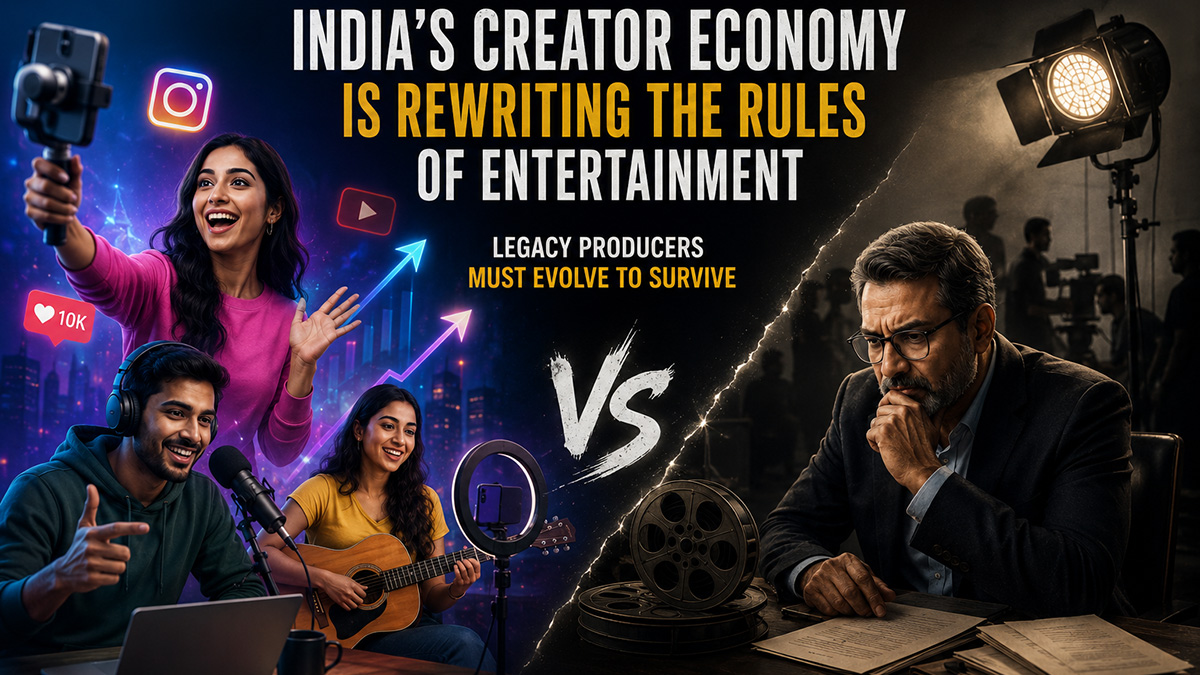
MUMBAI: There is a moment that tells you everything about where Indian entertainment is heading. Bhuvan Bam, a Delhi boy who once filmed himself playing multiple characters on a phone front camera, walks onto a Netflix set to shoot Dhindora Season 2. Season 1, self-financed and self-released on YouTube, reportedly crossed 500 million views. He owns the IP. Netflix is now his production partner, not his gatekeeper. His stand-alone universe of characters (Titu Mama, Banchoddas, Janki) belongs to him, not to a studio.
Meanwhile, Samay Raina, a stand-up comedian who built a cult following through chaotic YouTube tapings, survives one of the most public controversies in Indian digital history (FIRs, channel takedowns, sponsor withdrawals) and comes back with India’s Got Latent Season 2 simultaneously on Netflix and YouTube. His comeback special Still Alive became the most-watched comedy special on YouTube globally. He still owns the show. And he is reportedly pulling in an estimated Rs 15-20 crore from Netflix, an estimated Rs 40-50 lakh in YouTube ad revenue on Day 1 alone, and multiple brand integrations (AI Nova, Flipkart Minute, Avvatar, Snitch) at an estimated Rs 2-3 crore per brand.
These are not merely individual success stories. They are data points in a structural rupture of the Indian entertainment industry. And everyone, from the legacy TV producer running fifty-episode soaps in a Mumbai studio to the theatrical distributor nursing a franchise across multiplexes, is now living inside the fault lines.
The Old Architecture and Its First Disruption
To understand what is breaking, you must first appreciate what was built.
Indian television was a cathedral of access control. You needed a channel. Channels needed TRPs. TRPs demanded a specific grammar: the extended family drama, the saas-bahu conflict, the K-serial formula that Ekta Kapoor turned into a dynasty at Balaji Telefilms through the 2000s. The channel was the chokepoint. The producer was the intermediary. The advertiser paid CPT rates for mass reach with zero targeting precision.
Film was similarly gatekept. Dharma, YRF, T-Series: these houses controlled star access, distribution relationships, and theatrical slot negotiations. The first OTT disruption (Netflix entering India in 2016, JioHotstar scaling on IPL, Amazon commissioning Mirzapur) initially reinforced this architecture even while challenging it. The streamers largely chose established producers. Applause Entertainment, Sameer Nair’s Aditya Birla-backed venture, became the bellwether of this first wave: Scam 1992 for SonyLIV, Criminal Justice for JioHotstar, Black Warrant for Netflix. The platforms needed credentialed production capacity. They turned to professionals. The creator economy was a different species.
The Second Wave: Creators With Production Muscle and Owned IP
What has decisively changed is that creators have stopped being amateur. They have professionalised. And they have done so with their audiences already assembled and their intellectual property already owned.
Bhuvan Bam did things differently from every creator who came before him. Traditionally, digital creators used online platforms as springboards into Bollywood, leaving their internet IPs behind in the process. Bam took the road less travelled: he self-funded Dhindora Season 1 from YouTube earnings, built a universe of characters that resonated with middle-class Delhi audiences, and took that owned IP to Netflix as a negotiating asset, not a rights sale. By partnering with the global streaming giant for Season 2, confirmed as part of Netflix’s Next On Netflix 2026 India slate, he became one of the few independent Indian creators to successfully transition a self-funded intellectual property into a major platform original. Netflix is co-producing. Bam retains ownership. His estimated net worth stands at approximately Rs 122 crore, with brand endorsements and his merchandise brand Youthiapa generating an estimated Rs 35-45 crore annually, figures that, on their own, rival what mid-tier production houses earn in aggregate platform fees.
Samay Raina represents a different archetype, the creator as cultural provocateur. India’s Got Latent built a cult following, imploded spectacularly when a 2025 episode featuring Ranveer Allahbadia triggered widespread backlash, FIRs across multiple states, and sponsor withdrawals, then returned stronger. The comeback trajectory is astonishing. Still Alive broke global YouTube records for comedy specials. Then came the Netflix deal for Season 2, simultaneously on YouTube, unfiltered, with no windowing. Ashish Chanchlani, appearing in the announcement’s comment section, humourously requested: “Is baar disclaimer daal dena please — case ladne mein easy hota hai.” The comedy around the seriousness told you everything about how the digital creator world processes its own controversies: with self-awareness and commercial resilience that legacy broadcasters, operating under regulatory scrutiny, simply cannot match.
Ashish Chanchlani, with over 30 million YouTube subscribers and five billion cumulative views, took perhaps the most audacious bet of any Indian creator: he spent his entire earnings from two years of content creation on Ekaki a sci-fi horror-comedy he wrote, directed, produced, and released for free on his own YouTube channel. His CA was, he has admitted, genuinely alarmed. Ekaki accumulated close to 145 million views across five episodes. He declined to release it on an OTT platform, choosing instead to maintain direct connection with his subscribers. He has already started writing Season 2, this time aiming for a platform deal to fund the bigger vision. He is also reportedly working on an untitled project with TVF. Crucially, Chanchlani declined “token funny character” roles in Bollywood films like Jugjugg Jeeyo, refusing to be typecast, and instead chose to build a cinematic universe on his own terms, citing Christopher Nolan as a creative inspiration. This is a creator who understands that the offer of a cameo is not career advancement; it is institutional co-option.
The New Creator Archetypes: What They Mean for the Industry
The creator landscape is not monolithic. Understanding the different models illuminates different threats and opportunities for legacy players.
The Lifestyle-to-Mainstream Crossover: Dolly Singh
Dolly Singh began with fashion sketches and character comedy (most notably her “South Delhi Girl” and “Raju Ki Mummy” portrayals) and built a loyal community over a decade of consistent, relatable work. The journey has been one of patient, strategic crossover: Bhaag Beanie Bhaag on Netflix, Modern Love Mumbai on Prime Video, Double XL theatrically, Thank You for Coming. By 2025, she won Instagram’s Rings Award for Bold Creators, confirming her status as a platform-level celebrity, not merely a content creator in the old sense.
Her Instagram bio (“Creator/Actor/Storyteller @dollywoodfilums”) captures the evolution with precision. She runs her own production outfit and has created Instagram-native scripted content (the Best Worst Date rom-com series, adapted specifically for scrolling consumption). She describes her decade-long evolution with a sharp self-awareness: “Fame in 2025 is tricky. You can go viral overnight and be forgotten in five days. The real success lies in turning that viral moment into something more — when people discover you, follow your work, and become part of your tribe.”
What Dolly Singh represents for the legacy industry is the creator-as-actor-in-demand. When she appears in a Netflix show, her two million Instagram followers are a built-in marketing audience. She is not a celebrity slumming in digital; she is a digital-native who has earned mainstream credibility through consistent work. Her model, building a personal brand through character-driven content, then leveraging it for screen roles while retaining a digital-first content practice, is being replicated by dozens of Instagram creators. Shreya Gupto, Prajakta Koli (who starred in Dharma’s Jugjugg Jeeyo and Netflix’s Mismatched), and a new wave of Gen-Z women creators are all following variants of this path.
The Podcast Sovereign: Raj Shamani
Raj Shamani is not a film or web series creator in the traditional sense. He is something the legacy entertainment industry barely has a category for: a media institution built entirely on personality, consistency, and the podcast format.
His Figuring Out podcast, launched in 2021, became one of India’s most influential interview shows by combining entrepreneurship content with access journalism: guests have included Emmanuel Macron, Bill Gates, and Vijay Mallya, whose four-hour interview generated 20 million views within four days and became one of the most discussed media moments of 2025. He has over 11 million YouTube subscribers and an estimated net worth of Rs 90-100 crore. His income model spans podcast sponsorships, YouTube ad revenue, brand collaborations with CRED, CoinDCX, Groww, and others, startup investments, and his family’s FMCG business Shamani Industries, which generates over Rs 200 crore in revenue. He is also co-founder of House of X, a platform enabling creators to launch direct-to-consumer brands.
For brands selling to India’s ambitious middle class, Raj Shamani is among the most efficient paid-media replacements available. His audience is highly engaged, business-literate, and conversion-oriented: the qualities advertisers are most desperately trying to buy through traditional media and failing to find. A single podcast sponsorship episode with Shamani, distributed across YouTube, Instagram, Spotify, and LinkedIn, reaches multiple platforms and multiple consumption contexts simultaneously.
The threat Raj Shamani and the podcast format represent to legacy media is the complete disintermediation of the talk show. Koffee With Karan needed a broadcast slot. The Kapil Sharma Show needed a GEC time band or a streaming platform, a studio audience, and a channel’s marketing support. Figuring Out needs a phone, a recording setup, and a YouTube upload. The economics are incomparably more efficient, and the creative control is entirely the host’s.
The Gen-Z Relatability Creator: Srishti Garg
Srishti Garg is a different kind of story, not yet at the scale of Bhuvan Bam, but representative of a far larger and more structurally significant trend. She is a Gen-Z creator from a non-metro background who began on Twitter, evolved onto Instagram through fashion and lifestyle Reels, and has built one of the most engaged communities in the mid-tier creator space, with 450,000+ Instagram followers and a 3.9 per cent engagement rate, which comfortably outperforms the average for her follower tier.
Her transition into scripted storytelling (she describes her background as a scriptwriter, and her Instagram-native content increasingly adopts narrative form) represents the leading edge of what short-form storytelling looks like when it is native to the platform rather than adapted from another format. She has spoken candidly about the algorithm’s demands (“you need to figure out what the audience wants to watch”) while insisting on authenticity as the only sustainable currency.
In five years, creators at Srishti Garg’s level are the ones OTT platforms and production studios will be partnering with for the next wave of mobile-first, vertical-format, short-form narrative content. Legacy producers who dismiss this tier as “micro-influencer territory” are misreading where tomorrow’s IP originators are being trained.
The Brand Money Revolution: How Advertisers Are Funding the Creator Takeover
Perhaps the most consequential (and least discussed) dimension of this transformation is what it has done to the Indian advertising market.
For decades, advertisers had two premium options: GEC primetime slots (mass reach, no targeting, expensive CPM) and theatrical tie-ups (high-visibility, short window, cinema-going demographics). Digital advertising created targeting precision, but it took the creator economy to create something neither TV nor display advertising could offer: trusted, contextual, personality-endorsed integration at scale.
When a brand appears in Samay Raina’s India’s Got Latent, it is not running a 30-second spot that viewers fast-forward through. It is being introduced by a host whose audience trusts him enough to have spent hours watching him through genuine personal crisis and comeback. The brand association is entirely different in character. Reportedly, Rs 2-3 crore per integration, with multiple brands in a single episode, is often more efficient for the advertiser than buying equivalent GRP points on a GEC, and it is measurable in ways that TRP-based TV advertising simply is not.
What has structurally shifted is that OTT platforms have now opened the door to this, accepting brand integrations within creator-led content that would once have been considered incompatible with their “prestige streaming” positioning. Netflix, which once marketed itself globally as an ad-free sanctuary, has launched ad-supported tiers and is accepting brand integrations within content. JioHotstar, built on an ad-supported model, is structurally receptive. The result is a funding mechanism for creator-led productions that supplements or replaces platform licensing fees entirely.
The model, fully assembled, works like this: the creator retains IP and YouTube rights; brands pay for integration in the YouTube version (which reaches the organic mass audience); the platform pays a licensing or co-production fee for premium streaming rights; YouTube ad revenue provides a third income stream (estimated at Rs 40-50 lakh on a 25 million view Day 1); and merchandise or live event revenue provides a fourth. A creator-led property at the right scale is structurally more resilient than a traditional production house, which typically depends almost entirely on a single platform licensing deal.
The brands flocking to this model are instructive. D2C brands (Snitch for menswear, Avvatar for nutrition, Flipkart Minute for hyperlocal delivery, fintech players like CRED and Groww) have found that creator show integrations convert audiences into customers more efficiently than traditional media. They are not brand-safety-first conservative advertisers. They are new-economy brands whose target demographic, urban, 18-30, digital-first, aspirationally entrepreneurial, responds to edgy, unfiltered content far better than to polished corporate advertising.
This advertiser shift is existential for traditional GEC broadcasting. If D2C brands that once bought television spots to reach young urban India can now reach the same audience more efficiently through creator integrations on YouTube and OTT (at lower cost, with better measurement, and without broadcast content restrictions), the advertising revenue that sustained the GEC ecosystem begins to hollow out from the middle. Not from the top (mass cricket, prime-time tentpoles) and not from the bottom (regional daily soaps), but from precisely the segment that used to be most lucrative: youth-oriented Hindi GEC primetime.
Balaji Telefilms: The Most Instructive Legacy Evolution
Of all the legacy players navigating this transition, Balaji Telefilms offers the most instructive case study in both the difficulty and the possibility of genuine evolution.
Ekta Kapoor did not wait for disruption to arrive. She launched ALTBalaji in 2017, becoming the first major legacy TV producer to launch her own OTT platform, an extraordinarily bold bet that if she owned the distribution infrastructure, she could control both production and destiny. The bet was ambitious but ultimately overreached. Maintaining a standalone OTT platform against Netflix, Amazon, and JioHotstar proved economically brutal. ALTBalaji faced chronic subscriber acquisition challenges and eventually found itself caught in regulatory crossfire; in July 2025, the ministry of information and broadcasting banned ALTBalaji alongside 24 other platforms for content violations.
But the Balaji story does not end with ALTBalaji. The more significant evolution has been the pivot to Netflix. In 2025, Balaji Telefilms and Netflix announced a long-term partnership to collaborate on original films and series across multiple genres for the Indian market. The terms represent exactly the lesson the industry needs to learn: Balaji’s real asset was never the distribution platform. It was the format IP and the production capability. By directing those assets toward Netflix rather than defending an underfunded proprietary platform, Balaji gets global distribution, production investment, and the credibility of the world’s largest streamer, while the format creativity and production execution remain theirs.
The clearest demonstration of this evolution is Lock Upp. Season 1 (Lock Upp: Badass Jail, Atyaachari Khel!), hosted by Kangana Ranaut, premiered on ALTBalaji and MX Player in February 2022 and became an instant cultural phenomenon, a prison-setting reality format that was genuinely edgier than anything on traditional GEC, generating massive digital engagement and making Munawar Faruqui a household name.
Season 2 (Lock Upp: Sach Ya Saza) tells the complete story of where the industry has moved in four years. Produced by Balaji Telefilms and co-produced by Colosceum, it premiered on Netflix from 27 June 2026, with new episodes streaming Saturday to Wednesday. Kangana Ranaut, now a member of parliament after winning from Mandi on a BJP ticket in the 2024 Lok Sabha elections, is not returning, replaced by Farah Khan and Riteish Deshmukh as hosts. The show moved entirely from ALTBalaji to the world’s largest subscription streaming platform. Its marketing campaign (masked “qaidis” marching through major Indian cities, billboard takeovers) speaks the language of Netflix-era launch strategy, a long way from ALTBalaji’s scrappier beginnings.
What the Lock Upp arc demonstrates: the format has genuine IP value that travels. The ALTBalaji platform did not travel. Ekta Kapoor’s insight, belatedly applied, is that Balaji’s competitive advantage is in originating distinctive format IP with popular culture resonance, not in running a streaming platform. The pivot from distribution ownership to format IP licensing is the right one, even if it came after a costly detour.
Balaji has also been experimenting with genre diversification for OTT: the superhero-themed Power of Paanch signals that it recognises streaming audiences demand variety beyond conventional family drama grammar. The production house’s three decades of brand clout give its digital projects a head-start in visibility that no new entrant can easily replicate. The unanswered question is whether Balaji can consistently originate OTT-native IP rather than migrating television sensibilities into a streaming format, a distinction that audiences, and increasingly algorithms, can detect.
The Platform Calculus: Why Streamers Accept What They Once Refused
The conventional narrative is that OTT platforms are the new gatekeepers. The reality in 2026 is more nuanced: the platforms are simultaneously gatekeepers and supplicants, dependent on creator audiences for subscriber acquisition in ways they would not have acknowledged five years ago.
In 2025, Netflix led India’s streaming market with over 236 million total viewership across its top originals; JioHotstar led specifically for Indian-language content, with 188 million. But the top-line numbers obscure a strategic anxiety: premium subscriber acquisition is expensive, content differentiation is eroding, and every major platform is competing for the same urban audience with essentially the same grammar of prestige scripted drama.
Creator content offers platforms three things traditional production cannot:
Built-in audiences that become subscriber acquisition engines. When India’s Got Latent moves to Netflix, some percentage of Samay Raina’s YouTube audience subscribes to watch. The creator’s own platform becomes the streaming service’s marketing channel. The cost per acquired subscriber via this route almost certainly beats paid marketing.
Quantified audience proof before commitment. A creator-led property that has already demonstrated demand on YouTube carries less uncertainty than a greenlit script. Ekaki at 145 million views before a platform deal exists is a proof-of-concept no pitch deck replicates.
Cultural freshness in a genre-saturated market. Creator content signals what India’s 18-35 digital-native cohort (the most valuable demographic for streaming subscriptions) is actually choosing to watch. Platforms that ignore this signal risk producing beautifully executed content for an audience that has moved on.
The simultaneous Netflix-YouTube release of India’s Got Latent Season 2 represents the platforms’ deliberate acceptance of the new architecture. Netflix’s logo appears on every viral clip. Every viewer who watches on YouTube without a Netflix subscription is a potential subscriber acquisition opportunity. The creator’s YouTube channel has become Netflix’s free sampling layer. OTT platforms accepting brand integrations within creator content, which they are now doing, completes the financial circle: the creator funds the YouTube version through brand deals; the platform funds the streaming version through licensing; the audience sees both simultaneously. The advertiser, the creator, and the platform all win. The only loser is the model where the platform owned everything.
Five Scenarios for the Legacy Industry
Scenario 1: The Smart IP Adaptor. Legacy producers who abandon work-for-hire production and become genuine IP originators, retaining partial ownership rather than selling everything in a single rights deal. Applause Entertainment, with its hub-and-spoke model and non-exclusive multi-platform deals across Netflix, Prime Video, SonyLIV, JioHotstar, and Z5, represents this posture. Balaji’s Lock Upp on Netflix while retaining format IP represents it in reality television.
Scenario 2: The Reluctant Conceder. Production houses that continue to supply content on work-for-hire terms but find their negotiating leverage eroding as platforms increasingly prefer creator-attached projects with built-in audiences. Many mid-tier OTT producers currently occupy this space without fully acknowledging it.
Scenario 3: The Infrastructure Partner. Studios like Dharma and YRF that focus on what they uniquely possess: pan-India theatrical distribution, the ability to mount Rs 200+ crore productions, institutional relationships to secure 3,000-screen opening weekends. Creators need this infrastructure for theatrical ambitions. Dharma casting Bhuvan Bam in Kuku Ki Kundali is exactly this exchange: the studio provides scale; the creator provides audience.
Scenario 4: The Conglomerate Play. Industrialists entering entertainment not as passion but as strategic allocation. The Aditya Birla Group’s dual presence, Applause Entertainment for OTT series, and Birla Studios (launched by Ananya Birla in February 2026) for prestige theatrical films with a multi-language slate, is the clearest example. These are not entertainment companies learning to compete; they are conglomerates with deep balance sheets entering a sector where returns are becoming visible and IP ownership is appreciating.
Scenario 5: The Format Specialist. Traditional GEC producers who double down on unscripted formats, reality, game shows, talent competitions, rather than competing with scripted OTT content. Bigg Boss, KBC, and Shark Tank India continue to perform because they exploit television’s unique affordance: live, participatory, appointment viewing with social commentary built in. The format that puts 20 million viewers in front of the same screen at the same time is something streaming, by design, cannot replicate.
The Creator’s Own Precarious Position
Power in media is never stable, and the creator ecosystem’s structural advantages carry specific vulnerabilities.
The most acute is platform dependency. Even creators who own their IP remain dependent on YouTube’s algorithm for organic reach. A single policy change (CPM rates, content moderation thresholds, algorithmic de-prioritisation of long-form content) can materially damage a creator’s revenue base with little warning. Samay Raina’s channel removal during the India’s Got Latent controversy illustrated this acutely.
The second is the content arms race and budget inflation. Ekaki nearly bankrupted Ashish Chanchlani. Two years of earnings, one project, released for free. This is not a sustainable model at scale. As creator ambitions grow, production costs inflate: VFX, locations, cast, theatrical release infrastructure. At a certain scale, the creator becomes the production house, with identical overheads and identical slate risk. The lean creative advantage begins to calcify.
The third is personality brand fragility. India’s Got Latent ceased to exist because of one panellist’s remark in one episode. Dolly Singh’s content brand rests on her persona. A traditional production house can weather a controversy because the brand is institutional. Creator brands do not have this resilience. When the brand is the person, the brand is as fragile as the person’s worst day.
The fourth is regulatory exposure. India’s OTT content regulation is in active and unpredictable flux. Creator-led content (edgy, unfiltered, irreverent) is precisely what draws regulatory attention. The July 2025 banning of 25 OTT platforms including ALTBalaji is a preview of what happens when digital irreverence collides with the state’s content expectations at scale.
The Fault Line That Defines the Next Decade
Here is the question that will determine who survives: Who owns the relationship with the audience?
The legacy TV producer never owned it; the channel did. The first-generation OTT producer doesn’t own it; the platform does. The creator, uniquely, does own it, because the subscriber came for them, not for the distribution infrastructure they happen to use.
This is the structural advantage that makes the creator economy genuinely disruptive rather than merely fashionable. An audience relationship is a durable asset. It generates IP value, negotiating leverage, merchandise revenue, live event revenue, direct advertising income, and, crucially, the ability to take a format from one platform to another without losing the audience. Bhuvan Bam could, in theory, move Dhindora Season 3 from Netflix to Amazon. He would still have Titu Mama. He would still have the audience that grew up on BB Ki Vines. The platform cannot take that away.
The legacy industry’s best response is not to dismiss this, or to try to replicate it through manufactured digital presences. A corporate brand cannot manufacture the authenticity that built these audiences. The response must be to partner intelligently: to bring what only institutional players can bring (scale, theatrical access, regulatory navigability, production infrastructure) and to accept that the creator is no longer a vendor to be commissioned on work-for-hire terms, but a co-creator to be respected as an IP owner and long-term partner.
The screen has always belonged to whoever holds the audience’s attention. For a long time, that was the channel and the studio. Increasingly, it is the person who filmed themselves on a phone at home, and spent a decade earning, carefully and relentlessly, the right to own what they created and take it wherever they chose.
The new deal terms are being written right now, one negotiation at a time. The producers and platforms who understand this will shape the next era of Indian entertainment. Those who don’t will spend the next decade watching someone else do it, from the wrong side of the table.
India’s entertainment industry is at an inflection point that comes once a generation. The creator economy has already rewritten the terms of engagement. The legacy industry’s question is no longer whether to respond; it is whether to lead the response, or be led by it.






