Connect with us

Brands

Three Tata Brands in top 20 list of India’s Most Consumer-Focused Brands

Published

on

MUMBAI: TRA Research has launched the second edition of ‘India’s Most Consumer-Focused Brands 2019’ (CFB), a study measuring the brands’ increase in Buying Propensity, the keenness-to-buy among Indian consumers.

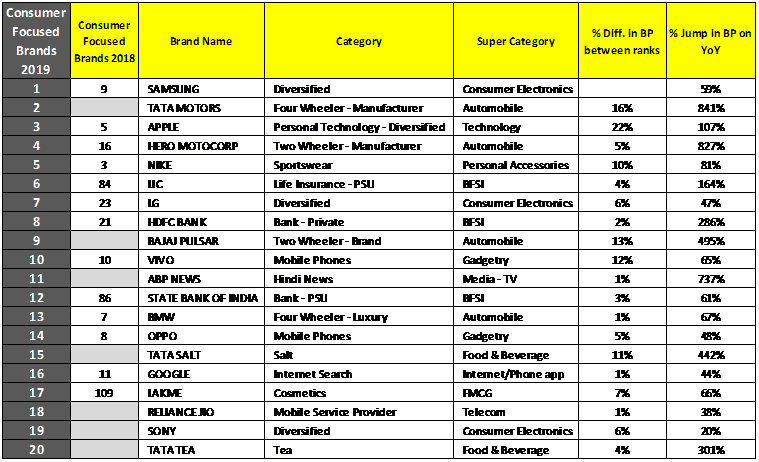
Samsung, the South Korean multinational major leads the TRA’s most consumer-focused brands 2019 report this year. It is followed by Tata Motors at scond place and Apple has secured third position with the latter having climbed two ranks over last year. Hero Motocorp has secured fourth slot while Nike is at fifth rank for consumer-focus.

CFB 2019 reports the list of brands that increased their buying propensity over last year. This year’s report lists 500 brands based on the buying propensity comparison of two successive years’ data.

Advertisement

Commenting on the launch of CFB Report 2019, TRA Research CEO N Chandramouli said, “TRA‘s Most Consumer-focused brands 2019 report in its second edition exhibits substantial shift. The biggest find is that of the seven new brands that made it to the list as compared to last year all have made it into the Top 20 Most Consumer-Focused Brands list. Three Tata Brands – Tata Motors (ranked 2nd), Tata Salt (ranked 15th) and Tata Tea (ranked 20th), which were not a part of the list last year, also made it to the Top 20.  Some other new entrants to the Top 20 list include Bajaj Pulsar (ranked 9th), Reliance Jio (ranked 18th) and Sony (ranked 19th). A few brands made significant strides over last year to make it to the Top 20 Most Consumer-Focused Brands. These include LIC (ranked 6th, with a jump of 82 ranks), State Bank of India (ranked 12th with a climb of 74 ranks) and Lakme (ranked 17th with a jump of 92 ranks). Of the 11,000 brands studied, only 541 brands showed an increase in buying propensity over last year, with 95 per cent brands registering a fall in buying propensity in the same period.”
“TRA’s Buying Propensity Matrix is a scientific brand measurement model that gets to the root of consumer buying behaviour to understand and measure the customer’s buying keenness. It attempts to understand this through the overt, covert and contextual buying drivers of consumer influences. By increasing buying propensity a brand creates a natural pull for the consumer towards the brand measured as a consumer’s trust (the transactional drives to buy) and attractiveness (the psycho-socio-cultural desire drives to buy). These two combine to make the fundamental substrate on which all buying decisions are made,” Chandramouli added.

Among India’s 500 Most Consumer-Focused Brands, 37 super-categories and 236 categories were listed. The categories with the maximum brands were F&B, FMCG and automobile contributing to 28 per cent of the total brands in the listings.

Advertisement

Some of the important category leaders in Consumer-Focused Brands are Panasonic (rank 57) in Consumer Electronics; Liberty (rank 64) in Footwear; Kenstar (rank 163) in Durables, L’Oreal (rank 66) in FMCG; Sun Pharma (rank 76) in Pharmaceuticals;  Tata Sky (rank 72) in DTH;  DMart (rank 111) in Retail, Fastrack (rank 31) in Branded Fashion, JW Mariott (rank 155) in Premium Hotels, Google (rank 16) in Internet Search, and Kit Kat (rank 135) in Food & Beverage.


Click to comment

Leave a Reply

Your email address will not be published. Required fields are marked *

Brands

Wipro hires 7,500 freshers, withholds FY27 hiring outlook

Profit rises to Rs 3,522 crore, Rs 15,000 crore buyback announced.

Published

on

MUMBAI- Hiring may be on, but visibility is off, Wipro is adding talent even as it pauses the crystal ball. The company hired 7,500 freshers in FY26 but stopped short of offering any hiring outlook for FY27, underscoring the uncertainty gripping the IT services sector as it pivots towards an AI-led operating model.

The disclosure came alongside its fourth-quarter earnings, where management flagged volatile demand conditions and refrained from committing to future workforce expansion. Chief human resources officer Saurabh Govil noted that over 3,000 of the total hires were onboarded in the March quarter alone, signalling continued intake despite a lack of clarity on deployment pipelines.

This divergence active hiring without forward guidance reflects a broader industry pattern where talent acquisition continues even as deal conversions remain uneven and client spending cycles stretch. Wipro expects its IT services revenue for the June quarter to range between a decline of 2 per cent and flat growth sequentially in constant currency terms, reinforcing near-term caution.

Advertisement

Chief executive officer Srini Pallia pointed to artificial intelligence as both a disruptor and an opportunity. He said evolving client priorities are pushing the company towards outcome-driven engagements, with Wipro increasingly focusing on a services-as-software model through its AI Native Business and Platforms unit. The shift marks a structural change from traditional headcount-led growth to AI-enabled delivery frameworks.

The company has already committed over $1 billion to its AI ecosystem, with investors closely watching how these investments translate into revenue. For now, the numbers present a mixed picture. Net profit rose sequentially to Rs 3,522 crore, while revenue grew 3 per cent to Rs 24,236 crore. However, core IT services performance remained under pressure, with full-year revenue declining 0.3 per cent in dollar terms and 1.6 per cent in constant currency.

Large deal bookings offered a counterpoint, rising 45.4 per cent year-on-year to $7.8 billion, highlighting a widening gap between deal wins and actual revenue realisation. On a quarterly basis, IT services revenue slipped 1.2 per cent sequentially, signalling continued softness in execution.

Advertisement

Margins, however, told a more optimistic story. Operating margins expanded to 17.3 per cent in the fourth quarter, up from 14.8 per cent in the previous quarter, reflecting improved cost discipline. That said, the company cautioned that upcoming wage hikes and the ramp-up of large deals could exert pressure going forward.

Attrition stood at 13.8 per cent in the March quarter, indicating stabilisation after periods of elevated churn. Alongside its earnings, Wipro also announced a Rs 15,000 crore share buyback, reinforcing its focus on shareholder returns, with a payout ratio of 88 per cent over the past three years.

Taken together, the numbers capture a company in transition investing in AI, maintaining hiring momentum, but navigating a demand environment where growth is uneven and visibility remains limited.

Advertisement
Continue Reading

Advertisement News18
Advertisement
Advertisement
Advertisement Whtasapp
Advertisement Year Enders

Indian Television Dot Com Pvt Ltd

Signup for news and special offers!

Copyright © 2026 Indian Television Dot Com PVT LTD

This will close in 10 seconds