Brands
Indian brands are turning to micro-dramas as TV ads lose ground
Zomato, Ajio and Myntra are ditching the 30-second spot for soap-opera-style micro-dramas, and the numbers say they are onto something


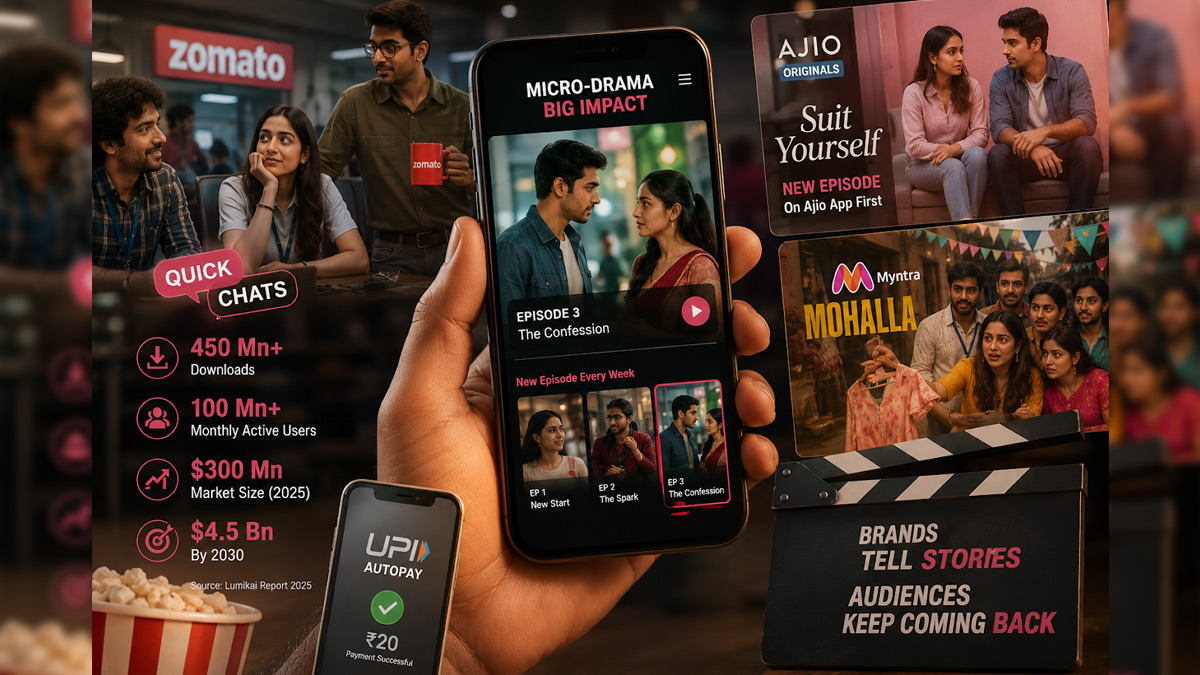
MUMBAI: The 30-second television commercial, that staple of Indian advertising for half a century, is looking distinctly elderly next to its new mobile-native rival. A wave of vertical, serialised micro-dramas, two-to-three-minute episodes built for a phone screen and designed to be binged rather than skipped, has gone from nowhere to a $300 million business in a single year, according to Lumikai’s State of India Interactive Media Report 2025. The format has racked up 450 million downloads and 100 million monthly active users, and Lumikai reckons it is on course to become a $4.5 billion industry by 2030, with growth of 91 per cent pencilled in for 2026 alone.
Three of India’s best-known consumer brands have already worked out how to ride the wave. Zomato’s Quick Chats, a six-episode workplace mockumentary shot in the deadpan style of The Office, swaps discount codes for corporate banter and chaotic food debates, with the app written in as the answer to the office’s everyday dramas rather than pitched as a product. Ajio has gone further still, launching a dedicated content arm, Ajio Originals, whose first release, Suit Yourself, casts recognisable screen names including Anya Singh and Rohan Gurbaxani in a six-episode relationship drama about flatmates navigating Valentine’s week, with new episodes dropped on Ajio’s own app hours before they reach Instagram, turning entertainment into a built-in traffic funnel. Myntra’s Myntra Mohalla takes the regional route, an ensemble comedy set in a Tier-2 neighbourhood gearing up for a wedding, in which characters work through outfit dilemmas across the mehendi, sangeet and big day itself, using Myntra’s catalogue of more than 15,000 brands as the on-screen solution to every wardrobe crisis.
For all the metro-led buzz around Zomato, Ajio and Myntra, the real volume engine of this market sits well outside India’s biggest cities. The micro-drama segment, valued at Rs 650 crore in 2025, is forecast to compound at more than 50 per cent a year through 2028, according to the FICCI-EY 2026 Media & Entertainment Report, and 60 to 75 per cent of its users already come from Tier-2 and Tier-3 towns. Language, in these markets, has stopped being a mere accessibility feature and turned into the thing that actually opens wallets: more than half of viewers insist on content in their native tongue, and platforms report markedly higher willingness to pay when characters speak in colloquial Tamil, Bhojpuri or local Telugu rather than polished Hindi or English.
The content itself splits cleanly along regional lines. In the Hindi belt, platforms such as Hungama’s FastTV lean on aspirational, rags-to-riches plotlines, the secret-billionaire-son-in-law school of storytelling, tuned to the class-mobility anxieties of towns such as Indore, Patna and Lucknow. In Tamil Nadu, Telangana and Andhra Pradesh, the format is closer to a speeded-up version of the television soap operas these audiences grew up on; Maran Group’s Kadhaishorts, with titles such as Kooraipalliyum Kavithavum, mines decades of conditioning around mother-in-law power plays and family friction, just compressed from a 22-minute linear episode into a 90-to-180-second vertical burst.
The format is also built around the practical realities of how Bharat actually watches. Most Tier-2 and Tier-3 viewers are on mid-range Android handsets costing Rs 8,000 to Rs 15,000, often watching on a crowded bus or in a shared front room, conditions in which subtitles are friction rather than a feature. Platforms have responded with full-voice dubbing rather than subtitling, and lean on low-cost, AI-enabled localisation to take a successful Hindi script and have it lip-synced and live in Tamil and Telugu within roughly 21 days, fast enough to sustain release schedules of 150 to 300 fresh episodes a month.
None of this would convert into revenue without a payment rail that small-town India actually trusts, and that rail turns out to be UPI AutoPay. Viewers who would never attach a credit card to an international streaming app are, platforms report, entirely comfortable authorising a Rs 20 to Rs 40 payment through Google Pay or PhonePe to unlock the next cliffhanger. That frictionless micro-payment habit is also why bigger players are circling: JioStar and Balaji Telefilms, through platforms such as Kutingg, are pushing to bundle regional micro-dramas into their broader OTT packages, using short-form content as a wedge into the long tail of regional viewership that independent micro-drama apps got to first.
The appeal for advertisers is partly economic. A conventional high-production television commercial can cost anywhere from Rs 50 lakh to Rs 2 crore for a single asset, while a six-to-ten episode micro-drama series can be shot in tight three-day windows on vertical rigs, squeezing far more content out of every rupee spent. It is partly structural too: rather than slapping a logo across the bottom of the screen, these series treat the product itself as a plot device, woven into a character’s mood or a story’s resolution, precisely so viewers do not reach for the skip button. Backers also point to retention: episodes built to end on a cliffhanger appear to be driving a marked uptick in viewers returning organically to brand handles for the next instalment, denting customer acquisition costs in the process.
New plumbing is being built underneath the format too. A tie-up between Vertigo Global Media and the AI ad-tech startup ADMOTT, incubated under the government’s WAVES initiative at the ministry of information and broadcasting, is bringing real-time virtual product placement to short-form streaming fiction, letting brands drop products into episodes after they have already been shot and posted.
Whether this turns into a permanent fixture of Indian marketing or a format that burns itself out depends largely on script quality. Flood the feed with enough forced, brand-shaped storylines and audience fatigue is only a matter of time. But the underlying shift looks harder to reverse: the old wall between entertainment networks and consumer brands has come down, and in India’s mobile-first attention economy, the businesses that win will be the ones that can make a viewer wait for the next episode.