MAM
Adex to surge 20 per cent to reach ₹89,285 crore in 2022: Pitch Madison report


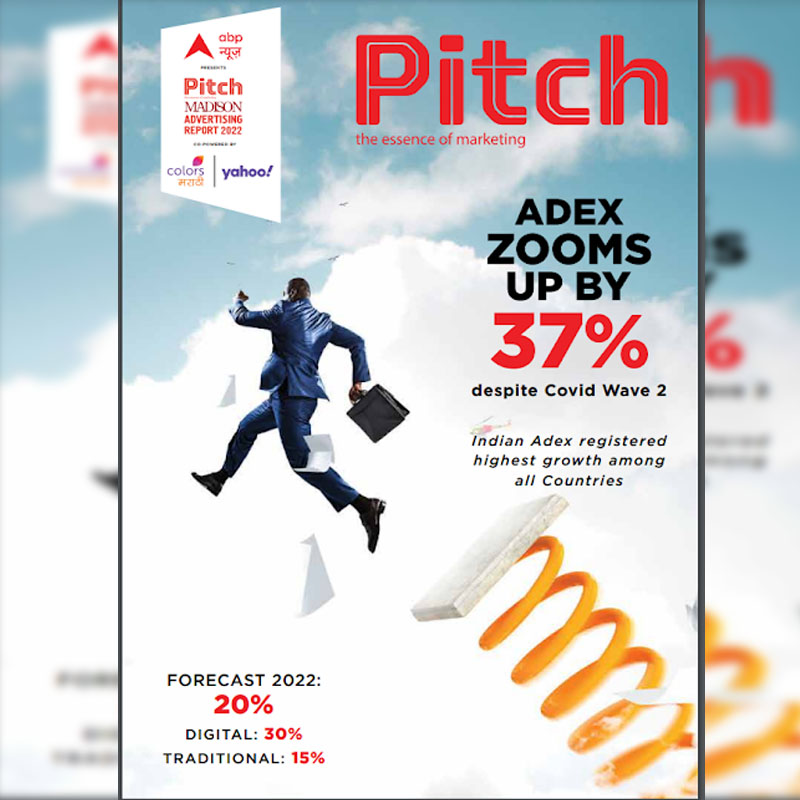
Mumbai: Despite the lingering impacts of the pandemic, advertising expenditure is set to surge by 20 per cent to reach nearly Rs. 90,000 crore, according to the Pitch Madison Advertising Report 2022 (PMAR) unveiled on Wednesday.
Launched by Pitch in partnership with Madison World, the report forecasted a robust recovery for the industry in 2022, with the traditional media, expected to grow at 15 per cent while digital to grow at 2X of traditional, and eventually overtaking Television in 2022.
According to the report, India will continue to be the fastest-growing ad market in the world. The Indian Adex registered an unprecedented 37 per cent growth rising to almost Rs 74,000 crore – the highest growth that Adex has registered in nearly the last two decades. The AdEx figures in 2021, according to the PMAR report, surpassed those in 2020 by Rs 20,000 crore and was over Rs 6,500 crore higher than 2019, bettering it by 10 per cent.
Television remained the only traditional medium that surpassed the pre-Covid revenues, recording a 25 per cent increase over 2020 and an 11 per cent increase over 2019. Print, the second-largest traditional medium registered a growth of 39 per cent in 2021, but could not cross its 2019 levels, having fallen short by as much as 17 per cent, as per the report. Similarly, OOH and Radio also grew significantly by 69 per cent and 36 per cent respectively, but were nowhere near the 2019 levels. Cinema, expectedly, was the only medium that could not even reach its 2020 level, with theatres shut across most states.
TV and Digital now contribute 72 per cent of overall Adex. Digital Adex rose significantly by 50 per cent to make up for the lower than average 10 per cent growth in 2020.
Madison World chairman and managing director Sam Balsara said advertisers should take advantage of the evolved digital infrastructure for distribution and advertising to prepare for future growth and invest in building their own D2C channels.
[[{“fid”:”1061749″,”view_mode”:”default”,”fields”:{“format”:”default”,”alignment”:””,”field_file_image_alt_text[und][0][value]”:false,”field_file_image_title_text[und][0][value]”:false},”link_text”:null,”type”:”media”,”field_deltas”:{“1”:{“format”:”default”,”alignment”:””,”field_file_image_alt_text[und][0][value]”:false,”field_file_image_title_text[und][0][value]”:false}},”attributes”:{“height”:763,”width”:700,”class”:”media-element file-default”,”data-delta”:”1″}}]]
Despite a large number of viewers moving to OTT and Connected TV, TV Adex put in a spectacular performance, registering a high spend of Rs. 28,151 crore. Advertisers’ faith in TV, Covid, or No-Covid continued and the medium commanded strong loyalty amongst both large and medium-size advertisers. In fact, with its 38 per cent share in 2021, India shared the credit of one of the top TV advertising countries along with Brazil (46 per cent), Italy (42 per cent) and Japan (34 per cent), as per the report.
Whilst Q1 started softly with a de-growth of minus six per cent over 2019, each subsequent quarter gained steam with TV Adex growing in size with Q4 of 2021 registering a sharp increase over respective quarters of 2019- thanks to IPL- which started in Q2 but got suspended and resumed in Q4.
Emerging categories : Ecommerce and ed-tech
Ecommerce ad spend almost doubled from Rs 3,000 crore to Rs 6,000 crore taking its share up from 8.5 per cent to 13 per cent and making it the second-biggest category of Adex, as per the PMAR report. Ed-tech sector also doubled its volume on the back of brands like Byju’s, WhiteHat Jr, Vedantu and Unacademy. BFSI also increased its share from two per cent to three percent on the back of new age Fintech Companies and CryptoCurrency players. For the first time in many years, BFSI showed a massive growth of 70 per cent in TV Adex, said the report. FMCG, the most dominant sector with a share of 51 per cent in 2020, lost as much as five percentage points and was down to 46 per cent. Ecommerce increased its share from 11 per cent to 18 per cent and Education from four per cent to six per cent. Telecom dropped its share substantially from eight per cent to four per cent.
[[{“fid”:”1061759″,”view_mode”:”default”,”fields”:{“format”:”default”,”alignment”:””,”field_file_image_alt_text[und][0][value]”:false,”field_file_image_title_text[und][0][value]”:false},”link_text”:null,”type”:”media”,”field_deltas”:{“2”:{“format”:”default”,”alignment”:””,”field_file_image_alt_text[und][0][value]”:false,”field_file_image_title_text[und][0][value]”:false}},”attributes”:{“height”:511,”width”:700,”class”:”media-element file-default”,”data-delta”:”2″}}]]
TV AdEx by genre
An analysis of ad volume beamed by various genres shows that all genres have grown significantly in 2021 versus a year ago with the exception of English movies which registered a de-growth for the second consecutive year. Hindi GEC continued to be the largest segment amongst all genres followed by Sports and then News, which came a distant third Sports genre on account of IPL, T20 WC and many bilateral cricketing tournaments across the globe, is 2nd in the pack in terms of absolute revenue. Despite the absence of Barc India ratings for the News genre, it registered a high growth of 19 per cent over 2019 and 29 per cent over 2020.
The Digital Juggernaut
The Digital Adex juggernaut moved ahead unabated, and grew by a phenomenal 50 per cent in 2021, taking Digital Adex to Rs. 25,438 crore. It even showed growth of 10 per cent in 2020, when all other mediums showed degrowth. Digital Adex has now reached a share of 34 per cent and is within striking distance of the largest medium TV. What helped Digital Adex grow, according to the report, is that it is firing on several verticals – Ecommerce, Search, Social and Video. With online sales galloping, the intense competition now has extended to online. Ecommerce advertising on brands such as Amazon and Flipkart have spiked. Traditional brands are also adopting Ecommerce and many of these brands in addition to using the E-commerce platforms are setting up their own online systems. D2C is expected to take off in a big way in the coming years.
[[{“fid”:”1061769″,”view_mode”:”default”,”fields”:{“format”:”default”,”alignment”:””,”field_file_image_alt_text[und][0][value]”:false,”field_file_image_title_text[und][0][value]”:false},”link_text”:null,”type”:”media”,”field_deltas”:{“3”:{“format”:”default”,”alignment”:””,”field_file_image_alt_text[und][0][value]”:false,”field_file_image_title_text[und][0][value]”:false}},”attributes”:{“height”:483,”width”:700,”class”:”media-element file-default”,”data-delta”:”3″}}]]
Top Advertisers in 2021
In keeping with the technology boom, 15 new-age Companies/start-ups entered the top 50 list, altering the composition of the list. These are Dream 11 at third position, BYJU’s at five, Phone Pe at 12, Upstox at 13, My 11 Circle at 14, and many others including CRED, Netmed, MPL, Policybazaar, Unacademy, WhiteHat Jr, Swiggy, Netflix, Coin Switch Kuber and Coin DCX, coming lower in the pecking order. The report shows as many as 14 new Advertisers in the list this year compared to ten last year. Six out of the top 10 are FMCG Advertisers, Hindustan Unilever, Reckitt, P&G, Reliance, Mondelez and ITC. FMCG still dominates the list with 15 players all with high ranks, but their dominance is decreasing.