
iWorld
From Taare Zameen Par to Thanda Matlab Coca-Cola, Prasoon Joshi on the power of lived experience
At FICCI Frames, the Prasar Bharati chairman explores ideas, experience and lasting storytelling


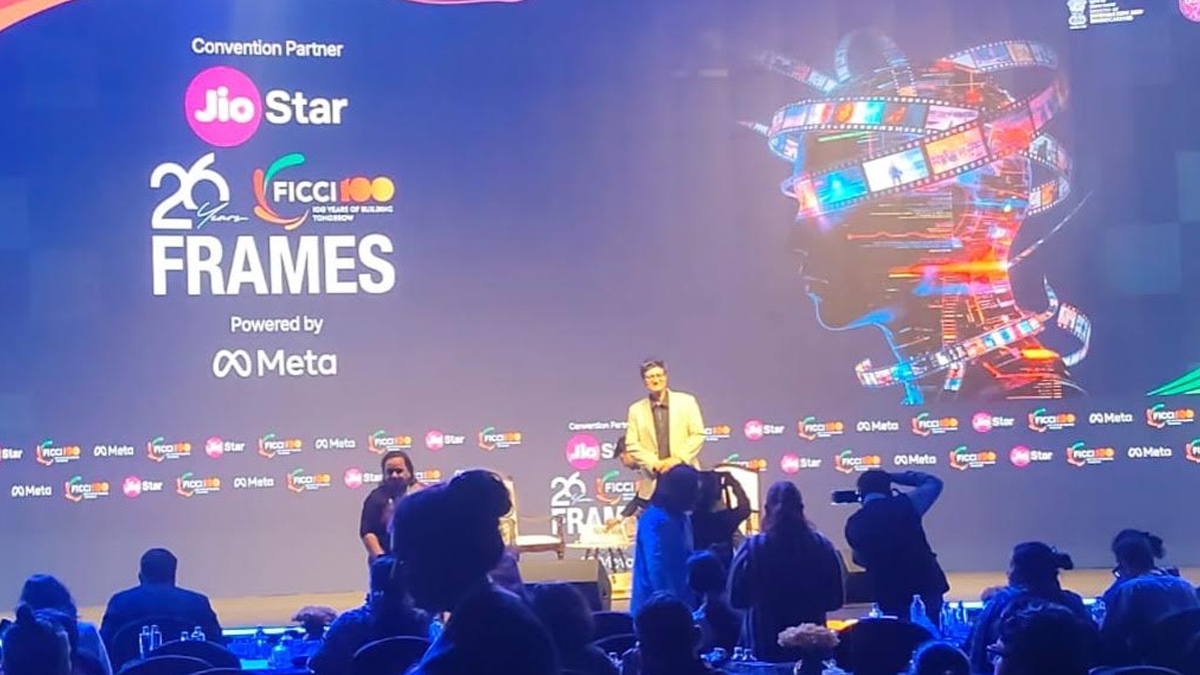
MUMBAI: In an age of infinite content, authenticity may be the one thing algorithms cannot manufacture.
That was the central thread running through a fireside chat featuring Prasoon Joshi at FICCI Frames 2026, where storytelling, personal experience, popular culture and the changing creator ecosystem came together in a discussion on what makes an idea travel and, more importantly, last.
Speaking with Mehak Kasbekar, Joshi explored how the same creative instinct can power advertising, cinema, music, poetry and everyday communication. At the heart of each, he argued, is storytelling.
From brand campaigns to films and songs, the idea is not simply to communicate a message but to turn it into a narrative that people can recognise, remember and eventually make part of their own lives.
The conversation examined why some lines, songs and campaigns move beyond being pieces of communication and become part of everyday language.
Examples such as Dettol campaigns, Fevikwik advertising and “Thanda Matlab Coca-Cola” have demonstrated how a well-observed idea can enter popular culture. The difference, the discussion suggested, lies in the ability to make communication feel lived rather than manufactured.
Authenticity emerged as the crucial link.
Joshi’s creative philosophy is closely tied to what he described as “experienced truth”, or drawing from emotions and situations that have been personally felt. The approach was illustrated through his work on Taare Zameen Par.
The emotional foundation behind songs such as “Maa” and “Bum Bum Bole” was connected to memories from childhood and experiences with his own daughter. Rather than treating a songwriting brief as a generic exercise, the creative process involved finding a real emotional reference point.
That experience, in turn, helped transform an individual memory into something that could resonate with children and parents much more broadly.
The same principle applied to his work around the life of athlete Milkha Singh. Rather than approaching the subject simply as a sports story, the creative lens focused on struggle, perseverance and the way obstacles shape people. The broader emotional experience became the bridge between a specific life story and a wider audience.
The discussion also turned to the role of childhood, geography and environment in shaping a creative voice.
Joshi’s upbringing in a small town in Uttarakhand, surrounded by nature, reading and long periods of observation, became an important source of imagery and sensibility.
Nature, he suggested, often enters creative thinking subconsciously. Experiences do not necessarily reveal their influence immediately, but can surface years later in the way a person writes, observes or understands characters.
Growing up around rivers, hills and communities also provided a different understanding of struggle and trust. Physical challenges in a natural environment can offer a more direct relationship with difficulty, while community life can build an instinct for mutual dependence.
Those early experiences have continued to appear in Joshi’s writing, including recurring imagery around sunlight and nature in his poetry and books.
Another major theme was the changing relationship between language, identity and popular culture.
Earlier generations of creators could feel pressure to hide regional accents, native languages or vocabulary that appeared too scholarly or local. The current creator ecosystem is increasingly comfortable embracing those identities.
Social media has played a significant role in this democratisation. Creators from different parts of India can now publish directly, speak in their own languages and build communities without necessarily passing through traditional cultural gatekeepers.
The shift is not simply about giving more people a platform. It is also changing what audiences are comfortable consuming.
Regional language, accents and local experiences can now become strengths rather than limitations. The result is a more participative culture in which the distinction between performer and audience is becoming less rigid.
This connects with the older traditions of Indian folk culture, where music and performance were often collective activities rather than experiences divided neatly between a performer and a passive audience.
The discussion then moved to one of the biggest questions facing today’s media industry: how can an idea survive when audiences are surrounded by an endless stream of content?
The answer offered was not necessarily greater complexity or more technical sophistication. Instead, lasting work comes from the purity of the idea and the honesty with which it is expressed.
The conversation used Rang De Basanti and its music as examples of work that continued to find audiences long after its initial release.
Songs such as “Luka Chuppi” did not necessarily arrive as instant cultural phenomena. Their impact grew over time, demonstrating how some ideas can have a slower trajectory before becoming deeply embedded in popular memory.
“O Rangrez” was another example of a song whose appeal developed gradually. The idea of a song being cooked on a low flame became a useful metaphor for creative work that does not need to chase immediate impact to have lasting value.
The broader discussion positioned authenticity as an increasingly important counterweight to algorithm-driven content creation.
Data can identify patterns, audiences and consumption behaviour, but lived experience can provide the emotional detail that makes a story feel human. The challenge for creators is therefore not simply to produce more content, but to bring something personal and recognisable into an increasingly crowded environment.
That principle extends from advertising to cinema, music, literature and digital content. A campaign can be built around a brand, a film around a character and a song around an emotion, but the underlying connection comes from whether audiences can see some part of themselves in the idea.
As content continues to multiply across platforms, the discussion suggested that the ideas most capable of enduring may not necessarily be the loudest or fastest-moving. They are the ones that begin with something real, carry the texture of lived experience and leave enough emotional space for audiences to make them their own.






