
Television
Twenty-eight years of indiantelevision.com: It’s been quite a journey
The channels multiplied. The screens moved. The money followed. A look back at how far we have come, and a plain word about where this is all headed.


MUMBAI: Twenty-eight years. For many that is a long time. For me it feels like yesterday.
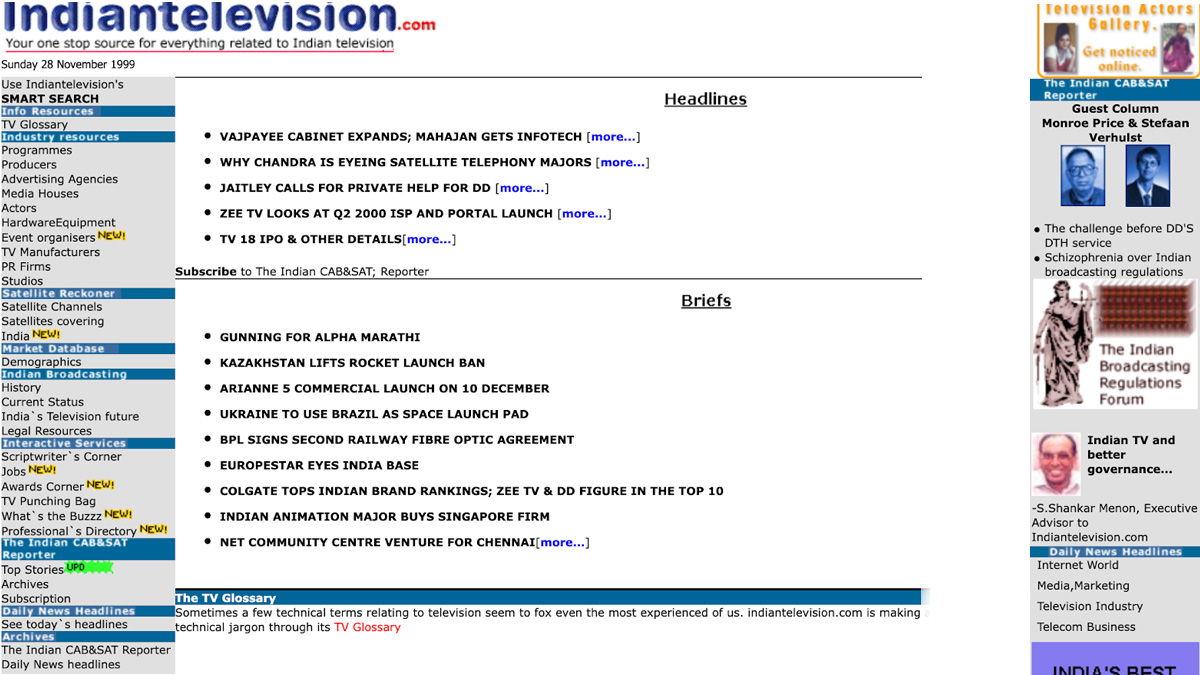
I can still see the screen. It started as an email newsletter, The Indian Cab&Sat Reporter, in 1998. I used to post it on a forum site under the brand name Ambez Media. That was where it began.
Then a developer, Amit Shah, and his team came on board and stood beside me as we hand-coded the home page of indiantelevision.com in plain HTML. There were a handful of satellite channels then. And tens of thousands of cable TV operators. The channels multiplied. The competition turned fierce. Production houses popped up like wild flowers in spring. While the newsletter from which the site originated started in September 1998 and the website indiantelevision.com emerged shortly thereafter as part of a soft launch, it was officially launched at the hands of Zee TV boss Subhash Cahndra in early 2000.
The world has changed since. Faster than any of us thought it would. Faster than anyone can imagine even now.
Take television. It started analogue. Then it turned digital. Somewhere along the way it missed the addressability bus. Today it lives on in free TV, in smart and connected TVs with FAST channels, on streamers who have bundled themselves together and sit side by side on a single platform.
The screen itself has moved. A large young audience now watches on the mobile, the laptop, the desktop, the tablet. The same legacy channels are there. So are the micro and vertical dramas on their specialised platforms. So are the long-format series and the movies on Netflix, ZEE5, SonyLIV, Prime Video, JioHotstar, HoiChoi.
It is a vibrant spread. Something for everyone, on every platform.
But follow the money. It tells the truth before anyone else does. Advertising left television for digital a while ago and has not looked back. The thirty-second spot that once ran this whole industry now fights for scraps against a young person with a phone and a ring light. That is not a small shift. That is the ground moving under our feet.
And the giants have stopped fighting and started marrying. Two of the biggest stables in the country folded into one house that now towers over the rest, hundreds of channels, a streaming platform, and the cricket, all under a single roof. When elephants marry, the grass has to decide what it will do next. It is the mid-sized broadcaster, caught between the giant above and the creator below, who should be losing sleep.
Here is the warning. Take great care not to look the same. Do not keep offering more of the same.
The streamers risk walking into the very trap legacy television built for itself. Repackaging one another. Lifting a Chinese show, a European one, a South Korean one. A tweak here, a tweak there, and calling it new.
What will set one streamer apart from another, one vertical drama platform from the next, is how it tells its stories. Especially now, when production money is turning scarce. The customer is god. Goddess. King. Queen. Monarch. Every other name you can give her or him.
And that customer, more and more, does not speak English. She never really did. She is watching in Tamil, Telugu, Bhojpuri, Marathi, Bangla, Punjabi, Kannada. The next hundred million viewers will arrive in their own tongue, not ours. The smart money has already worked this out and is making shows in the language of the street, not the language of the boardroom.
Bharat was never a market to be added later in a strategy deck. It was always the market.
The biggest studio in the country today may well be a young person in a bedroom in a small town. No commissioning editor. No pilot. No committee of ten deciding what the nation should watch. Just a camera, an idea, and an audience that turned up overnight. Legacy media still calls them influencers, as though it were a passing season. It is not a season. It is the competition, and it works cheaper and faster than any of us.
Through all of it, we still cannot agree on how to count. Who watched what, on which screen, for how long. Television has a currency many distrust. Digital throws up numbers nobody can fully audit. Whoever cracks measurement, honestly, across every screen a person owns, will hold the most valuable thing in this business. You cannot sell what you cannot count.
Pricing needs the same care. Because one monster is always in the room. YouTube. It offers the viewer everything. At no cost. All you have to tolerate are those irritating, repeated ads, dropped in at the worst moment, just when a scene has you in its grip.
One thing still pulls the whole country into the same place at the same moment. Cricket. It is the last great mass gathering we have, and everyone in the trade knows it, which is why the rights now cost what a small country spends in a year. But even cricket is watched free on a phone today. The old comfort, that live sport alone would keep the cable connection alive in the home, is gone.
And now the machine has walked into the edit suite. AI writes, it dubs, it subtitles, and soon it will build the scene itself. A show shot in one language will reach twenty by evening, the lips moving in time, the voice a fair copy of the star’s own. It will bring cost down. It will also raise a hard question none of us has begun to answer honestly, who made this, and who gets paid for it.
The viewer, meanwhile, is tired. Tired of paying for ten apps to watch three shows. Bundling was meant to be the cure, until the bundle grew as fat and as confusing as the old cable package it was built to replace. We have travelled a full circle and landed almost where we started. Only the picture is sharper now.
We at indiantelevision.com have been recording all of it. The big shifts and the small ones. The cable operator turning into an internet service provider. Their numbers shrinking as they change shape.
We will keep doing it for as long as we can, and for as long as the industry walks with us.
No one can tell you what television will become next. Holographic? 3D? Projection that throws a picture onto any surface from a device strapped to your wrist? Or a device you fix to your temple that sends the visuals straight into the seeing part of your brain, no strain on the eyes at all? My guess is as good as yours.
A big thank you to everyone who has written in to congratulate us on twenty-eight years, on our LinkedIn page and on mine.
Let me ask for one thing in return. Keep the wishes coming. Keep reading indiantelevision.com, and our two-year-old baby, indianmedia.biz. And get ready to send many more when we cross fifty.
Amen.






