GECs
Alok Jain says unscripted content is becoming India’s cultural engine
JioStar executive cites 40 plus shows, 17 upcoming titles and 460 billion minutes watched


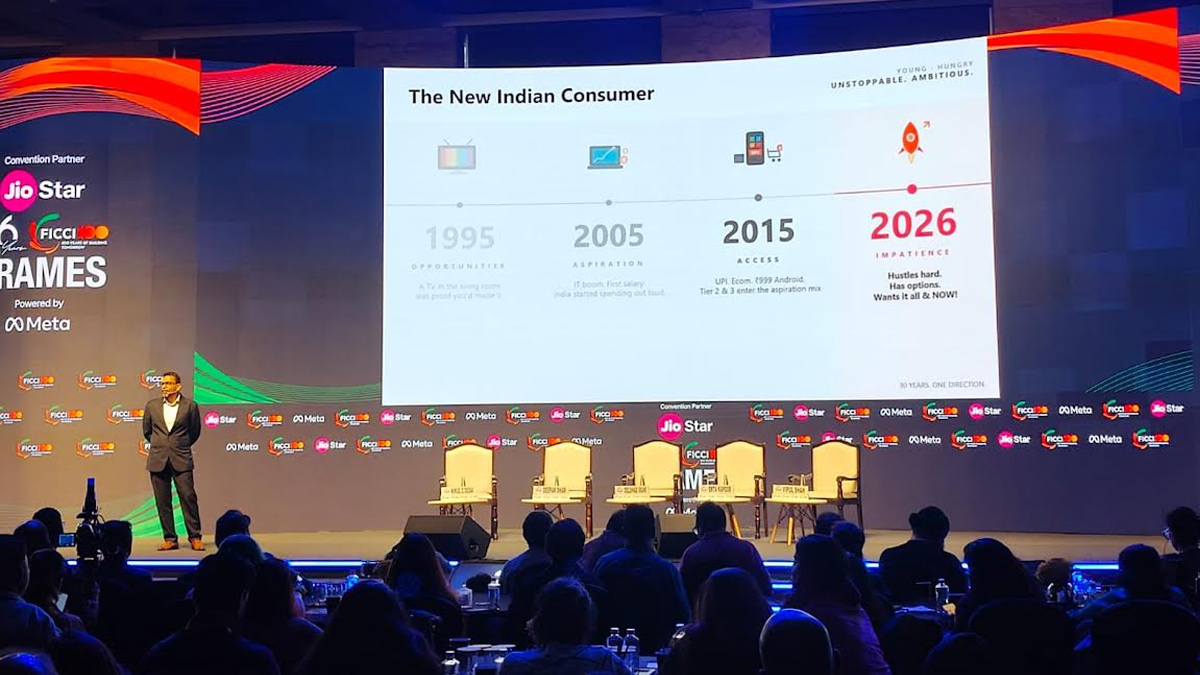
MUMBAI: Scripted or unscripted, the plot is thickening and India’s reality entertainment business is increasingly writing its own rules. At FICCI FRAMES 2026, Alok Jain, Head – Hindi & English Entertainment Business (Streaming, TV and Studios), JioStar, described unscripted content as a powerful engine for cultural moments, audience engagement, talent discovery and brand growth.
Speaking at the industry forum themed ‘India’s Media Moment: Creating Value in an Age of Infinite Content’, Jain traced the rapid evolution of the Indian consumer and argued that unscripted entertainment is particularly well suited to an audience that is young, ambitious, digitally connected and increasingly impatient for immediate entertainment.
For Jain, the appeal of unscripted programming lies in its ability to turn unexpected moments into conversations that stretch well beyond the screen. He pointed to the recent example of Bigg Boss Season 20, where an episode involving host Salman Khan became a wider cultural talking point, drawing attention from the entertainment industry as well as brands such as Blinkit.
The example, he suggested, illustrates the distinctive power of reality programming: a moment that happens inside a show can quickly become a conversation across social media, entertainment, advertising and popular culture. In that sense, the programme does not simply deliver content; it creates moments that other parts of the ecosystem can build around.
Jain placed the rise of unscripted content against a much longer transformation in Indian consumer behaviour. He traced the journey from the post-1995 period, when economic liberalisation was opening up new opportunities, through the IT boom and the growth of aspiration, followed by the digital revolution and its acceleration during Covid-19.
By 2026, he said, the Indian consumer has become significantly more connected and demanding, particularly among younger audiences. The combination of ambition, digital access and a desire for immediate experiences has created fertile ground for formats that are unpredictable and participatory.
Unscripted programming fits naturally into that environment because its outcome cannot be completely predetermined. While makers can establish the format, participants, challenges and broad structure, the actual interactions and reactions remain uncertain.
That unpredictability works on both sides of the screen. For audiences, it creates suspense because they do not know what will happen next; for creators, it means the raw material can constantly produce unexpected moments that can reshape an episode or even a show’s wider cultural impact.
Jain identified three characteristics that make unscripted programming particularly compelling: it is bold, unpredictable and authentic. The format allows creators to push the boundaries of audience engagement while keeping real personalities and their reactions at the centre.
Unlike scripted entertainment, where the outcome is determined before production, unscripted programming has an element of uncertainty built into its DNA. Even the makers may not know which interaction, conflict, friendship or emotional moment will eventually become the defining part of a show.
That uncertainty is increasingly valuable in a media environment where audiences can access an enormous volume of professionally produced and user-generated content. When viewers have seen familiar storytelling patterns repeatedly, the possibility of witnessing something genuinely unexpected can become a powerful hook.
The category is also expanding beyond conventional reality formats. Jain noted that unscripted programming is now exploring emotions and themes including love, drama, conversation, adventure, music and strategy, creating a much wider entertainment universe around the format.
The expansion is visible in the sheer volume of programming entering the market. Jain said more than 40 unscripted shows had been released across television and digital platforms over the previous year, while another 17 shows were already lined up for the following three to four months.
That pipeline indicates how quickly broadcasters and streaming platforms are increasing their bets on the category. It also suggests that unscripted programming is no longer being treated as a narrow segment of television, but as a cross-platform entertainment business with multiple formats and audience propositions.
The growing number of shows also creates space for experimentation. Different formats can target different emotions, age groups and communities, while successful ideas can potentially develop into recurring franchises.
For the industry, that creates a programming flywheel where one successful format can generate not only another season, but also talent, creators, brand partnerships and new production opportunities.
Jain described unscripted entertainment as an ecosystem that begins with talent but does not end with the person appearing in front of the camera. Reality shows can provide a launchpad for people at the beginning of their careers, while also giving established celebrities opportunities to expand their visibility.
The effect can work across different levels of fame. An ordinary participant can become a celebrity, an emerging personality can become more established and an existing star can gain another layer of audience engagement.
That talent pipeline has become one of the category’s most visible contributions to the wider entertainment business. Over the years, reality formats have provided a recurring mechanism through which new personalities can enter the mainstream.
But the talent ecosystem also extends behind the camera, with writers, producers, directors, format developers and production teams benefiting from the growing volume of unscripted programming.
The creator economy represents another layer of the flywheel.
Jain pointed out that a show producing five hours of primary content can generate opportunities for around 20 hours of additional content around it. That could include creator-led commentary, reactions, short-form videos, social conversations and other forms of audience-driven material.
This expands the commercial and creative life of a programme beyond its scheduled broadcast or streaming episode. Creators can take moments from a show and reinterpret them for their own audiences, while the programme itself benefits from additional visibility and conversation.
The relationship can become mutually reinforcing. A popular show creates more material for creators, creators create more conversations around the show, and those conversations can bring more viewers back to the original programme.
Jain also highlighted fandom as a key component of the unscripted economy.
The response to auditions for Roadies, he said, demonstrated the strength of the fan communities that can build around long-running reality properties. Audiences do not simply watch these shows; they can develop strong attachments to their formats, participants and recurring personalities.
That loyalty becomes particularly valuable when a show returns with a new season or launches a new format. A strong existing fan base can provide an initial audience while giving producers a platform from which to experiment.
Fandom can also help brands. Shows with strong communities create environments in which advertisers can associate themselves with moments, personalities and conversations that already have audience attention.
The commercial opportunity is another major part of the unscripted growth story.
Jain said more than 1,000 brands had participated in JioStar’s shows over the past decade, using the programming environment to build and scale their brands. The appeal comes from the combination of mass reach, recurring audience engagement and the ability to integrate brands into entertainment that people are actively following.
The evolution of reality programming therefore has consequences beyond television ratings or streaming views. It creates an advertising ecosystem in which brands can participate in cultural conversations rather than simply placing conventional spots around content.
When a moment from a reality show becomes a talking point, advertisers can potentially enter that conversation in real time. The Bigg Boss Season 20 example cited by Jain, involving Blinkit, illustrated how quickly brands can move into culturally relevant entertainment moments.
For JioStar, the scale of the opportunity is particularly significant.
Jain said JioStar’s Hindi entertainment business reaches around 1 billion people every year, equivalent to roughly two-thirds of India’s population of around 1.5 billion. That reach extends across television, digital and connected TV, creating multiple touchpoints through which the company can engage audiences.
The company also records around 460 billion minutes of watch time, according to figures shared by Jain. That scale is powered by a combination of home-grown formats and global franchises that have continued to develop year after year.
The figures underline why unscripted programming has become strategically important. At mass scale, even a small shift in audience attention can create significant opportunities for content, talent, advertising and platform engagement.
The next ambition, however, is not simply to make more shows for the Indian market.
Jain said the opportunity ahead is to take unscripted entertainment deeper and wider across India while also taking Indian formats and content to global audiences. The longer-term vision is for programming that is made in India but designed to travel beyond India.
That ambition puts Indian formats into a much larger competitive arena. If the country can develop distinctive unscripted concepts with strong emotional hooks and flexible formats, they could potentially be adapted or exported for audiences in other markets.
It also changes the way success can be measured. A format’s value may no longer lie solely in its domestic audience, but in the talent, intellectual property, creator ecosystem, brand opportunities and international potential it can generate.
Jain’s FICCI FRAMES address ultimately positioned unscripted entertainment as more than a television genre. It is increasingly a meeting point for audiences, talent, creators, brands, platforms and cultural conversations.
Its greatest advantage may be the thing that makes it hardest to control: nobody knows exactly what will happen next. In an industry overflowing with content, that element of surprise can turn a programme into a moment, a moment into a conversation and a conversation into a cultural phenomenon.
With more than 40 shows already released in the past year, 17 more lined up over the next three to four months, around 1 billion annual Hindi-market viewers, 460 billion minutes of watch time and more than 1,000 brands participating over a decade, the numbers suggest that India’s unscripted business is no longer waiting for its big break.
The next challenge is to take that engine beyond scale and turn India’s unpredictable reality into globally exportable entertainment.