iWorld
ZEE5 goes global with competitive rates

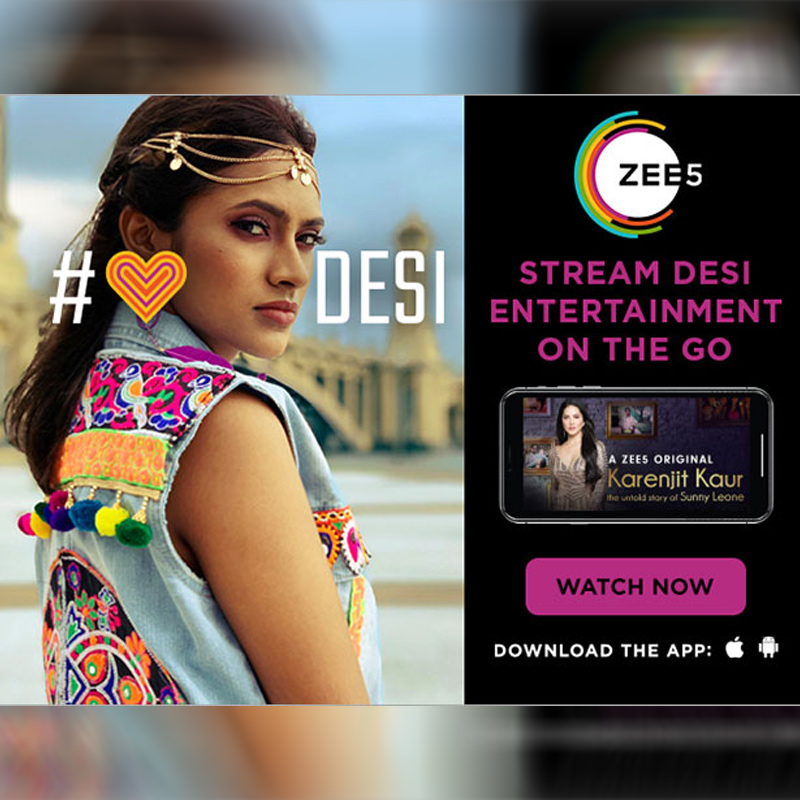
MUMBAI: If everyone else is coming here, we're going there, said Zee. Within less than a year of launch in India, Zee Entertainment Enterprise Ltd's (ZEEL) digital arm ZEE5 has gone global. In the first leg of the international rollout, the OTT platform has launched a global campaign recently targeting South Asian audience across the world. Talking about the global launch, ZEE5 global chief business officer Archana Anand said it has priced the subscription rates very competitively.
The TVC of ‘Dil se Desi’, crafted in collaboration with Publicis has a very funky feeling where rap has been used as the medium. While ZEE has been traditionally looking at slightly older audiences, the new campaign intends to attract younger audiences conveying the message that ZEE5 as a global platform aspires to have content for all these audiences.
“Apni Bhasa Me Feel Hain was also to say that new age Indians are savvy, millennial, use digital and speak English, but when we speak we like to use references from our language. We want to watch content in our language and we love it. Now, in Dil Se Desi it is taking that context globally saying that the South Asian audience which loves our content lives across the globe and all of them may have advanced and in first world countries. Technology, globalisation all of that happened but their heart is Dil se Desi,” Anand commented.
The TVC part of it is playing across the ZEEL network globally and right now it isn't going to third parties for inventories. The first phase of the launch is targeted to APAC, MENA and Africa. Later, the markets where connected devices got ready including Europe, Canada and the Caribbean will be targeted. While the short term goal is to become the entertainment destination for south Asian audience immediately, the long term goal is to position the platform as a top entertainment destination going beyond south Asians.
The new campaign took around five to six months to be rolled out. It worked closely with Publicis, the creative partner in the mandate. There was a rigorous pitching process where multiple agencies took part. BBH and Publicis were neck-to-neck. Interestingly, BBH won the mandate for the Indian campaign earlier.
“When I created the strategy for India, I wanted say that the new trend is languages, regional and masses. That was my co-proposition for India. For the global creative, I did not want to go too far from that co-thought. It had to be an extension,” Anand commented.
Going forward, plans are on for two TVCs for Pakistani and Bangladeshi audiences particularly.
Other than the TVC, the campaign has its counterparts in digital and social media also. The #lovedesi has already gone viral across social media. As the out-of-home marketing will not be very effective abroad as the target audience lives in pockets, there will be a lot of on-ground activity.
Just like Airtel in India, there are global telecom partners as well.
While there are several Indian OTT platforms that are already targeting diaspora audience, especially in the presence of international giants like Netflix, Amazon Prime, ZEE5 is confident to make a difference on the back of its language content. Anand said though many other platforms are also boasting about having content in several languages, ZEE5’s boast is very real owing to its depth.
Anand who has been learning quite a lot in the space, thinks that the final call in content creation should be taken based on gut instinct and data both. According to her, before going into any new market, everyone has to invest a lot in research to understand consumer sights and find a need gap.
While the subscription rates are very different across the globe, even in APAC itself, in every market it has taken account of competition rates, pay TV costs and priced it competitively. Though targeting a large crowd spread across various locations is not easy, Anand seems confident about her strategy.






