iWorld
Netflix’s binge scale reveals TV series to devour and savor upon


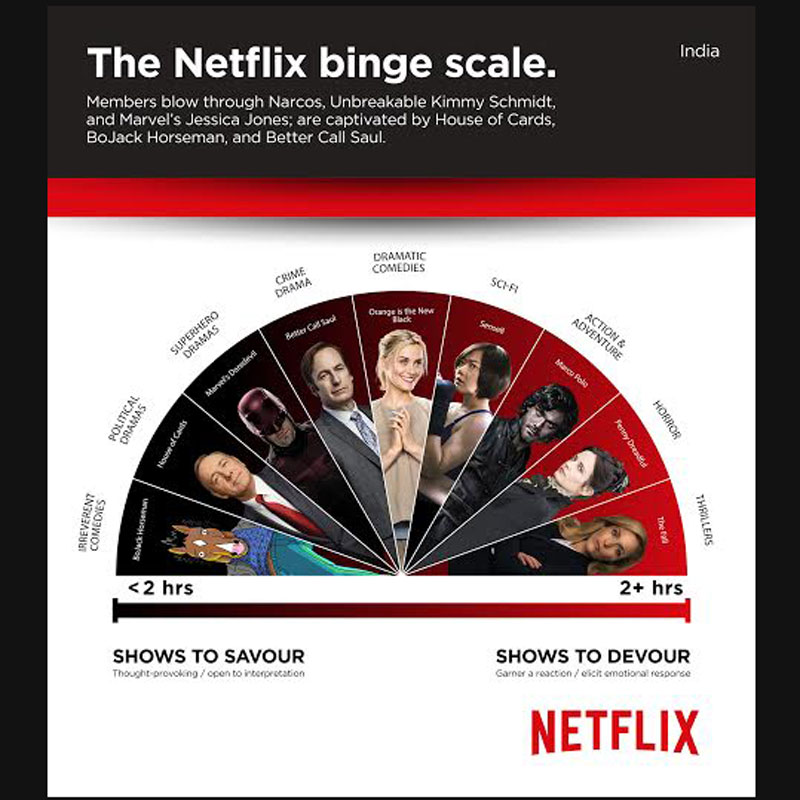
MUMBAI: Netflix members around the world are making their own rules when it comes to watching TV. Instead of one episode per week, Netflix members choose to binge watch their way through a series. Though binge watching is clearly the new normal, not all series are enjoyed the same way. Netflix has unveiled The Binge Scale, revealing which shows they devour and which they savor.
Netflix examined global viewing of more than 100 serialized TV series across more than 190 countries and found when members are focused on finishing a series, they watch a little over two hours a day to complete a season. When organizing series in relation to this benchmark, interesting patterns emerge, ranging from high energy narratives that are devoured to thought-provoking dramas that are savored.
Series like Sense8, Orphan Black and The 100 grab you, assault your senses, and as The Binge Scale shows, make it hard to pull away. The classic elements of horror and thrillers go straight for the gut, pushing the placement of series like The Walking Dead, American Horror Storyand The Fall towards the devour end of the scale. Likewise, comedies with a dramatic bent, like Orange is the New Black, Nurse Jackie andGrace and Frankie, seem to tickle our fancy and make it easy to say ‘just one more.’
It’s no surprise that complex narratives, like that of House of Cards and Bloodline, are indulged at an unhurried pace. Nor that viewers take care to appreciate the details of dramas set in bygone eras, like Peaky Blinders and Mad Men. Maybe less obvious are irreverent comedies like BoJack Horseman, Love and Unbreakable Kimmy Schmidt. But the societal commentary that powers their densely layered comedy paired with characters that are as flawed as they are entertaining allow them to be savored.
“As The Binge Scale indicates, the viewing experience of a series can range from the emotional to the thought-provoking,” said Netflix VP of original content Cindy Holland. “Netflix helps you to find a series to binge no matter your mood or occasion, and the freedom to watch that series at your own pace – whether that’s to appreciate the drama of Bloodline or power through Orange is the New Black.”
The Netflix Binge Scale based on global viewing data by the platform
SAVOR
|
Irreverent Comedies |
Political Dramas |
Superhero Dramas |
Crime Dramas |
Historical Dramas |
|---|---|---|---|---|
|
· Arrested Development · BoJack Horseman · Club de Cuervos · F is for Family · Love · Summer Heights High · Unbreakable Kimmy Schmidt · Wet Hot American Summer |
· House of Cards · Homeland · Occupied · The Good Wife · The West Wing |
· Marvel’s Daredevil · Gotham · Marvel’s Jessica Jones · The Flash |
· Better Call Saul · Bloodline · Fargo · The Blacklist · The Bridge · Twin Peaks |
· Mad Men · Narcos · Peaky Blinder · The Americans |
DEVOUR
|
Dramatic Comedies |
Sci-Fi |
Action & Adventure |
Horror |
Thrillers |
|---|---|---|---|---|
|
· Orange is the New Black · Flaked · Grace & Frankie · Weeds |
· Sense8 · Between · Under the Dome · The 100 · Ascension · Heroes · Orphan Black · The 100 · The 4400 |
· Marco Polo · Arrow · 24 · La Reina del Sur · Marco Polo · Outlander · Prison Break · The Last Kingdom · Turn · Vikings |
· Scream · Penny Dreadful · American Horror Story · Hemlock Grove · The Walking Dead · Z Nation |
· Dexter · Bates Motel · Breaking Bad · The Fall · Sons of Anarchy · The Fall · The Following · The Killing |