iWorld
Nagarjuna launches season two of Krish, Trish and Baltiboy: Bharat Hain Hum, at IFFI Goa


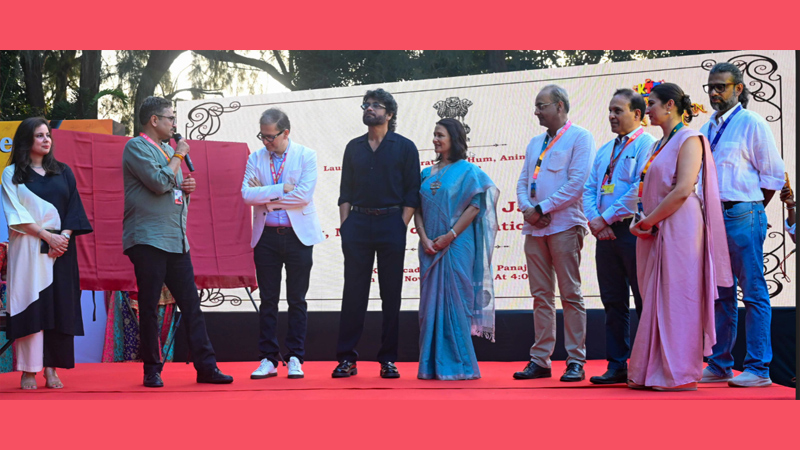
Mumbai— The Ministry of Information and Broadcasting launched the second season of the celebrated animated series Krish, Trish, and Baltiboy: Bharat Hain Hum at the ongoing International Film Festival of India (IFFI) Goa.
Nagarjuna graced the event along with Information & Broadcasting secretary Sanjay Jaju; Prasar Bharati CEO Gaurav Dwiwedi; CBC, DG, Yogesh Baweja; Graphiti Studios creators Munjal Shroff and Tilak Shetty ; Prime Video, India director & head – SVOD, Shilangi Mukherji and Netflix India director of public policy Mahima Kaul.
The groundbreaking animated series, which celebrates India’s lesser-known freedom fighters, made history with its season one debut across multiple platforms.
Season two of the animation series, like season one, will premiere simultaneously across Doordarshan, Prime Video, and Netflix.
The series will be available in 12 Indian languages—including Hindi, Tamil, Telugu, Kannada, Malayalam, Punjabi, Marathi, Gujarati, Bengali, Assamese, and Odia—and seven international languages – French, German, Spanish, Russian, Korean, Chinese and Arabic making it accessible to a global audience in 150 countries, further amplifying its reach.
Season two continues the mission to highlight unsung heroes from all across the country, including Taji Dele and Ponge Dele from Arunachal Pradesh, Wazir Ram Singh Pathania from Himachal Pradesh, and Birsa Munda from Jharkhand, among others.
These stories are meant to inspire pride in India’s history while celebrating the diversity and resilience of the country’s freedom fighters.
The secretary highlighted the importance of such initiatives in nurturing national pride among India’s young generation.
“The diversity of India’s freedom struggle needs to be communicated in ways that appeal to children. By using animation, we’re making these rich histories not only accessible but also engaging. Through these animated stories, we’re offering young minds a chance to learn about the unsung heroes who played pivotal roles in shaping India’s destiny,” Jaju said.
“We are delighted to launch a new season of Krish, Trish and Baltiboy: Bharat Hain Hum on Prime Video starting 1st December. The series beautifully highlights the invaluable contribution of several heroes who played a significate part in India’s freedom struggle, giving viewers in India and around the world a chance to learn more about our rich history,” said Mukherji. “We would like to congratulate the Ministry of Information and Broadcasting (MIB), Central Bureau of Communication, and Graphiti Studios for producing this wonderful series. The series is a significant step in our efforts to foster the growth of India’s creative economy and give Indian stories a global showcase. We are confident that the new season will be as well-received by our viewers as the first season.”
“I have grown up watching a lot of mythology, and stories of Shri Ram, Lakshman, Bharat, Arjun, but stories on our freedom fighters who sacrificed their lives for our country is equally important. With the new show Bharat Hai Hum, the children and the next generation will get to know about our heroes,” said Nagarjuna.
Munjal Shroff and Tilak Shetty, the series’ creators, added, “The stories of India’s unsung heroes have often been overshadowed, but through this series, we aim to ensure that their contributions are remembered and celebrated by the younger generation. It’s not just a story of the past; it’s a lesson for today’s youth to understand the values of courage, resilience, and patriotism.”
The creators employed nearly 1,000 professionals across India, including animators, voice artists, and production experts, in order to meet an ambitious timeline and deliver the series in record time.
Krish, Trish, and Baltiboy: Bharat Hain Hum will also be available in an innovative format: a radio series and a podcast. The Krish, Trish and Baltiboy– Bharat Hain Hum Radio Series will premiere on 1 December on All India Radio (AIR), broadcasting in 12 languages across India. Each episode will be heard at 10:30 AM on Sundays, just 15 minutes before the animation series airs on Doordarshan at 11 AM. The radio show will promote the animated series, creating a seamless cross-platform transition that will help maximize the show’s audience. The unique scheduling strategy promises to offer a significant push for the animation series, ensuring that the young and diverse audience can transition from radio to television effortlessly.
Additionally, a podcast will be available worldwide on Spotify in 180 countries. This podcast will feature episodes from the series, while also encouraging listeners to watch the animated show on Prime Video, Netflix, Waves and Doordarshan amplifying the reach of this cross-platform distribution strategy.