eNews
India’s micro-drama boom is rewriting the OTT playbook

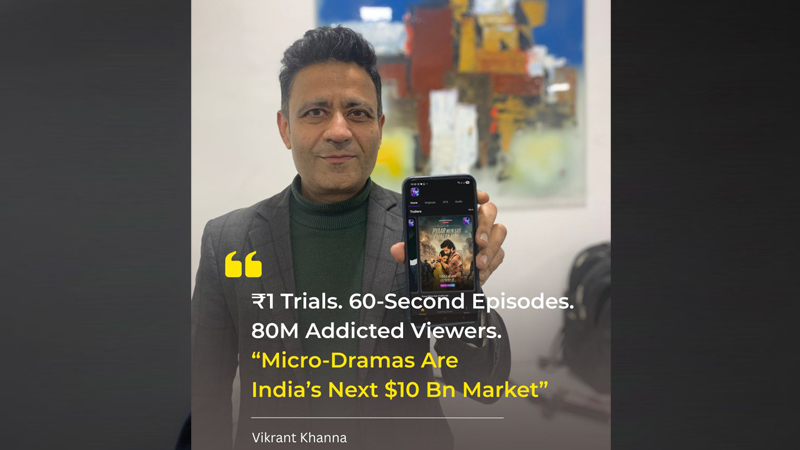
DELHI: At 1 AM, 23-year-old Priya Sharma is glued to her phone, bingeing a revenge thriller in 90-second episodes. She is far from alone. Over 80 million Indians are now hooked on micro-dramas, bite-sized, mobile-first narratives that are turning India’s OTT industry on its head.
Vikrant Khanna, founder and CEO of Mogi I/O, calls it India’s latest entertainment gold rush. In a LinkedIn post, Khanna wrote that a Re 1 trial can quickly turn into Re 300-plus monthly spends, and that the biggest battle for attention is no longer on TV screens but in the palm of the hand.
The market is crowded and fiercely competitive. More than ten platforms are vying for viewers, each with a different strategy. Some are chasing volume, Netflix-style. Others are going cinematic, HBO-style. A few are spending twice the traditional TV budgets on vertical-first content. Talent is following the money, with TV stars and Bollywood actors increasingly headlining micro-dramas, drawn by creative freedom and strong paychecks.
Pricing psychology is driving engagement. Platforms charge Re 1 for a seven-day trial, leveraging cliffhangers, emotional hooks and multiple storylines to convert casual viewers into paying subscribers. Many users come for a single show and stay for months.
China’s micro-drama market offers a blueprint, growing from $500 million in 2021 to $9 billion in 2025. India has the advantage of a larger population, mobile-first behaviour and a deep daily-soap culture. Tier 2 and Tier 3 cities are expected to fuel the next phase of growth.
Content itself is evolving. While early micro-dramas focused on romance, family drama and revenge, high-octane action is now moving vertical, with large casts, real stunts and cinematic ambition. Episodes remain under 60 seconds, dropped daily, but series span 30–45 minutes cumulatively — a new kind of daily soap designed for habit, not appointment viewing.
Khanna stresses that micro-dramas are more than a trend. They are a business model shift — built for mobile, monetised through emotion rather than subscriptions, and increasingly powered by AI and data. For viewers like Priya in Lucknow, scrolling at 1 AM is already normal. For creators, investors and platforms, the micro-drama moment is only just beginning.
Vikrant Khanna is a seasoned P&L leader and entrepreneur with rich experience across FMCG, telecom, virtual retail and Internet businesses. He founded Mogi I/O, a B2B video-tech venture that compresses video size by up to 50 per cent while streaming buffer-free, high-quality content. Mogi leverages these IPs to provide no-code video apps across mobile, web and TV, helping OTTs, broadcasters, publishers and edtech platforms monetise content efficiently.
Before Mogi, Khanna launched BoomAGift, a gifting-on-the-go app for low-ticket items, which has since pivoted into Mogi. He also held leadership roles at Homeshop18 as COO and at Bharti Airtel, where he led youth marketing campaigns, digital strategy and the sponsorship of India’s first Formula 1 Grand Prix.
India’s OTT future, Khanna says, may no longer be written in hours. It could be written in 60-second episodes.