I&B Ministry
I&B Secretary Sanjay Jaju calls for AI-led entertainment growth at CII Big Picture Summit

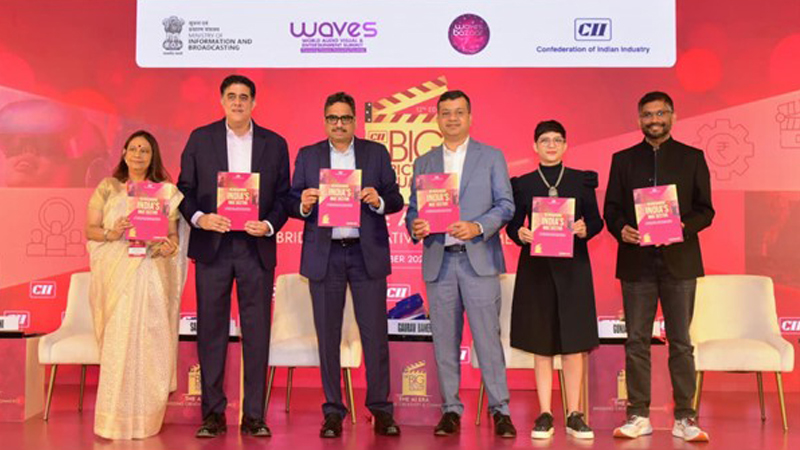
MUMBAI: Artificial intelligence is barging into India’s media and entertainment business, and the country must use it to jump from a bit-player to a global powerhouse. That was the message from Sanjay Jaju, secretary, ministry of information and broadcasting, who urged the industry to convert its creative capital into world-class products.
Speaking at the opening of the CII Big Picture Summit in Mumbai, Jaju said the WAVES Summit should not remain a one-off event but become a continuing drive for innovation and transformation.
“The summit is more than an event. It is a movement,” he said, invoking the prime minister’s call for each wave to push the nation further. “It should force us to reflect on where we stand and how we move ahead together.”
Entertainment, he noted, is not merely leisure but a pillar of society and a source of employment and harmony. The creative economy already fuels more than 10 million jobs and contributes nearly Rs 3 lakh crore to the GDP.
A billion stories with a two per cent market share
India’s storytelling legacy is deep and diverse, yet its current share of the more than USD 2 trillion global entertainment market is only two per cent.
“Our challenge and opportunity is to turn creative potential into globally recognised products and stories,” Jaju said. “If we do not embrace new technologies, our share will shrink. India’s stories must be heard and seen worldwide. This is our soft power.”
Government’s responsibility, he added, is to facilitate and support the sector by building capacity, providing incentives and ensuring a level playing field.
Jaju cited the Indian Institute of Creative Technologies in Mumbai as an example of effective public-private collaboration in nurturing world-class talent.
A reform roadmap for global competitiveness
The summit also saw the release of the CII White Paper on policy priorities for the creative economy. The paper outlines steps to strengthen innovation, skill development and India’s international competitiveness.
Industry leaders expressed strong alignment with the government’s vision.
Gaurav Banerjee, chair of the CII national council on media and entertainment and MD and CEO of Sony Pictures Networks India, called for specialised talent institutions, regional clusters and faster collaborative action. “India is a nation of 1.4 billion stories. Global demand is rising and we must scale creators to match,” he said.
Rajan Navani, co-chair of the council and MD and CEO of Jetsynthesys, said AI is fast becoming a creative partner, and stressed the need for trust-based frameworks to fuel innovation and skills.
Gunjan Soni, country MD, YouTube India, highlighted the importance of safety and responsibility as content creation becomes increasingly democratised.
Conclusion
India’s media and entertainment sector has the talent, technological momentum and ambition to break through globally. What it needs now is focus, scale and the confidence to ensure India’s stories conquer worldwide audiences.