Hollywood
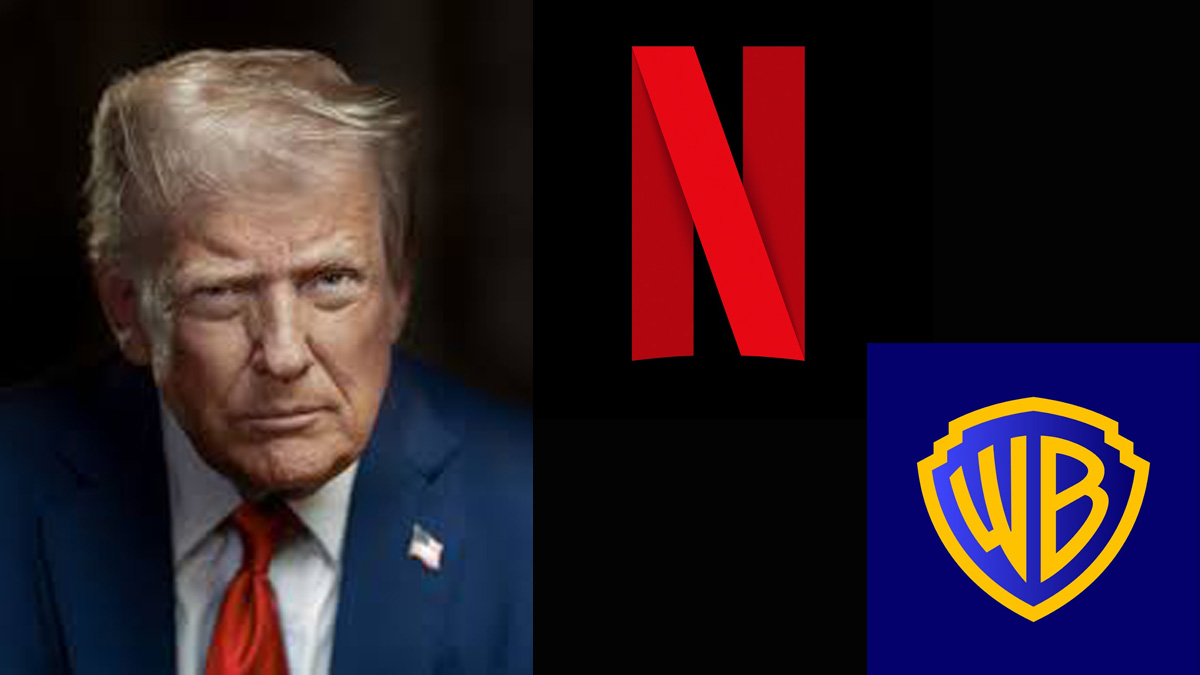
Trump invested over $1.1m in Netflix bonds at the peak of Warner Bros bidding battle
Financial disclosures show U.S. president also bought Warner Bros Discovery debt during high-stakes media takeover race.
WASHINGTON: New government financial disclosures show that U.S. president Donald Trump purchased more than $1.1 million worth of bonds issued by Netflix over the past three months. The transactions occurred during a period when Netflix was engaged in a competitive bidding war for Warner Bros. Discovery, a potential merger that the Trump administration had publicly criticised on antitrust grounds.
Between December and January, the president acquired Netflix bonds valued between $1.1 million and $2.25 million. The bonds carry a 5.375 per cent interest rate and are scheduled to mature in November 2029. Financial disclosures also revealed an additional investment in Warner Bros Discovery bonds. The purchase was valued between $500,002 and $1 million, with the debt reportedly bought at roughly 92 cents on the dollar. The bonds are now trading at around 95 cents on the dollar, leaving the position currently in profit.
The timing of the investments has drawn scrutiny because the administration had been openly critical of Netflix’s market activities at the time. While the president’s trust was purchasing the debt, the administration reportedly pressured Netflix to remove board member Susan Rice and expressed concerns that a Netflix–Warner merger could harm competition.
The White House has dismissed conflict-of-interest concerns, stating that the president’s assets are managed independently by his children. Spokesperson Anna Kelly said U.S. presidents are legally exempt from the conflict-of-interest laws that apply to other federal officials.
Despite the financial interest, Netflix ultimately lost the race to acquire Warner Bros Discovery. Paramount Skydance secured the deal on 27 February with a $110 billion offer. The acquisition was backed by Larry Ellison, who guaranteed $40 billion to support the bid, while major lenders including Bank of America, Citigroup and Apollo Global Management provided $39 billion in financing.
The final acquisition leaves the combined Paramount entity carrying roughly $85 billion in debt, while Netflix withdrew its bid roughly two weeks before the official disclosure report was released.

Hollywood
Utopai Studios partners Huace to deploy PAI for long form content
Deal includes revenue sharing as Huace adopts AI engine across global ops
MUMBAI: Lights, camera… algorithm, the script just got a silicon co-writer. In a move that signals how storytelling itself is being re-engineered, U.S.-based Utopai Studios has partnered China’s Huace Film & TV Co. Ltd. to bring artificial general intelligence into the heart of long-form content creation.
At the centre of the deal is PAI, Utopai’s cinematic storytelling system, which Huace will deploy as a core engine across its production pipeline from development and creative iteration to global localisation. The partnership includes a large-scale annual usage commitment from Huace, alongside a usage-based revenue-sharing model, underscoring both ambition and commercial confidence on both sides.
For Huace, one of China’s largest film and television companies, the bet is not on automation alone but on scale with control. With distribution spanning over 200 countries and a presence across more than 20 international platforms, including Netflix and YouTube, the company brings a vast content ecosystem where even marginal efficiency gains can translate into significant output shifts. Its extensive TV IP library further positions it as fertile ground for AI-assisted storytelling workflows.
The choice of PAI follows what Huace described as a rigorous evaluation of existing AI tools, many of which remain limited to fragmented use cases such as video generation or editing. What tipped the scales, according to the company, was PAI’s ability to handle long-form narrative complexity maintaining continuity, structure, and creative coherence across entire story arcs rather than isolated clips.
Utopai, for its part, is using the partnership to anchor its international expansion strategy, pitching PAI as an enterprise-ready system built for customisation, privacy, and regulatory adaptability across markets. That positioning becomes particularly relevant as global media companies increasingly scrutinise how AI integrates into proprietary workflows.
The timing is notable. Earlier this month, Utopai upgraded PAI to support three-minute 4K video generation and advanced multi-shot sequencing features designed to tackle one of AI storytelling’s biggest hurdles: consistency across scenes.
What emerges is not just another tech collaboration, but a glimpse into how the grammar of filmmaking could evolve. Because if stories were once crafted frame by frame, the next chapter might just be coded scene by scene.