Brands
Cricket and cinema: the strategic brand accelerator in India’s cultural economy

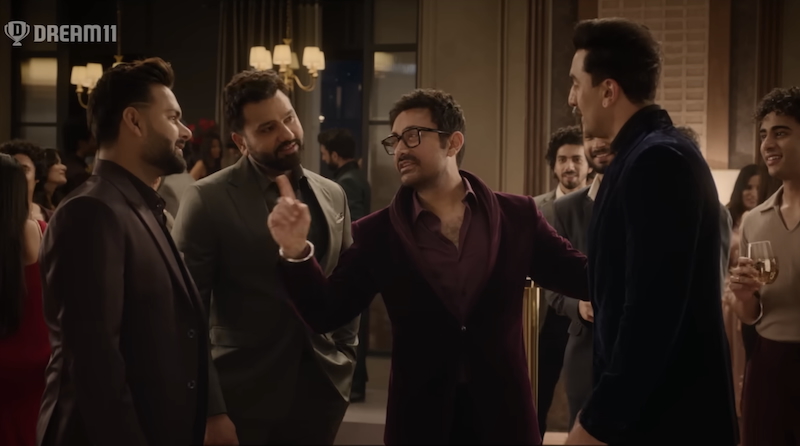
MUMBAI: With IPL 2025 underway, it’s worth examining why the combination of cricket and Indian cinema remains the most potent market entry and brand acceleration strategy in India’s dynamic consumer economy. Brands like Dream11 and EMotorad continue to demonstrate how effectively leveraging the insight ‘cricket and cinema unite India as a country’ can drive exceptional marketing results.
What makes cricket and cinema uniquely powerful is their unparalleled ability to transcend India’s extraordinary diversity. In a nation with 22 official languages and countless regional subcultures, these two cultural forces create a shared national experience that cuts across all demographic divides. The data supports this observation: when mapped against consumer engagement metrics, no other cultural touchpoints come close to matching their penetration across income brackets, age groups, and geographic regions. This isn’t merely entertainment – it’s the social fabric that connects 1.4 billion people.
For brands like Dream11 and EMotorad that recognise this cultural alignment, the benefits extend far beyond conventional marketing metrics:

The 2024 IPL season shattered all previous viewership records, reaching an astonishing 572 million viewers across platforms, with average engagement time increasing to 47 minutes per match. This represents nearly 40 per cent of India’s population actively engaged with a single longish running event.
When these viewership patterns are overlaid with the social media footprint of leading Indian cinema personalities – many commanding follower-ships larger than the population of European countries – the potential reach becomes unparalleled in global marketing. The cross-platform amplification effect creates a visibility multiplier that traditional media planning simply cannot replicate.

Analysis of over 200 Indian brand campaigns shows that those leveraging both cricket and Indian cinema consistently generate emotional engagement scores 3.7x higher than those using either element alone. This emotional resonance translates directly to brand affinity metrics that persist long after campaign completion.
The strategic advantage of this dual approach lies in its demographic universality. Consumer panel research across 18 Indian states reveals that cricket-cinema integrations uniquely solve the urban rural divide that plagues most marketing strategies.
In a market where consumer trust metrics show declining confidence in traditional advertising, the implicit endorsement effect of cricket-Indian cinema integrations provides a critical credibility accelerator. Recent research indicates brands with authentic cricket and cinema associations report up to 41 per cent higher trust ratings than category competitors. This trust premium directly influences the consumer decision journey, with 68 per cent of consumers demonstrating increased purchase intent for products within this ecosystem.
Forward-thinking brands are now moving beyond simple endorsements to create sophisticated ecosystem strategies that maximize the cricket-cinema connection. Through narrative integration, these brands develop authentic storylines that merge cricket themes with Indian cinema storytelling conventions, creating content that resonates at a deeper cultural level with Indian audiences.
Their platform architecture constructs comprehensive touchpoint ecosystems that begin during IPL broadcasts, extend through celebrity social channels, and culminate in immersive digital experiences, creating seamless consumer journeys across multiple media. Additionally, strategic brands position themselves to capitalise on specific cricket-cinema convergence points—such as celebrity reactions to dramatic match moments—enabling real-time engagement that feels organic rather than manufactured. This integrated approach allows brands to participate in cultural conversations in ways that traditional advertising simply cannot achieve.
As more brands recognize this strategy, the key differentiator has become execution sophistication. Brands achieving breakthrough results are those implementing “cultural intelligence” – the ability to authentically participate in the cricket-cinema conversation rather than simply appropriate its imagery.
The most successful campaigns demonstrate deep understanding of the subtle cultural codes embedded within both cricket and cinema, allowing them to engage at a level that feels native rather than commercial.

Perhaps most importantly, leading brands have developed specialized metrics to quantify the impact of cricket-cinema integrations beyond traditional marketing KPIs. These include cultural relevance scores, conversation share analysis, and cross-platform engagement attribution that capture the true business impact of these strategies.
In India’s intensely competitive brand landscape, the cinema-cinema convergence represents not just a marketing tactic but a strategic imperative. Brands like Dream11 and EMotorad haven’t merely adopted this approach – they’ve embedded it within their core business strategy.
With another IPL season, the brands that will emerge victorious are those that recognize a fundamental truth: in India, cricket and cinema aren’t just marketing channels – they are the cultural operating system through which consumers experience and interpret brand meaning.
The question for strategic leaders isn’t whether to engage with this cultural ecosystem, but how to do so with the sophistication and authenticity that today’s discerning Indian consumer demands.






Brands
Estée Lauder to shed 10,000 jobs as new boss bets on digital shift
The cosmetics giant raises its profit outlook but stays silent on a possible merger with Spain’s Puig, as job cuts deepen and a three-year sales slump weighs on the turnaround

NEW YORK: Stéphane de La Faverie is not done cutting. Estée Lauder announced on Friday that it plans to eliminate as many as 3,000 additional jobs, taking its total redundancy programme to as many as 10,000 roles, up from a previous target of 7,000 announced a year ago. The company, which owns La Mer, The Ordinary, Tom Ford, and Aveda, employs roughly 57,000 people worldwide. The mathematics of what is now being contemplated is stark.
The fresh round of cuts is expected to generate a further $200 million in savings, bringing the total annual savings from the programme to as much as $1.2 billion before taxes. That money, De La Faverie has made clear, will be ploughed back into the turnaround.
A CEO in a hurry
De La Faverie, who took the helm in January 2025, inherited a company that had endured three consecutive years of annual sales declines. His response has been to move fast and cut deep. A significant portion of the latest redundancies reflects his push to reduce headcount at US department stores, long a cornerstone of Estée Lauder’s distribution model but now a channel in structural decline. In their place, he is accelerating the shift toward faster-growing online platforms, including Amazon.com and TikTok Shop, a pivot that is reshaping not just where Estée Lauder sells but how it thinks about its customers.
The numbers are moving in the right direction
Despite the pain, there are signs the medicine is working. Estée Lauder raised its profit outlook for the remainder of the fiscal year, guiding for adjusted earnings per share in the range of $2.35 to $2.45, above analyst estimates and a notable step up from the $2.05 to $2.25 range it had guided for in February. Organic net sales growth is expected to come in at 3 per cent, the company said, at the high end of the range it set out in February.
The share price tells a mixed story. After De La Faverie took charge, the stock surged nearly 60 per cent, buoyed by investor optimism that a longtime company insider could finally arrest the decline. But 2026 has been rougher: the shares have fallen 27 per cent this year, weighed down by disappointing February results and the overhang of unresolved merger talks with Spanish beauty giant Puig Brands SA. The company gave no additional details about those discussions on Friday, leaving the market to guess.
Silence on Puig
The proposed tie-up with Puig remains the most consequential unknown hanging over Estée Lauder. A deal with the Barcelona-based group, which owns brands including Carolina Herrera and Rabanne, would reshape the global luxury beauty landscape. But with nothing new to say and a turnaround still very much in progress, De La Faverie is asking investors to trust the process.
Three years of sales declines, 10,000 job cuts, and a merger that may or may not happen. At Estée Lauder, the overhaul has barely started.