MAM
Nourish brings Shetty sisters for its new TVC ‘#SehatKiSunoNourishHiChuno’
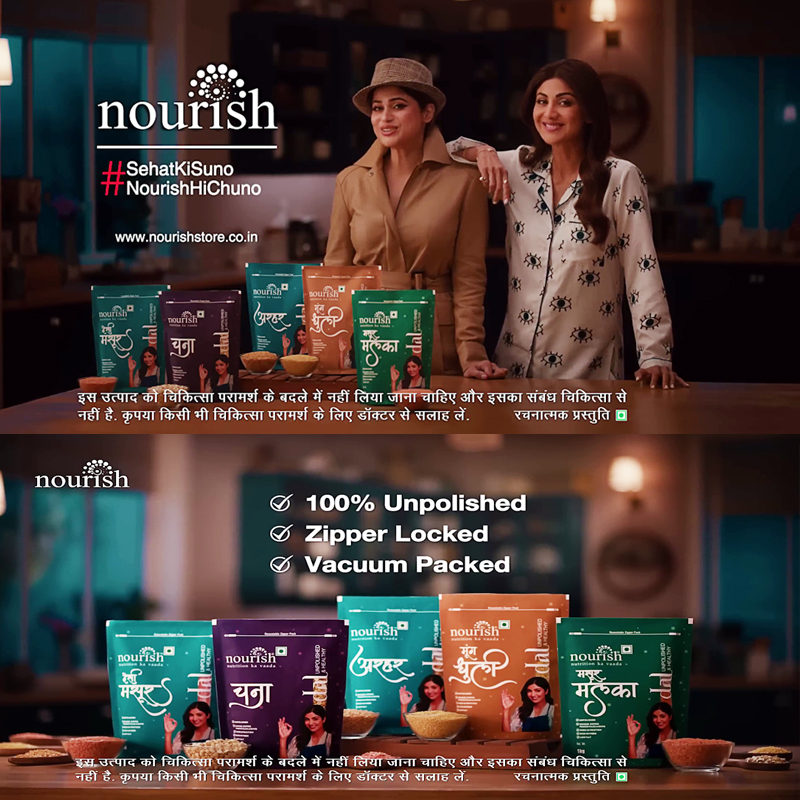
Mumbai: In a recently launched television commercial, “#SehatKiSunoNourishHiChuno” from Nourish, fitness icon and Bollywood actor Shilpa Shetty (aka Munki) is seen advising her on-screen and off-screen sister, Shamita Shetty (aka Tunki), on the benefits of consuming only unpolished pulses.
Conceptualised by Leads Brand Connect, the commercial reinforces the importance of choosing the healthiest and most nutritious range of unpolished pulses. The ad intends to showcase the reasons and importance of eating unpolished pulses in comparison to polished pulses.
In the opening scene of the ad, Shamita, dressed as a detective, is trying to look for the polished pulses from the dal box kept in the kitchen, to which Shilpa comments that she will not find any polished seed in the box as they consume Nourish pulses, which are 100 per cent unpolished, hygienic, and healthy. In the second scene, Shilpa advocates that Nourish pulses are nutritious and have high levels of protein. Being vacuum-packed and zip-locked, the freshness and hygiene of the pulses are maintained. Closing in on the lines
#SehatKiSunoNourishHiChuno, Munki puts an end to Tunki’s struggle to find polished dal in Nourish’s unpolished dal and tells her to be smart and make the right choice for her health.
“My staple lunch is always dal, chawal, and roti. I prefer food that is unpolished, high in fiber, and protein-enriched. What I like about Nourish is that its pulses are unpolished; it’s not about how it looks but what it does,” says Nourish’s brand ambassador Shilpa Shetty.
Speaking on the latest ad, BL Agro managing director Ashish Khandelwal commented, “We have always believed in offering nutrition and healthy foods to our customers. Through this ad, we intend to further highlight our uniqueness in packaging the unpolished pulses to keep their freshness intact.”
Leads Brand Connect managing director Richa Khandelwal added, “The ad takes a more quirky approach by showcasing Shilpa Shetty as the nutrition champion while Tunki (Shamita) is slightly jealous of the fact that Munki (Shilpa) is always right. We wanted to create an ad that can keep the viewers engaged to know what exactly Shamita is up to and then highlight the benefits of Nourish.”
With the release of this ad, BL Agro is running a contest called #NourishTunkiMunki on all its social media handles. The company intends to engage existing and prospective customers through this contest, where winners are chosen on a daily basis. The questions of the contest revolve around nutrition and food.
“The best part of the contest is that there will be not one but 100 winners every day. This will keep the excitement and engagement levels high as the chances of winning the Nourish hampers as gifts are higher,” adds Richa.
The hashtags of the contest are “#SehatKiSunoNourishHiChuno” and “#NourishTunkiMunki,” and the tag is @worldofnourish.

MAM
Best Family Health Insurance Plans in India with OPD Cover
If we think about how many times you visited a paediatrician during the year for your child’s fever, or went to the pharmacy for cough syrup, antacids, or prescription cream; how many physiotherapy appointments your spouse had throughout the year, or how many routine diabetes check-up appointments you had; most families would say that the ongoing healthcare cost to their family isn’t necessarily the sudden expense of a grown adult being admitted to the hospital, but rather the ongoing and regular expenses of running the household. Because of this, the search for the best family health insurance plans in India have evolved to include OPD covering as a significant factor in their decision making process.
As someone who has reviewed countless policies for families, I’ve seen a clear shift. Families are no longer satisfied with a plan that only activates during a hospital crisis. They want a partner for everyday wellness, and that’s what modern, comprehensive Health Plans for Family aim to be.
OPD Cover: The Game-Changer in Family Health Insurance
OPD, or Outpatient Department, cover handles expenses incurred outside of a hospital admission. This includes:
- Doctor consultation fees (General Physicians and Specialists)
- Diagnostic tests (blood work, X-rays, MRIs)
- Pharmacy bills (medicines prescribed)
- Minor procedures (dressing, injections)
Without OPD coverage, all these costs come directly from your monthly budget. A comprehensive Health Insurance with OPD Cover absorbs these shocks, transforming your policy from a seldom-used safety net into an active, year-round health management tool. For a family with children or aging parents, this isn’t a luxury; it’s a practical necessity.
Identifying the Best Family Health Insurance Plans In India with OPD
Not all OPD covers are created equal. When comparing Health Plans for Family, you must dig into the specifics. Here’s what separates the good from the truly valuable:
Integrated vs. Add-on Cover: Some of the Best Family Health Insurance Plans In India bundle OPD within the base plan (e.g., HDFC Ergo’s Optima Restore). Others offer it as a paid add-on rider. Integrated covers are often more seamless, but add-ons allow you to customize. Compare the sub-limits and overall value.
Realistic Sub-Limits: OPD coverage always has limits. Look for plans that offer a dedicated annual OPD sum insured (e.g., ₹10,000-₹25,000 per family) rather than a tiny per-consultation limit. This gives you flexibility, you can use it for a few major diagnostics instead of just small consultations.
Cashless OPD Network: The true convenience of health insurance with OPD cover is cashless access. Leading insurers have tied up with pharmacy chains, diagnostic centers, and clinic networks. You can walk in, show your card, and walk out without paying upfront. Check the insurer’s network partners in your locality.
Simplified Claims Process: For reimbursements outside the cashless network, the process should be digital and straightforward—via an app with document upload. Cumbersome OPD claim processes defeat the very purpose.
Key Players and What to Look For
Several insurers have pioneered strong family floater plans with OPD benefits. While new products emerge, plans like HDFC Ergo’s Optima Restore, ICICI Lombard’s Health Advantage Plus, and Niva Bupa’s ReAssure 2.0 have been notable for their structured OPD components. Star Health’s Family Health Optima also offers a comprehensive package.
However, the plan name is less important than its architecture. Your checklist for the Best Family Health Insurance Plans In India with OPD should verify:
Adequate In-patient Sum Insured: This is your core cover. Don’t compromise this for OPD. Start with at least ₹15-20 Lakh for a family of four.
Restoration Benefit: Crucial for families. It restores your main sum insured if exhausted, often including the OPD cover.
No Claim Bonus (NCB): Your reward for a healthy year should protect your OPD benefit too, often by increasing your overall sum insured.
Preventive Health Check-ups: A sign of a wellness-oriented insurer. Many top Health Plans for Family include free annual check-ups, complementing the OPD benefit.
Making the Smart Choice for Your Family
Choosing the right plan requires a simple audit. Tally your family’s average annual spend on doctor visits, tests, and medicines. You’ll likely find it’s a significant amount. Then, compare the premium of a comprehensive Health Insurance with OPD Cover against a basic plan plus your out-of-pocket OPD expenditure. The difference is often negligible, but the value is monumental.
For families, the Best Family Health Insurance Plans In India will be those that acknowledge the fact that the “real” journey for your family’s health occurs daily and not just during emergencies. By choosing a Family Health Insurance plan with meaningful OPD coverage, you will not only be insuring against your family getting sick, but also investing in your family’s ability to see their doctors or other healthcare providers on a more frequent basis for non-emergency issues and providing your family with a significant degree of peace of mind with regards to their financial and physical well-being. The shift away from reactive insurance to proactive insurance by families is now essential; it has become a necessity for the modern family that is living with intention.