Television
TV viewing reaches 12-month high in January 2026, Nielsen reports
Nielsen Gauge shows cable surges 9 per cent, streaming holds 47 per cent share amid sports and drama boosts.
MUMBAI: When winter chills hit and big games kick off, viewers didn’t just stay in, they stayed glued. Nielsen’s latest Gauge report shows total TV and streaming consumption climbed to a 12-month peak in January 2026, up 3.7 per cent from December, driven by a potent mix of high-stakes sports, returning broadcast dramas and colder weather keeping people indoors.
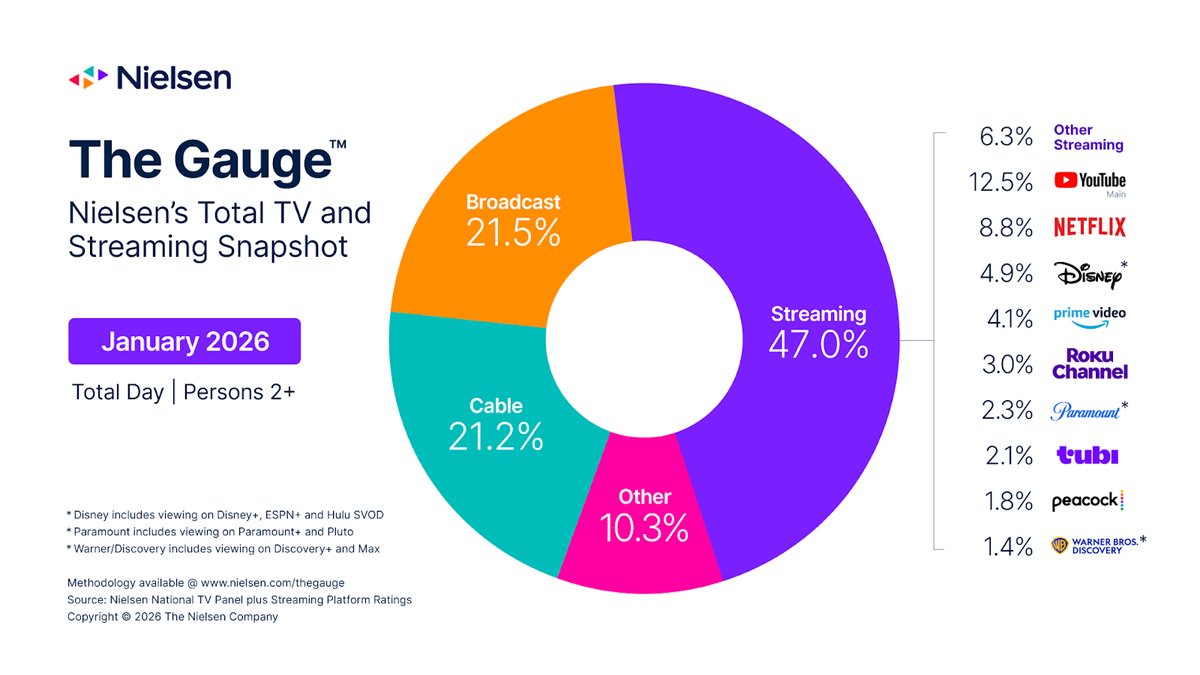
Cable led the charge with the biggest monthly jump, capturing 21.2 per cent of total TV usage (up 1.0 percentage point). Cable sports viewing exploded 49 per cent over December, fuelled by ESPN’s coverage of the College Football Playoffs quarterfinals, semifinals and championship, included sending ESPN’s viewing soaring 82 per cent. Cable news also rode an active news cycle, rising 13 per cent, with Fox News Channel up 17 per cent and CNN jumping 29 per cent. Together, ESPN and FOX News each claimed 2.2 per cent of total TV usage, accounting for 21 per cent of January’s cable viewing.
Broadcast held strong at 21.5 per cent of TV (up 4.2 per cent month-on-month), anchored by NFL dominance, the top 15 broadcast telecasts were all football games, giving sports 30 per cent of the category. Dramas bounced back 24 per cent, with ABC’s High Potential emerging as the month’s most-watched drama. Broadcast news gained 10 per cent, led by ABC World News Tonight.
Streaming proved its staying power after December’s record highs, growing 2.7 per cent month-on-month and commanding 47.0 per cent of total TV usage. Netflix mirrored the category’s resilience with a steady 1 per cent increase to 8.8 per cent of TV, holding the top streaming programme for a second month as Stranger Things racked up 15.4 billion viewing minutes. Peacock jumped 10 per cent to 1.8 per cent of TV, boosted by the new season of The Traitors and NFL simulcasts on NBC most noticeably on 18 January during the L.A. Rams vs Chicago Bears Divisional Playoff, which drove a 78 per cent spike over its monthly average.
Free ad-supported platforms kept pace, Tubi rose 6 per cent to 2.1 per cent of TV, while The Roku Channel gained 5 per cent to hold its platform-high 3.0 per cent share for a second straight month.
The January data covers four weeks from 29 December 2025 to 25 January 2026, following Nielsen’s Monday-start broadcast calendar. In a media landscape where every screen fights for eyes, January proved that when sports roar and dramas return, the living room still wins, even if the remote is within arm’s reach of the streaming button.

Sports
Shikhar Dhawan launches a cricket high performance centre in Gwalior
The former India opener wants to build a nationwide network of academies — and he is starting in the heartland
Gwalior: Shikhar Dhawan is done playing. Now he wants to build the system that produces the next generation of players who will. Da One Sports, the performance and pathway-building arm of Dhawan’s Da One Group, has launched its first High Performance Centre (HPC) at the Aditya World Cricket Academy in Gwalior, in partnership with the Madhya Pradesh League and the Bundelkhand Bulls.
The centre is conceived as the first of many. The ambition, plainly stated, is a nationwide network of structured training hubs designed to pull talented young cricketers out of the regions and push them towards the highest levels of the sport.

The Gwalior facility is not a vanity project dressed up in cricket whites. It comes with turf and synthetic pitches, all-weather training nets, strength and conditioning facilities and dedicated recovery zones. Certified coaches, performance analysts and sports science experts are on the staff. Technology-driven tools including video analysis and performance tracking will be used to monitor athlete progression. Talent identification trials will feed a clear pathway from grassroots training to competitive opportunity. Admissions are already open.
Leading the centre as technical director is Saba Karim, the former India wicketkeeper and national selector, a man who has spent a career on both sides of the selection table. Mentorship will come from Madan Sharma, who coached Dhawan as a child and therefore knows better than most what it takes to get a raw talent to the top.
Dhawan, who chairs the Da One Group and won the Arjuna Award for his services to cricket, was direct about his motivation. “Cricket has given me everything, and I have always felt a strong responsibility to give back to the sport in a meaningful way,” he said. “Having experienced the journey myself, I understand what it takes to prepare champions at the highest level. With Da One Sports, our vision is to create a system that nurtures young talent with the right guidance, structure, and mindset, so they are better equipped to succeed. The Da One High Performance Centre is a step towards building that future.”

Anshita Gupta, chief executive of the Da One Group, framed the Gwalior launch as the foundation of something larger. “Our focus is on creating the right infrastructure and pathways that allow young athletes to transition from potential to performance,” she said. “This collaboration enables us to build a strong, structured ecosystem that supports athlete development at every stage.”
Rohit Wadhwa, team owner of the Bundelkhand Bulls and chairman of RW Group, was equally forthright. “The philosophy of Da One Sports strongly resonates with our vision of nurturing budding talent and helping them evolve into elite players,” he said. “This High Performance Centre is a step towards creating that environment, where young athletes are given the right platform, exposure, and support to realise their full potential.”
Mahanaarayaman Scindia, president of the Madhya Pradesh Cricket Association, added that investing in grassroots cricket was essential to keeping India’s cricket ecosystem “sustainable, competitive, and globally dominant in the years ahead.”
India has never lacked for cricketing talent. What it has lacked, repeatedly and expensively, is the infrastructure to find that talent in the towns and districts where it quietly exists and give it somewhere to go. If Dhawan’s network of HPCs can begin to close that gap, the Gwalior academy may one day be remembered as the place where the next Dhawan first picked up a bat. The trials are open. The clock is running.