VBS 2026
Dish TV CEO pitches unified content marketplace for India
Manoj Dobhal outlines a three-day plan in March 2026 to fix fragmentation


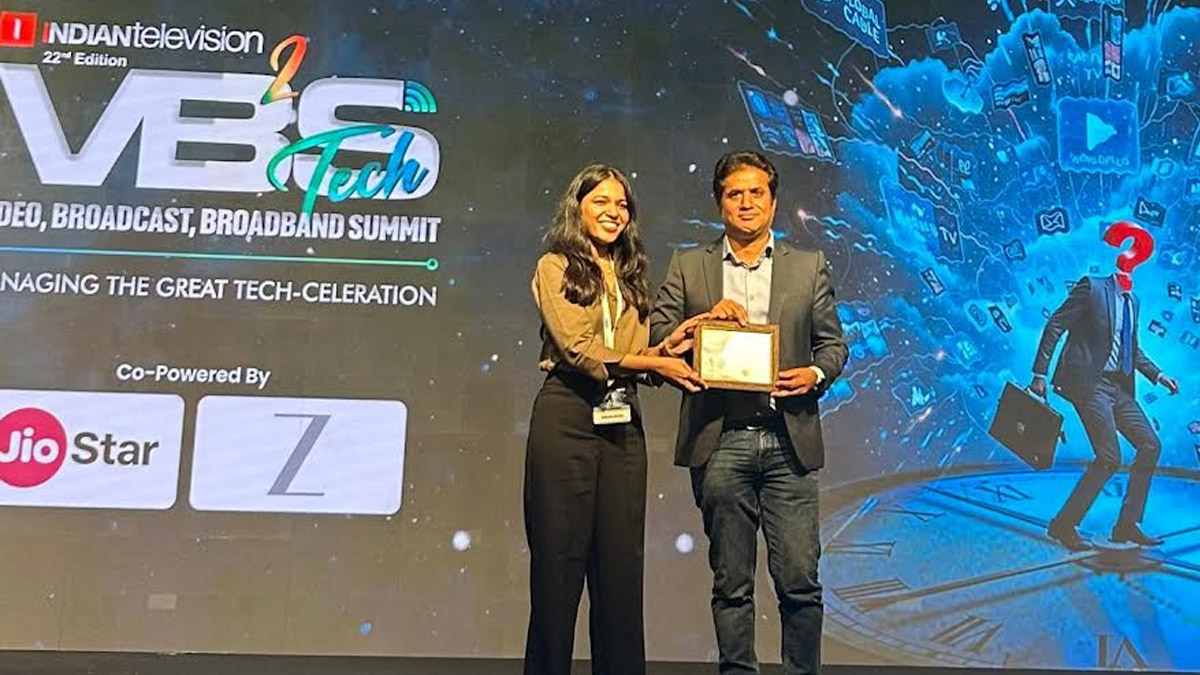
MUMBAI: If India is not short of stories, it may well be short of structure. At the 22nd edition of the Video Broadcast and Broadband Tech Summit hosted by IndianTelevision.com, Manoj Dobhal, Chief Executive Officer and Executive Director of Dish TV India, used a fireside chat to dissect what he believes is the single biggest inefficiency in the country’s content economy: fragmentation.
India hosts conferences on media and entertainment almost every month, he noted. Panels debate OTT growth, AI disruption, creator monetisation and global ambitions with clockwork regularity. Yet despite the churn of ideas, the ecosystem remains splintered.
“We know the problem is fragmentation,” Dobhal said. “It slows growth and does not unlock the value which the content really deserves.” The result is not a complete absence of monetisation, but persistent under-monetisation.
Around 18 months ago, Dish TV decided to interrogate the issue more systematically. Over a 6 month period, the team travelled across Mumbai, Hyderabad, Delhi, remote Indian markets and international hubs such as Canada. The objective was to understand the pain points across the value chain.
Creators are building compelling stories but lack direct access to global buyers. Producers are navigating complex and often opaque monetisation models unique to India’s distribution landscape. Technology firms are innovating rapidly in AI, VFX and production tools, yet struggle to plug seamlessly into commercially viable storytelling pipelines. Platforms and distributors face a different problem altogether: discoverability in an overcrowded marketplace.
Dobhal also pointed to the accelerating impact of artificial intelligence. AI, he suggested, is reshaping content creation, aggregation and distribution at a pace the industry collectively struggles to respond to in a structured way. Adaptation is inevitable, but coordination is lagging.
In September 2025, Dish TV convened a one and a half day closed door roundtable at Taj 97. It was not positioned as another networking event. Instead, it was framed as a narrative setting exercise.
Producers, creators, investors, global studios, technology leaders and distribution players were brought into a single room. The goal was to de-layer the business, interrogate bottlenecks and test a larger hypothesis: can India build a unified, globally connected and commercially sustainable entertainment ecosystem?
India produces enormous volumes of content across languages and formats. It has one of the largest diasporas in the world, representing a ready global audience. Yet access to international distribution houses, structured investor networks and global buyers remains limited to a relatively small circle.
“There are very few distribution houses or buyers whom everybody knows,” Dobhal observed. For many creators, the journey of a script often ends at informal networking. Beyond a handful of producers and directors, pathways narrow quickly.
The next step in this experiment will unfold on 16, 17 and 18 March 2026. Dish TV plans to launch a three day marketplace that combines streaming showcases, investor access, business matchmaking and structured networking under one roof.
Dobhal was careful not to oversell it as a career shortcut. “It is not just about a career boost,” he said. “It is a roadmap.” Partnerships formed during those three days, he argued, could shape trajectories for three to five years, potentially extending beyond 10 years as value compounds annually.
The marketplace aims to attract not just Indian participants but global studios, investors and buyers from markets such as the United States and Canada. The intention is to create cross border synergies rather than isolated domestic deals.
If India’s content appeals to global audiences, Dobhal argued, then the ecosystem must facilitate global access. By bringing international franchises, diaspora stakeholders and Indian creators together in a curated setting, the industry can move from conversation to transaction.
A recurring theme in Dobhal’s remarks was the gap between discourse and deal making. India has no shortage of summits. What it lacks, in his view, is sustained business architecture that binds creators, capital and distribution.
The fragmentation problem, he suggested, is as much structural as cultural. Silos exist between creative teams and technology providers, between regional content hubs and national platforms, and between Indian producers and global buyers. Without deliberate aggregation, value leaks at every stage.
The proposed marketplace is designed as a magnet, a deliberate attempt to cluster stakeholders who otherwise operate in parallel tracks. In theory, this could reduce friction in monetisation, accelerate discoverability and provide emerging creators with clearer entry points.
Dobhal’s broader argument extends beyond one event. The Indian content ecosystem is at an inflection point. OTT modulation needs refinement. Production pipelines require better integration with technology. The creative ecosystem needs nourishment and global amplification.
AI is accelerating disruption, but without structural alignment, its potential may be unevenly realised. A unified platform, he believes, can serve as connective tissue.
Whether three days in March 2026 can truly recalibrate a multi billion rupee industry remains an open question. But the diagnosis is hard to dismiss. India’s content economy is vibrant, inventive and prolific. Its challenge is not scarcity of stories, but scarcity of structured pathways.
If fragmentation is the fault line, aggregation may be the fix. And in a market where value is often hidden in plain sight, bringing everyone into one room might just be the first step towards unlocking it.