
VBS 2026
AI and data reshape advertising in converged media era
Industry leaders debate storytelling, CTV growth and ROI metrics


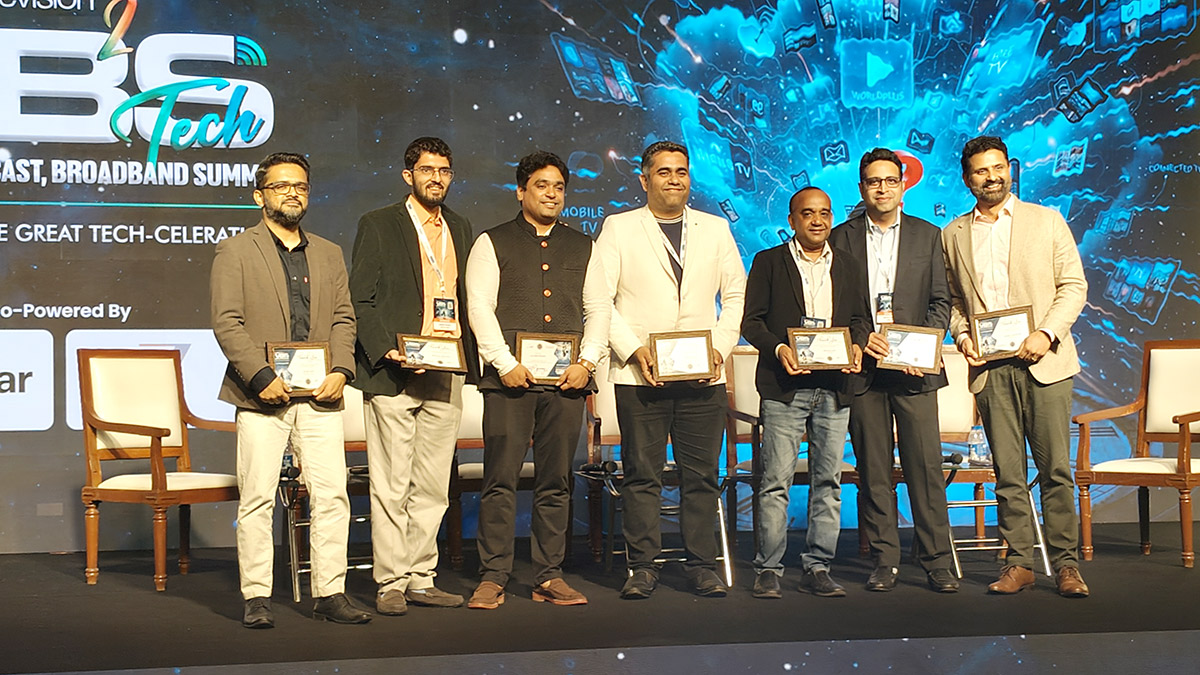
MUMBAI: If advertising once fought for eyeballs, it is now fighting for milliseconds, metrics and mindshare often all at once. At Panel Discussion 5 on Reimagining Advertising in a Converged Media Ecosystem at the 22nd Edition of the Video Broadcast and Broadband Tech Summit 2026, senior leaders from brands, agencies and ad tech firms unpacked how AI, data and connected TV are reshaping the grammar of modern marketing.
Chaired by Rahul Kapoor, VP Partnerships at Trade Desk, the panel featured Sujay Ray of L’Oréal India, Anooj Shetty of WPP Media, Abhinay Bhasin of dentsu India, Sandeep Balani of JioAds, Deepak Karnani of CereOne and Pratap Jain of Chana Jor.
Between performance dashboards and poetic storytelling, the session revealed an industry in transition more measurable than ever, yet more uncertain about what truly matters.
For Sujay Ray, Head of Consumer Experience, Content and Advocacy at L’Oréal India, the conversation begins not with AI, but with imagination.
“The biggest challenge today is the lack of good stories,” Ray said, arguing that brands are increasingly chasing trends rather than crafting distinct narratives. In a world where consumers can access content across countless platforms, differentiation is no longer optional, it is survival.
“Brands are not differentiating their storytelling. Everybody is following what is trending,” he noted, warning that this herd mentality creates a disconnect with audiences.
Ray cautioned against the industry’s growing obsession with performance metrics. “Just because a metric is available, you do not overanalyse it,” he said, adding that marketers have become “slaves to measurability”.
While data is critical, Ray emphasised that brands must invest in deeper frameworks such as Marketing Mix Modelling to identify which mediums actually drive awareness and intent. “If a medium is driving the right intent, even if it is comparatively costlier, it makes more sense than chasing a lower CPM that delivers nothing meaningful,” he argued.
Importantly, he shifted the lens from incremental reach to absolute reach. “The more people know about you, the higher the chances of conversion over time,” he said, underscoring that awareness remains the foundation of brand building whether the final purchase occurs online or offline.
Artificial intelligence, however, was impossible to ignore.
Pratap Jain, Founder and CEO of Chana Jor, shared how his bootstrapped platform is using AI in practical ways generating creatives, designing ad assets and analysing what content keeps audiences engaged.
“We know from the data what people are watching and we create accordingly. AI helps us in doing that,” Jain said.
Yet he drew a firm boundary. “When a human writes a story, it comes with emotions and uniqueness which say a ChatGPT does not have.” For him, AI can support efficiency and scale, but originality remains inherently human.
Abhinay Bhasin, Senior Vice President Product and Technology at dentsu India, positioned AI as a force multiplier rather than a creative threat. It enables rapid simulations, multiple creative iterations and cost effective experimentation.
“AI creates room for experiment,” Bhasin said. Where earlier brands might test one or two routes, they can now generate hundreds of variations, use platform embedded AI to pressure test ideas and refine campaigns in near real time.
He described AI as “the world’s smartest apprentice” always available, capable of processing vast datasets and accelerating execution. But the core of storytelling, he insisted, must remain intact.
Rahul Kapoor noted that campaigns today are more complex than ever, spanning television, OTT, influencer marketing, programmatic digital and retail media simultaneously. The linear funnel has given way to a web of touchpoints.
Anooj Shetty, National Head Growth Account Advanced TV at WPP Media, highlighted how brands now demand incremental reach rather than inflated gross numbers. Deduplication across platforms has become central to planning.
“Every brand is very clear that it should get incremental reach,” he said, pointing out that the focus is on eliminating redundancy while optimising exposure.
He observed that strategy and execution have advanced significantly, “a leap of 60 per cent” but measurement capabilities are lagging at around “30 per cent”. Data from television panels, digital platforms and walled gardens often exist in silos, stitched together through simulations rather than true unification.
Connected TV sits at the centre of this complexity. With approximately 55 million connected TV households in India roughly 25 per cent of total TV homes CTV has reached a scale capable of independently building brands. Yet it occupies a grey zone between traditional broadcast and digital performance media.
“Connected TV lies between digital and traditional,” Shetty noted, creating friction between planners trained in GRPs and those accustomed to impressions and clicks.
Performance, but whose definition?
Deepak Karnani of CereOne pushed the conversation further by questioning what “performance” actually means in a CTV context. While shoppable ads and lower funnel conversions are possible, performance could equally mean attention, awareness, brand lift or footfalls.
“A CTV needs to deliver performance, but what is that performance?” he asked.
Sandeep Balani of JioAds acknowledged that digital’s greatest advantage measurability has also become its burden. Advertisers scrutinise mobile metrics intensely, often more aggressively than CTV, despite both being part of the digital ecosystem.
“One of the curse of digital is that it is very measurable,” Balani observed. Brands demand conversion clarity, sometimes overlooking the role of upper funnel influence.
Bhasin added that the proliferation of walled gardens and changing consumer behaviour have put measurement itself under scrutiny. “As an industry we are obsessed with measurements and numbers. We should look at it from a direction but not get obsessed with it,” he said.
Jain raised a practical concern: while CTV campaigns in the US or Europe can generate significant revenue, Indian CPMs remain comparatively low. Effective monetisation remains a challenge in a cost sensitive market.
Ray responded by reiterating that price should not be the sole driver of investment decisions. The focus must shift from cheapest impressions to meaningful impact.
Shetty agreed that measurement is complex, particularly as the medium continues to grow rapidly. Yet he maintained that the growth trajectory of connected TV signals strong long term potential.
Across the discussion, fragmentation emerged as a defining theme. Consumers are exposed to up to nine hours of content daily across OTT, gaming, television and digital platforms. Navigating this abundance requires coordination across technology, creativity and commerce.
“There is a lot of fragmentation and knowing all of it comes at a cost,” Ray said, calling for harmonisation within the ecosystem.
The panel ultimately converged on a nuanced conclusion. AI and data are indispensable in a converged media environment. Intelligent reach, programmatic precision and unified measurement are critical to staying competitive.
But if advertising becomes only about dashboards and data points, it risks hollowing out the very thing that drives consumer connection.
In a marketplace saturated with metrics, the brands that win may be those that remember that behind every impression is a human being and behind every algorithm, a story waiting to be told.






