
GECs
Reality TV emerges as a hit-making engine at FICCI FRAMES 2026
Makers say authenticity, casting and fast paced formats are reshaping reality TV


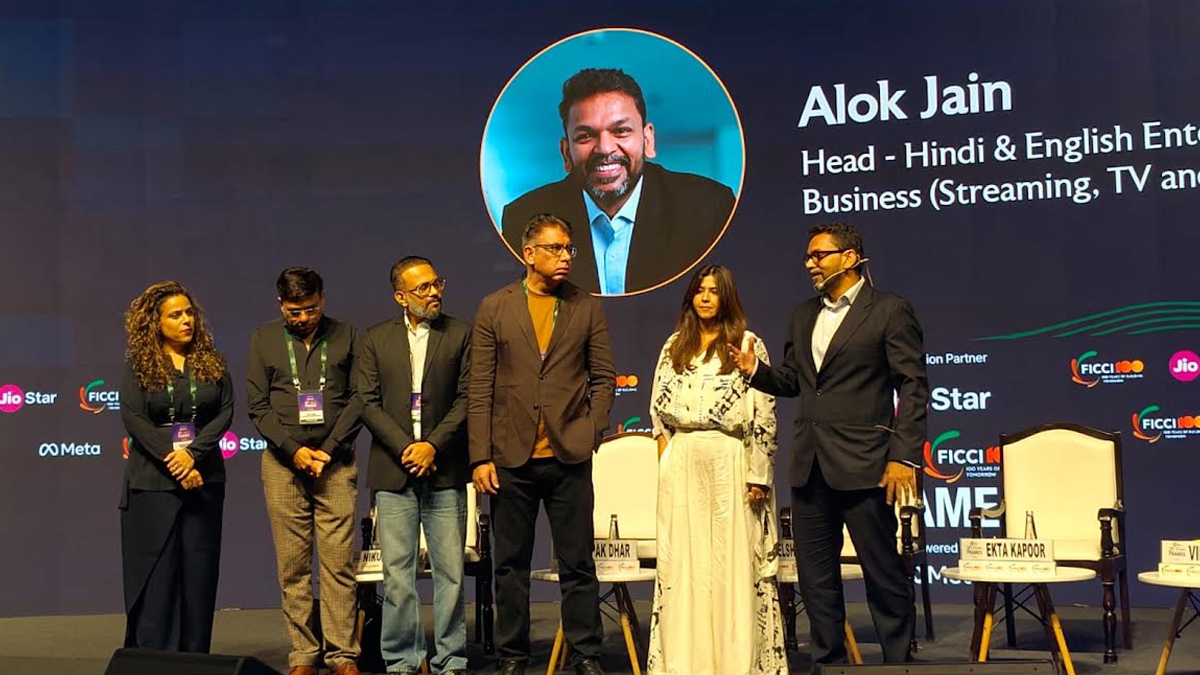
MUMBAI: Reality may be unscripted, but making it a hit is anything but accidental. At FICCI FRAMES 2026, makers and executives unpacked the mechanics behind India’s reality television boom, from the unpredictable moments that become cultural talking points to the casting, partnerships, budgets and audience behaviour that can make or break a format.
The session, titled ‘Reality – The Hit-Making Engine: Moments that turn into Cultural Phenomena’, brought together Alok Jain, Head – Hindi & English Entertainment Business (Streaming, TV and Studios), JioStar; Deepak Dhar, Founder and Group Chief Executive Officer, Banijay Asia and Endemol Shine India; Ekta Kapoor, Founder, Balaji Telefilms; Vipul Shah, Founding Chairman and Managing Director, Optimystix Entertainment; Apoorva Mehta, Chief Executive Officer, Dharma Productions; and Nikul Desai, Founder and Producer, Eevaan Films and Story Weaver Collective. The discussion was moderated by Delshad Irani and explored why unscripted entertainment continues to find new audiences even as viewing habits fragment across television, streaming, social media and short-form video.
For Alok Jain, the scale of the category is tied closely to how dramatically the Indian consumer has evolved. He pointed to a journey that began with liberalisation in 1995, accelerated through the IT boom a decade later and then gathered further momentum with the digital explosion around the Covid-19 period. By 2026, he described the Indian consumer as young, ambitious, impatient and increasingly comfortable with consuming content across screens and formats.
That evolution is reflected in JioStar’s own entertainment footprint. Jain said the business reaches around 1 billion people every year in the Hindi market, roughly two-thirds of India’s 1.5 billion population, across television, digital and connected TV, with around 460 billion minutes of watch time. He also said more than 40 shows had been released across television and digital over the previous year, with 17 more titles lined up over the following three to four months.
The numbers, however, tell only one part of the reality story. The bigger attraction of unscripted programming lies in its ability to manufacture moments without necessarily manufacturing the moment itself. Jain described the genre as powerful because creators can establish the setting and the rules, but cannot completely determine what happens once participants enter that environment.
That unpredictability was echoed throughout the discussion. The panellists were asked to recall the unscripted moments that had stayed with them, producing stories ranging from a contestant taking a bath in the open during the first season of Lock Upp to a genuine argument between Kashmira Shah and Krushna Abhishek on Laughter Chefs. In another example, a joke and relationship dynamic from Dhamal With Pati Patni Aur Panga spilled into real household territory when a participant’s wife watched the first episode and objected to their personal matters becoming show material.
For Deepak Dhar, the challenge is not simply launching a reality format but keeping a familiar franchise fresh year after year. He pointed to legacy properties such as Bigg Boss and Khatron Ke Khiladi, which have been running for around 20 years and 15 years respectively, arguing that reinvention comes from respecting the core format while continuing to push new creative buttons.
Dhar also highlighted the advantage of working with formats that have travelled across markets. He said Banijay’s teams track trends around these brands across 40 countries, languages and communities, allowing Indian versions to absorb relevant learnings from different parts of the world. At the same time, he stressed that audiences have changed significantly, making unlearning as important as learning when it comes to long-running reality franchises.
The change is visible in the way audiences now enter a show. Dhar described a viewing journey that can begin with a Reel, move to a promo and eventually lead to the full programme, creating what he called a “wagon wheel” of consumption. That means the opening 10 to 15 minutes have become particularly important, with shows needing to establish a strong hook quickly enough to pull viewers further into the story.
Reality television has also moved beyond the traditional scheduled episode. Dhar pointed to the rise of 24/7 live streaming, where audiences can follow a feed almost continuously rather than waiting for a packaged television episode. The shift, he suggested, is still relatively new, with much of the innovation in the space having accelerated only over the last two to two and a half years.
Ekta Kapoor offered a different perspective on the appeal of the format. Her experience with Nach Baliye eventually led her to Lock Upp, and she argued that unscripted programming has an advantage in an entertainment environment increasingly dominated by Reels and 10-second videos. To compete for long-form attention, she said, reality shows need to feel shocking, provocative and genuinely real while leaving viewers with the sense that something unexpected could happen next.
That unpredictability also forces creators to abandon some of the control they have in scripted television. Kapoor explained that in scripted programming, makers can know several episodes ahead what the characters will do and how one twist will lead into another. In unscripted entertainment, however, a trigger can produce a completely different reaction from what was expected, forcing makers to stay on their feet and respond to the action rather than simply execute a predetermined plan.
Vipul Shah’s Laughter Chefs offered another lesson in how a reality format can be assembled from seemingly unrelated ingredients. He said the idea came from combining two forms of comfort — food and comedy — after observing how cooking and comedy became particularly prominent during Covid-19. Cooking provided the structure, contestants who were not necessarily skilled cooks supplied the comedy, celebrity participation created familiarity and interpersonal relationships added the reality element.
For Shah, the casting process is therefore almost a form of scripting. He argued that the right contestants can allow the rest of the format to fall into place, while comedy-based reality shows require performers with natural timing, a sense of humour and an ability to enjoy the process rather than become overly conscious of how their jokes are being received.
Casting becomes even more significant when a format is built around personalities audiences already know. Nikul Desai discussed Bhojpuri Bawaal, a follow-reality show designed to give viewers a closer look at the personal and professional relationships of prominent figures from the Bhojpuri industry. The idea was also to tap the large potential audience across Uttar Pradesh, Bihar and Jharkhand, while moving beyond the public personas audiences had already encountered on YouTube and social media.
The conversation also underlined that risk-taking in reality entertainment is rarely a solo act. Desai said a creator needs a platform willing to back the idea after signing on, while Shah stressed that broadcasters must have confidence in the genre and the audience proposition. For unscripted programming, where outcomes cannot be completely controlled, that partnership becomes particularly important because both sides have to stay committed after the cameras start rolling.
Desai added that doubts are part of the creative process rather than evidence that a project is going wrong. His approach is to examine a concept from multiple angles, weigh the risks and identify the option that can offer the strongest engagement before committing to it. Once that decision is made, however, the maker has to accept that the audience response is no longer entirely within their control.
And then comes the question reality television cannot escape: money. Dhar acknowledged that budgets matter, particularly when shows are trying to bring in major stars, but argued that bigger spending does not automatically create bigger hits. He pointed to The 50, which ran without major celebrity names or a conventional star host, instead centring on a masked man, and said the show was successful enough for a second season to be developed.
Dhar also cited Alliances with Kunal Khemu and Rise & Fall with Virender Sehwag as examples of a wider pipeline that does not depend exclusively on the biggest possible celebrity. For him, the real equation is the ecosystem around a show, its format, talent, mechanics, audience proposition and the combination of ingredients that can make it work — rather than simply the size of the cheque.
That thinking mirrors the broader evolution of unscripted entertainment in India. The genre is no longer confined to conventional reality competitions or celebrity-driven television. It now spans relationships, comedy, cooking, adventure, strategy, conversations, music and social experiments, creating multiple entry points for audiences and multiple opportunities for talent and brands.
The commercial ecosystem has expanded alongside it. Jain earlier noted that more than 1,000 brands have participated in JioStar shows over the past decade, while reality formats can generate an ecosystem of additional content around the core programme. A five-hour show, for instance, can become the source material for 20 hours of surrounding creator-led content, clips, conversations and social engagement.
That flywheel is one reason reality can extend far beyond its scheduled running time. A contestant can become a celebrity, an existing celebrity can find a new audience, a viral moment can become a meme, and a short clip can send viewers back to the full episode. In an environment where audience attention is increasingly fragmented, the ability to turn one television moment into multiple pieces of culture has become part of the format itself.
The session ultimately positioned reality entertainment less as a television genre and more as a constantly moving audience engine. Its greatest asset is also its biggest risk: nobody knows exactly what will happen next. But when the casting clicks, the format holds, the platform backs it and audiences find something recognisable in the chaos, an unscripted moment can become much bigger than the episode that created it.






