
TCHxVAM2026
India’s micro-drama makers race to crack the scroll-and-watch economy at TCH x VAM 2026
At TCH x VAM 2026, creators debate AI, language and retention in short-form storytelling


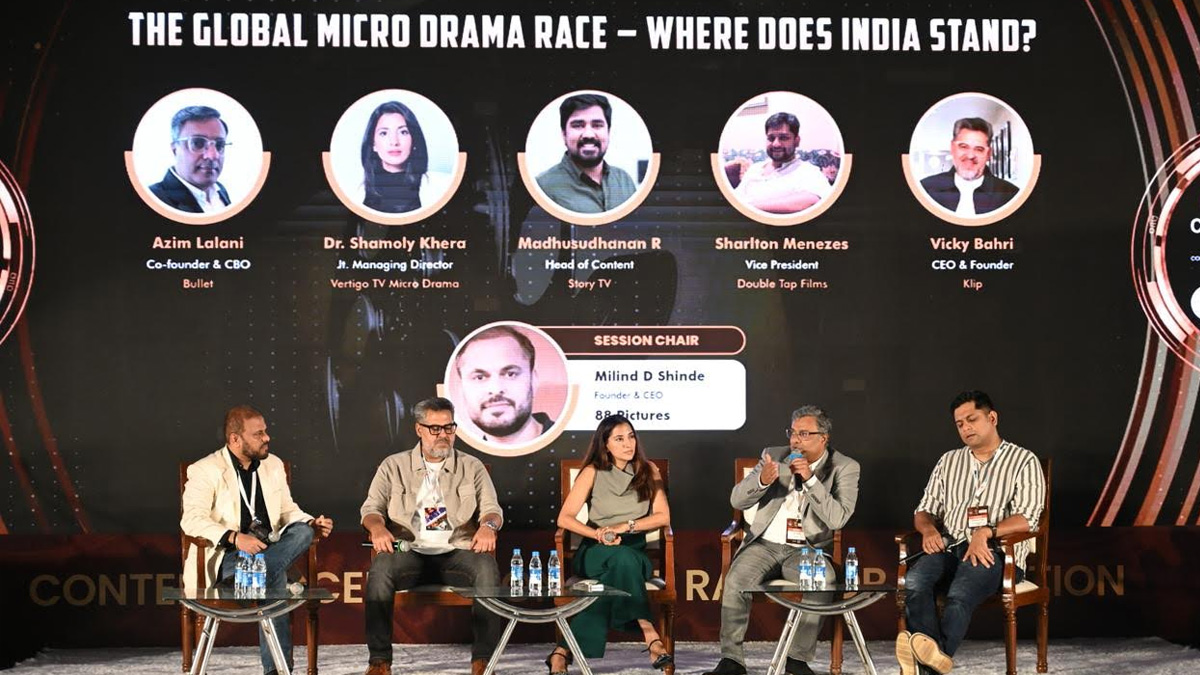
MUMBAI: In the age of endless scrolling, India’s entertainment industry is learning that the quickest way to attention may also be the shortest. At The Content Hub x VFX & More Summit 2026, panellists discussing “The Global Micro Drama Race: Where Does India Stand?” argued that bite-sized storytelling is no longer a passing fad but an emerging content economy with ambitions far bigger than its runtimes.
The session brought together Bullet co-founder & CBO Azim Lalani, Vertigo TV joint managing director Shamoly Khera, Double Tap Films vice president – IP & key partnerships Sharlton Menezes, Klip CEO & founder Vicky Bahri, with the conversation chaired by 88 Pictures founder & CEO Milind D Shinde.
If long-form storytelling once thrived on patience, micro dramas are built for impulse. The discussion repeatedly returned to the idea that India’s shrinking attention spans are reshaping how stories are written, edited and marketed. Creators argued that audiences now expect emotional hooks almost instantly, forcing writers to compress conflict, revelation and cliffhangers into episodes often lasting less than two minutes.
The panel noted that unlike films or premium OTT series designed for relaxed viewing, micro dramas are largely consumed during short breaks through the day. That behavioural shift is pushing creators to rethink storytelling mechanics entirely. Every few seconds, they argued, must carry emotional payoff or risk losing the viewer to the next swipe.
Yet beneath the speed lies a more complicated creative challenge. Panellists stressed that successful micro dramas cannot survive on shock value alone. India’s audiences, they said, remain deeply attached to emotional storytelling and character arcs, meaning even ultra-short content still requires layered writing and cultural familiarity. Formulaic hooks may grab attention briefly, but retention depends on relatable characters and rooted narratives.
The conversation also highlighted how India’s fragmented language ecosystem could become the country’s biggest advantage in the global micro-drama race. While China’s vertical-drama boom was often referenced as the benchmark, the panel argued that India’s linguistic diversity opens opportunities for highly localised storytelling. Several creators pointed to the fact that content resonating in one state often fails in another unless adapted carefully for regional nuances.
Rather than relying purely on dubbing, platforms are increasingly rebuilding stories for individual markets with fresh cultural settings, characters and contexts. Malayalam content in particular was highlighted as a high-engagement category, underlining how regional storytelling may power the next phase of growth.
Another recurring theme was the growing role of AI and data in shaping creative decisions. Panellists described a high-velocity ecosystem where platforms release multiple titles daily and constantly track audience behaviour. Data dashboards, viewing drop-offs and trend analysis are increasingly influencing commissioning choices, genre selection and even writing structures.
AI-assisted workflows, the discussion suggested, are helping companies identify which story tropes travel best, what themes are trending externally and how creators can improve content performance faster. Still, speakers maintained that technology alone cannot replace strong storytelling instincts. Data may sharpen strategy, but emotional resonance remains the real retention engine.
The business model around micro dramas also came under scrutiny. Panellists acknowledged that the sector is currently heavily dependent on aggressive customer acquisition and marketing spends, with many platforms investing more in visibility than in production itself. Social media feeds have effectively become discovery engines, where users stumble upon snippets before deciding whether to download an app or subscribe.
That model, however, may not remain sustainable forever. The panel suggested the industry would eventually need to strike a healthier balance between marketing velocity and content quality, especially in a price-sensitive market like India. Subscription models, affordable paywalls and stronger original IP were discussed as possible long-term solutions.
Importantly, creators also explored whether micro dramas could evolve into larger entertainment franchises. Strong characters and successful story worlds, they argued, may eventually migrate into long-format series, films or wider IP ecosystems, much like web novels and online fiction have done in China, Korea and Japan.
The panel closed on a note of cautious optimism around regulation and content responsibility. While acknowledging that provocative content can generate quick clicks, speakers broadly agreed that sustainable growth would depend on credibility, storytelling quality and culturally aware programming rather than pure sensationalism.
In a country where stories travel faster than ever and attention has become entertainment’s most valuable currency, India’s micro-drama industry appears ready to move from snackable experiment to serious business.






