
TCHxVAM2026
Indian cinematographers balance AI, OTT and budgets in race for attention at TCH x VAM 2026
The Content Hub panel explores how DPs are keeping storytelling human-first


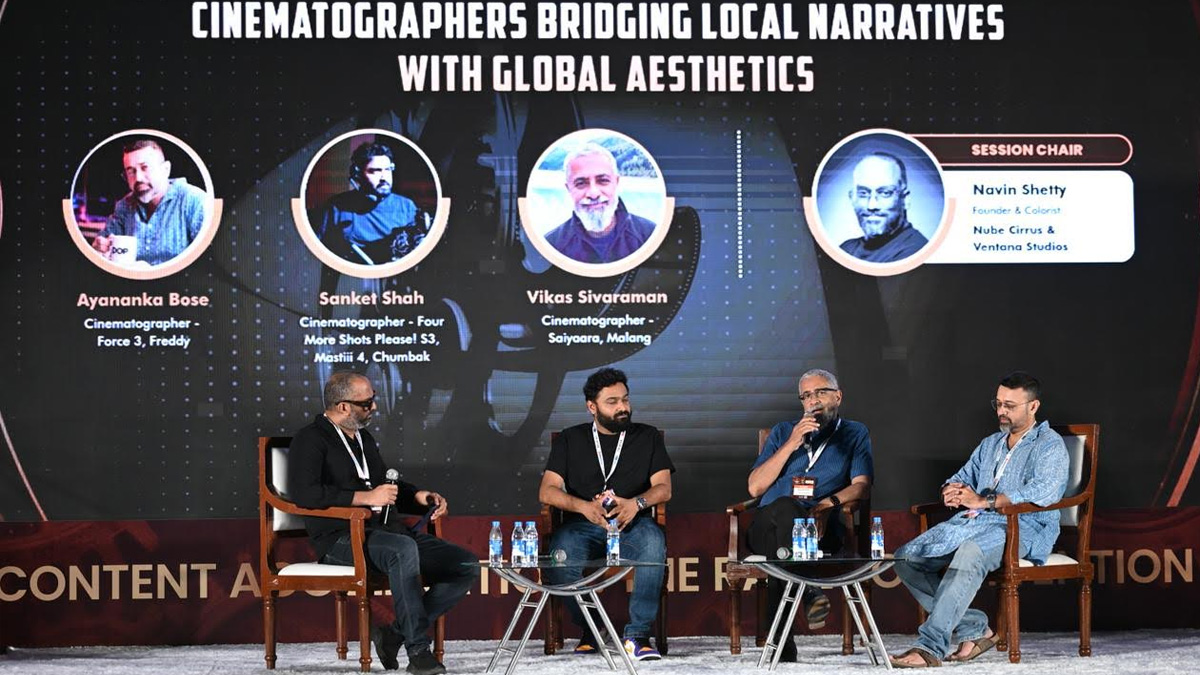
MUMBAI: In an industry now obsessed with clicks, crops and compression rates, Indian cinematographers are fighting to ensure the soul of storytelling does not get lost in the scroll.
That tension took centre stage at The Content Hub x VFX & More Summit 2026 during a panel titled Visual Storytelling In Modern Indian Cinema: Cinematographers Bridging Local Narratives With Global Aesthetics. The session brought together cinematographers Ayananka Bose, Sanket Shah and Vikas Sivaraman, with the discussion chaired by Navin Shetty, founder and colourist at Nube Cirrus and Ventana Studios.
The conversation moved fluidly between creativity, commerce, AI, OTT platforms and the changing grammar of visual storytelling, painting a picture of an industry where adaptability is now as important as artistic instinct.
A recurring theme throughout the session was the growing dominance of budgets in filmmaking conversations. What once began with scripts and visual ambition now often starts with cost discussions, forcing cinematographers to become equal parts artist, technician and negotiator. The panel explored how modern DPs constantly juggle creative aspirations with practical limitations, finding ways to preserve a director’s vision while working within shrinking production constraints.
Experience, the speakers suggested, has become the secret weapon. Years spent on sets have trained cinematographers to become problem-solvers rather than roadblock creators. The process today is less about demanding ideal conditions and more about finding intelligent workarounds, whether through tighter scheduling, smarter lighting plans or extensive pre-production preparation.
Prep, in fact, emerged as one of the industry’s biggest game changers. Detailed blocking, rehearsals, pre-visualisation and close coordination between departments now help productions save both time and money. Relationships between cinematographers and colourists have also evolved significantly, with look development increasingly beginning before a shoot starts. Instead of treating post-production as a finishing step, filmmakers are integrating grading and VFX planning into the creative process from day one.
The panel also reflected on how technology has quietly rewritten filmmaking economics. Advances in digital cameras, lighting systems and post-production tools have dramatically improved efficiency on set. Modern cameras require less lighting, shoots move faster, and fixes that once demanded hours on set can now be handled seamlessly in post-production. What was once considered a costly mistake, such as a cable slipping into frame or unwanted equipment appearing on screen, can now often be corrected later with minimal disruption.
Yet even with all the technological support available, the panel insisted that storytelling still dictates visual choices. The rise of OTT platforms and mobile viewing may have changed consumption habits, but the fundamentals of cinematic language remain intact. Wide shots still communicate loneliness, close-ups still carry emotion, and compositions are still driven by narrative needs rather than screen size.
The discussion became especially lively when the conversation shifted to vertical video and micro dramas, formats increasingly shaping the future of digital entertainment. While traditional cinematic framing has historically been built around horizontal compositions, the rise of phone-first viewing is forcing creators to rethink visual language altogether. The panel acknowledged that vertical storytelling is no longer a fringe experiment but a rapidly growing reality that filmmakers will need to adapt to.
AI, unsurprisingly, loomed large over the session. Rather than presenting it as a replacement for filmmakers, the discussion framed AI as a support system that is still finding its footing. From pre-visualisation and storyboarding to virtual production workflows and VFX planning, AI is already becoming embedded in production pipelines. At the same time, concerns remain about preserving emotional authenticity and avoiding overdependence on synthetic imagery.
The panel struck a balanced tone on the technology’s future. AI-generated filmmaking may still feel imperfect and occasionally cumbersome, but there was broad agreement that the pace of development is accelerating rapidly. Comparisons were drawn to the industry’s transition from film to digital, a shift that initially faced resistance before becoming the norm almost overnight.
If there was one takeaway from the session, it was this: cinematographers today are no longer just image-makers. They are collaborators, strategists, technicians and translators, balancing human emotion with machine-driven efficiency in an entertainment economy racing for attention.






