News Broadcasting
UTV IPO post-September; 12 m. shares at Rs 5 on offer


MUMBAI: 2004 looks to be turning into the year for media public offerings. After Aaj Tak and NDTV, it is the turn of UTV promoter Ronnie Screwvala, who has finally fixed the time-line for his much delayed public issue.
UTV’s IPO is expected to happen anytime between September and November, according to a company statement issued a short while ago. 12 million shares of Rs 5 par value is what will be on offer in the issue, the prospectus for which will be filed with the Securities and Exchange Bureau of India (Sebi) within the next three weeks. Of this 12 million, 6 Million will be fresh offer.
When asked how much he expected to raise from the public issue, Screwvala said it would depend on the market response. He however, added that the IPO would at the very least mop up Rs 1 billion.

Paving the way for the public issue as it were, Screwvala today announced that he has concluded the buy back of shares from News Corp (Star) as well as partly from leading Canadian investment fund manager CDPQ. The buyback will consolidate Screwvala’s shareholding, pre-IPO, to 54 per cent in holding company UTV Software Communications Limited.
CDPQ, which invested fresh equity of 9.6 million shares in UTV over two-and-a-half years ago, had initiated a scaling down of all its investments in Asia last year, according to the statement issued by UTV. Screwvala has therefore signed an agreement with CDPQ to buy back 3.6 million shares. The remaining 6 million CDPQ shares will be offered for sale in the forthcoming IPO.
CDPQ currently holds a 31 per cent stake in UTV, which will go down to 21 per cent following the buyback and further down to zero on completion of the public issue process, Screwvala said.
As for Star, Screwvala will be buying back 4.54 million shares, which represents a 15 per cent stake in UTV.
On the completion of these two transactions, Screwvala’s consolidated holding in UTV will move up to 54 per cent, pre-IPO. When queried as to what the buybacks represented in cash outflow terms, he declined to offer any numbers.
Commenting on the deal, he says, “In my original shareholder’s agreement with News Corp, I had an option to buy back shares pre-IPO and I have exercised that option to increase and consolidate my shareholding.” He adds, “UTV and Star share a multiple strategic relationship in television content, in movie co-productions, in Vijay TV and more recently in the distribution alliance for our kids channel Hungama TV, and we will continue to build on these strategic relationships.”







News Broadcasting
Network18 channels lead YouTube news viewership in March 2026
CNN-News18, News18 India and CNBC channels top categories with record views
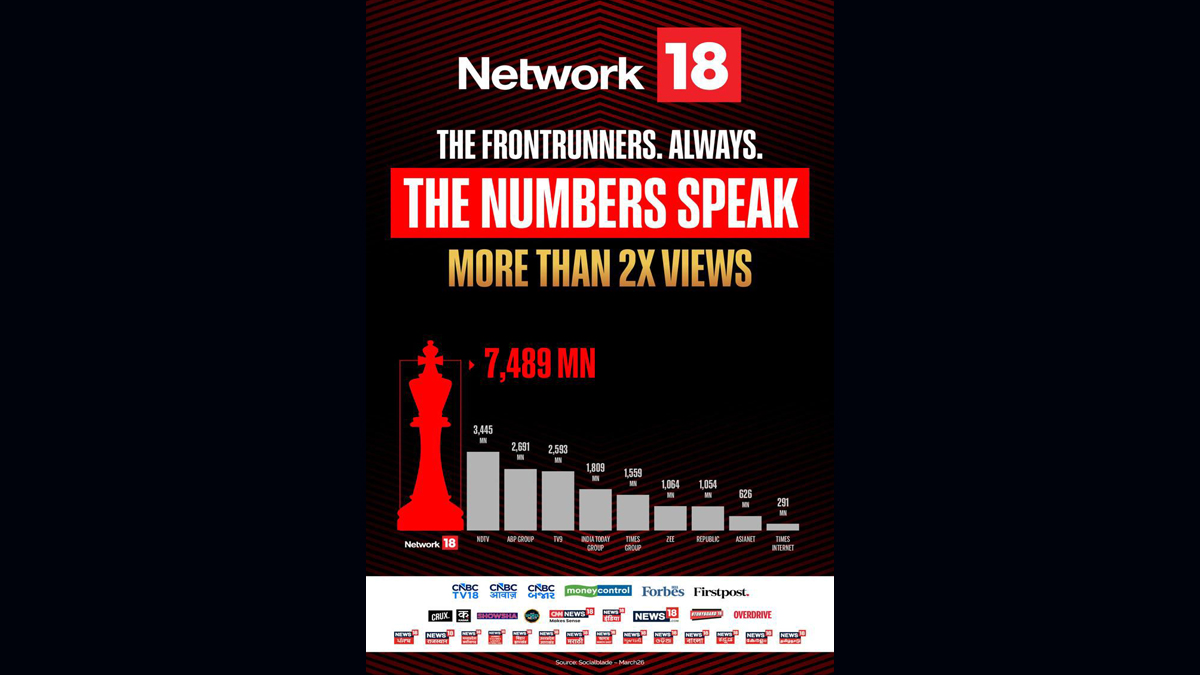
MUMBAI: When the world hit refresh on breaking news, Network18’s channels were already streaming ahead. As geopolitical tensions and war-driven headlines fuelled a surge in global news consumption, the network’s digital playbook delivered big clocking record Youtube viewership across English, Hindi and business news categories in March 2026.
At the forefront was CNN-News18, which emerged as the clear leader in the English news segment with 130 million live and video-on-demand views. The channel edged past competitors such as Times of India (126.5 million), Times Now (101.1 million), India Today (88.2 million) and NDTV (77.5 million), according to Databeings data for March.
In the Hindi news arena, News18 India delivered a commanding performance, racking up a staggering 3,297 million views on YouTube. The channel comfortably outpaced NDTV India, which recorded 3,119 million views, underlining its deep reach and consistent engagement with mass audiences, as per Playboard data.
The network’s dominance wasn’t confined to general news. In the Hindi business segment, CNBC Awaaz topped the charts with 92 million views, narrowly ahead of Zee Business (90 million) and well ahead of ET Now Swadesh (57 million). Meanwhile, its English counterpart CNBC-TV18 posted a strong 58 million views, reinforcing the network’s cross-category strength.
The spike in viewership reflects a broader shift in audience behaviour, with viewers increasingly turning to digital platforms particularly Youtube for real-time updates and in-depth coverage during high-intensity news cycles. For Network18, the numbers signal more than just scale; they underline the effectiveness of a multi-platform strategy that blends speed, credibility and continuous coverage.
In a month where the news never paused, it seems viewers chose to stay tuned where the stream never stopped.






