Connect with us

iWorld

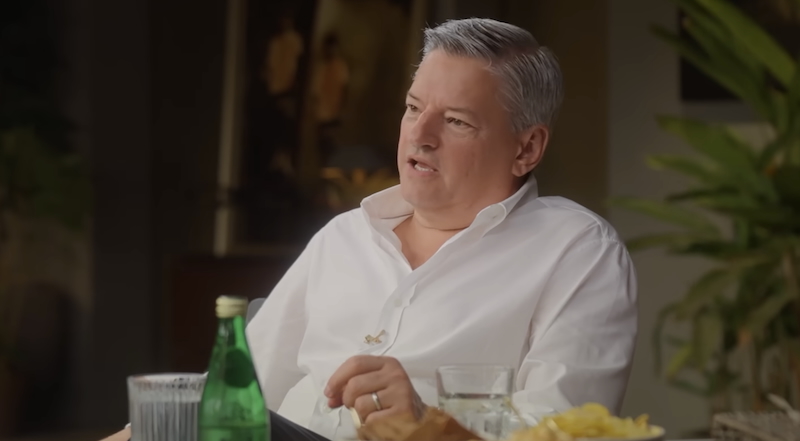
Ted Sarandos spills the Netflix masala to Indian billionaire Nikhil Kamath

Published

on

MUMBAI: What happenswhen a video store clerk-turned-media mogul sits down with a new-gen Indian billionaire?

Streaming gold. 

In a riveting episode of People by WTF, Netflix co-ceo Ted Sarandos spilt the tea, dropped truth bombs, and dished out storytelling wisdom in an electric tête-à-tête with Zerodha co-founder Nikhil Kamath. 

Advertisement

From his Phoenix roots to Hollywood power tables—and yes, dinners with Shah Rukh Khan—Ted held nothing back.

Sarandos shared his origin story: a would-be journalist whose real education came behind the counter at a video rental store. That humble setting gave him a ringside view of consumer desire—something he scaled up spectacularly at Netflix. “People hated late fees, but they loved discovering something new,” he quipped, summing up the genesis of Netflix’s ‘everything, anytime’ model.

Sarandos’ India story was peppered with glam. He reminisced about his first meal with SRK—“very different in Mumbai than in LA”—and lauded Aryan Khan’s directorial chops in The Ba**ds of Bollywood*. His creative crush? Sanjay Leela Bhansali. “Heeramandi felt like a dare… he pitched it in LA like, ‘I dare you to make this’,” said Ted, still in awe.

Advertisement

“For 10 years, I heard India was two years away,” Sarandos laughed. “Now, it feels truer than ever.” With local stories making global noise—think RRR or Kapil Sharma—Netflix doubled down. Sarandos noted that Indian audiences aren’t just watching Bollywood. They are binging Korean anime, true crime, Tamil action, and Turkish dramas with equal zest. “This market’s appetite is unmatched,” he said.
 

Nikhil Kamath Ted Sarandos

On leadership, Sarandos kept it brutally real. “Work-life balance? That’s a fantasy,” he shrugged. His playbook: take big swings, fail fast, and hire smart. He credited Netflix’s risk-positive culture to Reed Hastings, who saw streaming coming when dial-up ruled the world. “In 1999, Reed said, ‘Everything will come through the internet.’ It sounded crazy. Turns out, he was right.”

Sarandos bet big on local stories going global. “Squid Game was never supposed to be a global hit. But great stories travel.” He stays bullish on AI—so long as humans lead the charge. “The art of the prompt will be a human skill,” he remarked, calling AI a cost cutter, not a creator killer. “It’ll help make better films, but won’t replace human imagination or emotion.”

Advertisement

From gaming titles like Grand Theft Auto to video-forward podcasts, Netflix’s empire keeps expanding. Sarandos sees serious returns in content creation. “The best ROI? Still content. Delivery and monetisation are evolving faster than ever,” he noted.

His advice to young creators? Make the coffee. “Be a PA, join a writers’ room, see if this is what you really want. Passion often follows excellence,” he urged, advising rookies not to reverse-engineer Netflix’s tastes, but pitch what needs to be told.

The full episode of People by WTF featuring Ted Sarandos streamed on YouTube—popcorn highly recommended.


Advertisement
Click to comment

Leave a Reply

Your email address will not be published. Required fields are marked *

iWorld

Talk to your telly: JioHotstar’s new AI voice feature reads your mood to suggest shows

The streaming giant ditches the scroll for a “conversational” AI that understands moods, cricket and Hinglish

Published

on

MUMBAI: The era of the endless scroll may finally be over. JioHotstar has officially flicked the switch on its “Conversational Voice Discovery” (CVD) feature, a high-tech overhaul designed to turn the hunt for a Friday night film into a natural chat. Developed in a landmark partnership with OpenAI, the tool moves beyond clunky keyword searches, allowing users to find content by describing their mood, context or even the most bizarre viewing scenarios.

The feature is vision of Uday Shankar, vice chairman of JioStar, whose goal is to eliminate “content overload” by replacing the tedious, traditional scroll with natural dialogue. By leveraging ChatGPT’s ability to grasp context and cultural nuance, the new mobile interface allows users to bypass menus entirely, turning search into a seamless conversation.

The launch, which rolled out across India this month, sees a ChatGPT-powered interface integrated directly into the heart of the app. Instead of typing “action movie” into a sterile search bar, viewers can now speak to their devices as if they were asking a well-read friend for a tip. For now, the feature is exclusive to the mobile app, with a rollout for Connected TV (CTV) expected in later phases.

Beyond the keyword
The CVD feature is built on what JioStar calls “Multilingual Cognitive Search.” It is designed to interpret nuance rather than just matching text. If you tell the app, “I’ve had a long day, give me something mindless and funny,” it won’t just look for those words in a title; it will sift through 300,000 hours of library content to find a light-hearted sitcom or a stand-up special that fits the vibe.

The tech is natively multilingual, catering to India’s diverse linguistic landscape. Users can switch effortlessly between languages—asking for “Koi light-hearted comedy dikhao” (show me some light-hearted comedy) or requesting a “Thriller hai but zyada dark nahi chahiye” (a thriller that isn’t too dark).

Real-time curiosity and live sports
Perhaps the most ambitious aspect of the rollout is its integration with live sports. During a high-stakes cricket match, the AI acts as a digital companion. Fans can ask, “Who is the top scorer right now?” or “Show me that last wicket again,” and the system will pull the relevant data or clips instantly. It even attempts to explain the “why” behind the crowd’s energy, responding to prompts like, “Why is everyone reacting like that?” by contextualizing on-field events.

A shift in streaming strategy
The move is part of a broader reimagining of the entertainment experience following the massive merger between JioCinema and Disney+ Hotstar. Uday Shankar noted that the goal is to make premium entertainment “truly accessible” by embedding AI at the core of the user journey. By anticipating culture and context, the platform hopes to kill off “decision fatigue.”

For OpenAI, the partnership represents a major play in the Indian market. Fidji Simo, the head of applications at OpenAI, said the goal was to turn a “one-way” passive consumption experience into a “deeply personal conversation.”

As the feature goes live for millions of subscribers, the message from Bombay House is clear: the remote control is becoming obsolete. Whether you’re looking for a show that “feels like a rainy Sunday afternoon” or a crime series with a “strong female lead but not too violent,” all you have to do is ask.

Advertisement
Continue Reading

Advertisement News18
Advertisement
Advertisement
Advertisement Whtasapp
Advertisement Year Enders

Indian Television Dot Com Pvt Ltd

Signup for news and special offers!

Copyright © 2026 Indian Television Dot Com PVT LTD