iWorld
Reliance-FunOnGo’s multi-lingual Chillx app debuts in VOD market
MUMBAI: “Think big, think fast, think ahead. Ideas are no one’s monopoly,” is what kept Dhirubhai Ambani going in life. And, he could do all that just because he could dream, and dream big. Taking inspiration from the founder of Reliance Industries is yet another team. Founded by Vijay Singh and Ujjwal Narayan, FunOnGo is a content aggregator and licenses value added service.
Anil Ambani-led Reliance Entertainment has bought a two-thirds stake in the FunOnGo Media and Entertainment LLP. With this deal, the younger one of the Ambani brothers has forayed into the digital media content and distribution space.
It has launched its first offering in the entertainment space, an Android app called Chillx. The app offers 90 per cent of its content for free which is advertising-supported but also has a premium content ranging from movies, viral videos, music, games, infotainment, animation, short films, games, etc for different subscription packs. The rates range from Rs 10 a week for a game to a monthly charge of Rs 49 for standard definition (SD) and Rs 99 for high definition (HD).
The paid content will be ad-free whereas any free content which exceeds five minutes will have ads. Users can either pay through payment gateways, reward points or Google Playstore. “We will launch with over 7,000 pieces of content and will add 150 pieces every week
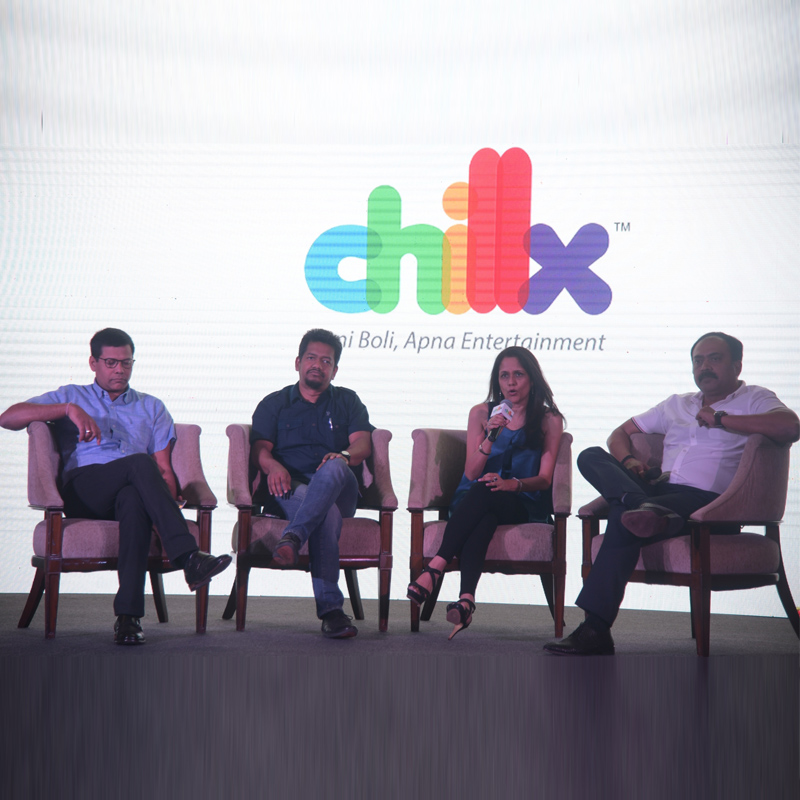
While apps downloaded are mostly in line with the global popularity, interest in content consumption in regional language is high. We have different models like subscription based, ad-supported, a la carte, etc. The priority in urban India which accounts for 33 per cent is entertainment, communication and social interactions whereas for rural which consists of 67 per cent first go for communication than social interactions followed by entertainment. This clearly indicates the digital galore from all India,” asserted Reliance Entertainment CEO content syndication Sweta Agnihotri.
With most of the VODOTT platforms providing content majorly in English and Hindi, the app supplies content in 9 languages (apart from English)- Bengali, Tamil, Telugu, Kannada, Malayalam, Punjabi, Marathi, Gujarati, Hindi Staying true to their tagline ‘Apni Boli, Apna Entertainment,’ the app has a content strength of over 120000+ songs, 10000+ video clips, 5000+ full length movies, 5000+ TV show clips, 2000+ best movie clips, 50000+ ringtones, 50000+ wallpapers and 500+ games. The movie titles from its partners will be made available on the app in 45 days of time right after its launch.
“We saw a clear need for a one-stop multi linguistic entertainment destination in India. Chillx is a one-stop-shop enabling and delivering entertainment on multiple smart devices like smartphones, smart television, tablets, etc. It provides a platform and promotes the consumption of content in numerous ways including preloading of content in devices, memory cards, pen drives amongst other advanced services. This endeavor allows us to widen the scope of consumer engagement on a scale that is possible only when you are a part of one of India’s leading conglomerates-Reliance Industries,” voiced Singh.
It is known that smartphones are the primary device for content consumption for users. Keeping that in mind, the company has partnered with several Original Equipment Manufacturer (OEM) and content curators. The app plans to provide a solution to not just the consumers but also their partners. Its clientele consisting of Karbonn, Lava, Micromax, Samsung, Intex, Videocon, etc, according to them make up for more than 60 per cent of the mobile market share. “32 per cent of the users consume entertainment which is mostly videos. With the mobile traffic growing to 72 per cent in 2020 from 40 per cent right now is a big thing. And they are all going to consume data in local languages. We have come up with co-branded OEM customization and exclusive content showcase with them,” added Singh.
From the past two months, all these mobile brands have included the app’s logo on their boxes thus reaching out to the masses. The app is also available at telecom retail stores and on Google Playstore. It already has got a million handsets from its Phase I, and are targeting 30 million in a year.
“Our content cost is much lower than other start-ups because of our existing relationships and group synergies. It is a good opportunity for us. We don’t plan to provide catch-up TV on our app because that is what the rest of the players are providing. For us, short format videos, games, apps and movies are a big play. We are providing the users one movie or game at Rs 10 which is very reasonable, according to me. Reliance believed in us and so did our advertisers which makes us very proud. The game section allows a user to try and buy premium games. We have an integrated telecom billing option ease of operation for the use and will launch with over 7,000 pieces of content and will add 150 pieces every week,” added Narayan.
The app also allows users to share it on Whatsapp and enables them to increase the brightness, volume and lock the screen without stopping the video. It also allows a user to choose the data limit and download options. It is backed by technology partners Wicore, Xerxes Technologies and Good value.
As far as the content goes, they have partnered with 9XM, Shemaroo, Phantom Films, Rajshri Entertainment, Disney UTV, Reliance Group Synergy, Plan C Studios, etc. Through this, the curators reach out to a larger audience, with better distribution, promotion and monetisation options. The partners can also live monitor all the action and have access to the online dashboard.
“We are very happy to partner with Vijay and Ujjwal. It all started one and half year back and the most important aspect was the kind of people we are working with. We have invested into the company because we believed in their thought process. All the credit goes to Vijay, Ujjwal, Sweta and their team for all the hard work that they have invested. Digital platforms are encouraging a wider audience with diverse consumption patterns, we recognize that this calls for innovative approach in the manner we produce and present our content. We have got more than 100 partners on board. The launch of Chillx is in line with our business vision,” said Reliance Entertainment COO Shibasish Sarkar.
With such a diverse content library, the company also plans to crowd-source content from across India. They have already got content fro 10 genre and are looking at approximately 2500 to 3000 content entries in 8 week’s time. It will also provide original content to the users.
In a world where dozens of apps remain just decorative icons on your smartphones, Chillx, standing true to its name, is a breath of fresh air for the users seeking destinations for entertainment beyond generic methods.

Gaming
India’s new online gaming rules take effect today, banning money games and creating a regulator
The rules, in force from today, separate e-sports from gambling and impose jail terms and stiff fines on violators
NEW DELHI: India’s online gaming sector woke up this morning to a new reality. The Promotion and Regulation of Online Gaming Rules, 2026, came into force today, May 1st, turning a year of legislative intent into enforceable law. The message from New Delhi is blunt: e-sports and social games are welcome; online money games are not.
The rules operationalise the Promotion and Regulation of Online Gaming (PROG) Act, passed by Parliament in August 2025. Together, they represent the most sweeping regulatory intervention India has made in its booming digital gaming market, one that generated Rs 23,200 crore in 2024 and is projected to grow at a compound annual rate of 11 per cent to reach Rs 31,600 crore by 2027. The stakes, in every sense, could not be higher.
A sector out of control
The urgency behind the legislation is not hard to find. An estimated 45 crore Indians have been affected by online money gaming platforms, with losses exceeding Rs 20,000 crore. Addiction, financial ruin, money laundering, and suicides have all been linked to the sector. Seventy-seven per cent of the market’s revenues came from transaction-based games, a figure that made regulators deeply uneasy.
The government’s response, effective as of today, is categorical. Online money games, whether based on chance, skill, or any mix of the two, are banned outright. So is their advertising, promotion, and facilitation. Banks and payment processors are barred from handling related transactions. Unlawful platforms can be blocked under the Information
Technology Act, 2000.
The penalties are designed to sting. Offering or facilitating online money games can attract up to three years in jail and a fine of up to Rs 1 crore, or both. Repeat offenders face a minimum of three years, extendable to five, with fines between Rs 1 crore and Rs 2 crore. Advertising such games carries up to two years in prison and fines of up to Rs 50 lakh, with repeat violations attracting higher penalties still. Cyber cell officers at state and union territory levels, including at police station, district, and commissionerate levels, are empowered to investigate offences.
The new sheriff in town
At the centre of the new framework sits the Online Gaming Authority of India, a digital-first regulator constituted as an attached office of the Ministry of Electronics and Information Technology, headquartered in Delhi. It is chaired by the additional secretary of MeitY and includes joint secretary-level representation from home affairs, finance, information and broadcasting, youth affairs and sports, and law and justice, a deliberately multi-sectoral design built for a complex sector.
The authority’s powers are broad. It will maintain and publish lists of online money games, investigate complaints, issue directions, orders, and codes of practice, hear appeals on user grievances, and coordinate with financial institutions and law enforcement to ensure effective and timely action.
Its decisions on game classification are to be completed within 90 days, a time-bound commitment that industry players have welcomed after years of regulatory ambiguity. Classification can be triggered by the authority acting on its own initiative, by an application from a service provider, or by a notification from the central government. Games will be assessed on objective factors: whether stakes are involved, whether players expect monetary winnings, the revenue model, and whether in-game assets can be monetised outside the game. The outcome is recorded in a determination order specific to the game and provider.
E-sports gets its moment
While the crackdown on money gaming dominates today’s headlines, the rules also carve out a structured path for e-sports and online social games. Registration, required when notified by the central government, applies to all games offered as e-sports and is based on factors including risk to users, scale, financial transactions, and country of origin. A successful application yields a digital certificate of registration with a unique number, valid for up to ten years. Service providers must display registration details, designate a point of contact, comply with data retention requirements, and follow directions on facilitating payments.
Online money games are explicitly ineligible for recognition or registration as e-sports under the National Sports Governance Act, 2025. The separation is deliberate, and the industry has noticed.
Akshat Rathee, co-founder and managing director of NODWIN Gaming, called today’s operationalisation “encouraging,” pointing to publisher-led registration of esports titles and a time-bound determination process as creating “much-needed certainty for all stakeholders.” He added that the “continued emphasis on clearly separating esports from online money gaming is critical in preserving the integrity of competitive gaming as a skill-driven discipline.” He described it as “a proud moment to see official acknowledgement of the broader benefits of responsible esports and gaming, from building confidence, discipline, and teamwork to creating new career pathways for young talent,” and said the framework sets “a strong foundation for the ecosystem to scale in a more structured and globally competitive manner.”
Animesh Agarwal, co-founder and chief executive of S8UL, was equally bullish. “This clarity is critical in unlocking investor confidence and attracting multi-genre brands, while also enabling organisations to take a more long-term view, whether in investing in talent, scaling teams, or building globally competitive formats,” he said, adding that it “strengthens trust among audiences and mainstream stakeholders, positioning esports not just as a sport, but as a fast-growing youth entertainment category in India.”
But Agarwal urged caution on several fronts. There remains limited clarity around financial frameworks, particularly in how esports earnings are treated by banks and financial institutions. A well-defined pathway for the formal recognition or registration of esports teams is still evolving, as are structured player protections. He also called for smoother visa processes for esports athletes competing in international tournaments and for government support in developing infrastructure, including bootcamps, training facilities, and access to high-performance equipment across titles.
Vishal Parekh, chief operating officer of CyberPowerPC India, pointed to downstream effects on education and careers. “With formal recognition and policy backing, colleges and institutions are more likely to take the sector seriously, whether through dedicated esports infrastructure, training programmes, or curriculum integration,” he said, adding that this helps students view gaming as a viable career spanning roles across competitive play, content, game development, and allied industries. He noted that as esports gains prominence in global multi-sport events, the framework strengthens India’s position in international competitive gaming, and called on the ecosystem to provide the right infrastructure and access to high-performance hardware to unlock opportunities in talent development and job creation.
Protecting users, one safeguard at a time
The rules introduce a layered system of user protections calibrated to the risk profile of each game. These include age verification, age gating, time restrictions, parental controls, user reporting tools, counselling support, and fair-play and integrity monitoring. Service providers must disclose their safety features and internal grievance mechanisms when applying for determination or registration.
A two-tier grievance redressal system sits atop these safeguards. Users who are dissatisfied with a platform’s resolution can escalate to the authority within 30 days. The authority aims to dispose of such appeals within a further 30 days. A second appeal lies before the secretary of MeitY, who must also endeavour to resolve matters within 30 days. Enforcement proceedings will be conducted in digital mode wherever possible, with cases targeted for resolution within 90 days from receipt of a complaint.
Penalties under the framework are proportionate, taking into account gain from non-compliance, loss to users, the gravity of the offence, and whether violations are recurring. Mitigation efforts by service providers will also be considered when determining penalties. All penalties imposed under the Act will be credited to the Consolidated Fund of India.
The money follows the rules
For investors and founders, the implications are immediate and significant. Sagar Nair, head of incubation at LVL Zero Incubator, a 100-day sprint designed to accelerate early-stage gaming startups across India, argues that with real-money gaming now prohibited, capital will shift “away from transaction-driven models toward content-led, IP-driven, and global-first gaming businesses.” He acknowledged trade-offs: for operators with exposure to real-money formats, the market becomes more restrictive in the near term. But he argued that by clearly separating esports and non-money gaming from online money gaming, “India is positioning itself as a hub for responsible, creative, and scalable game development.” The opportunity, he said, is “to view India not just as a monetisation-first market, but as a talent, IP, and scale market,” adding that “for founders and investors willing to adapt, this shift could ultimately strengthen India’s position in the global gaming landscape.”
The government frames the wider impact in equally ambitious terms: a boost to India’s creative economy and digital exports, new career pathways for young people, protection for families from predatory platforms, and a stronger voice in global digital governance. India, it argues, offers a model for other countries grappling with the same tensions between gaming’s economic promise and its social risks, one that shows innovation and strong safeguards need not be mutually exclusive.
Whether the framework delivers on those promises will depend on enforcement, always the hardest part. But from today, the architecture is firmly in place: a regulator with teeth, a classification system with deadlines, penalties designed to deter, and a clear dividing line between games that build careers and games that destroy finances. For a sector that has grown fast and governed itself loosely, May 1st, 2026 is the day the free ride ends.