iWorld
Old is gold but new is bold as storytellers strike a nostalgia-novelty mix

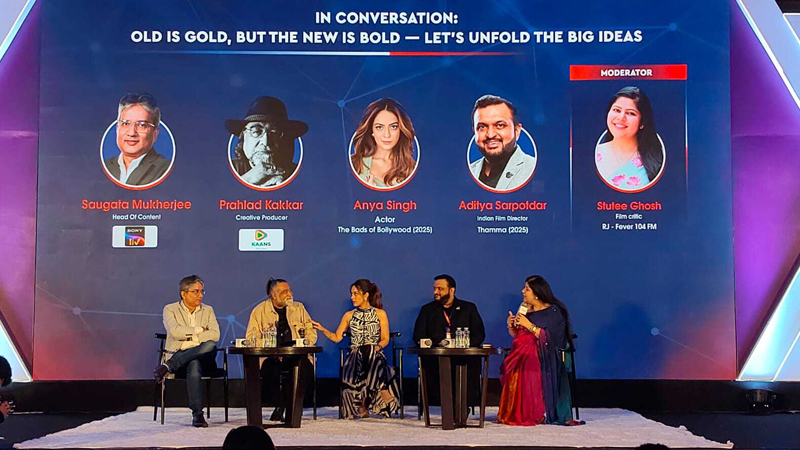
MUMBAI: If nostalgia is the comfort food of entertainment, India’s storytellers are now serving it with a spicy drizzle of novelty and audiences are lapping it up. That was the clear message from the Vidnet Summit 2025 panel titled “Old is Gold, But the New is Bold – Let’s Unfold Big Ideas,” where creators argued that the future of storytelling lies not in choosing between the old and the new, but in mixing them with flair.
Moderated by Stutee Ghosh, film critic and RJ at Fever 104 FM, the session brought together Saugata Mukherjee (content head, SonyLiv), filmmaker Aditya Sarpotdar, legendary adman Prahlad Kakkar and actor Anya Singh. Between banter, brutal honesty and bursts of classic movie references, the panellists dissected what drives today’s audiences and what keeps creators awake at night.
Ghosh kicked things off with praise-laced humour, calling Mukherjee “Ad-Man, Mad-Man”, a nod to his legacy of memorable ad films and platform-defining originals like Scam, Rocket Boys and Hunt. Mukherjee took the cue to make a larger point, “Are you discovering something? Are you looking at something new? Are you entering a world you slightly know but don’t know enough? That’s what streaming must do.” For him, originality isn’t optional, it is the oxygen of OTT.
From SonyLIV’s perspective, he said, audiences gravitate to worlds that feel familiar but fresh. “You give them something unique, something new, something to discover,” he said, citing how Scam, Rocket Boys and Hunt each pulled viewers into new universes anchored in Indian realities.
Filmmaker Aditya Sarpotdar expanded the thought with a paradox creators everywhere grapple with: “I am living through a creative paradox nostalgia and novelty must coexist.” Audiences want emotions, traditions and worlds they recognise, he argued, but told in a way that feels modern, international and visually inventive.
“You have to take them to something they know, but show it to them in a way they’ve never seen.”
He pointed to the response to films like Chhava and Gadar Raj, where audiences flocked to theatres not just for spectacle but for the emotional familiarity wrapped in contemporary storytelling.
Kakkar, never one to mince words, delivered his trademark candour, “The story is the heart of any project. You don’t need big cameras. If the filmmaker is a good storyteller, it doesn’t matter who you cast, if the story doesn’t connect, nothing will work.”
For him, technology is merely the new paintbrush, cheap, accessible and more powerful than ever but utterly useless without soul. “You can make a film on your phone today. The magic lies in narration. Special effects work only when you don’t notice them.”
He repeated his now-iconic line, eliciting laughter across the hall:
“There is no attention deficit, only content deficit. Kids today switch off because they can.” If a story isn’t gripping, he said, algorithms and audiences will send it “straight into a black hole”.
Actor Anya Singh, fresh off the success of The Bads of Bollywood, described the unpredictable nature of audience reception. “You hope for success, but you never know. I knew the show would be watched; I didn’t know every character would be loved this much.” She credited showrunner Aryan for “catching the nerve of every character”, leading to scenes like the viral Imran Hashmi–Raghav Juyal moment travelling far beyond the series. Success, she said, only reinforces instinct: “I don’t know how to be calculative. I’m instinctive and passionate.”
Ghosh steered the discussion toward an unavoidable reality: algorithms now influence what people consume, often more than marketing does. As she put it: “We’re in a landscape where the algorithm decides our viewing diet.”
Mukherjee countered that authenticity still wins over any machine. Shows like Maharani, Undekhi and Tabbar, he noted, worked because SonyLIV stayed committed to a clear content philosophy. “We will take the bets others don’t. The audience is very smart. Authenticity breaks through.”
Sarpotdar argued that audiences today also intuitively recognise which story belongs on which medium. “Every story has its own life. Some are meant for intimate OTT viewing; some demand collective theatrical energy.” Trailers, posters and first looks, he said, now instantly tell audiences whether a film deserves a cinema ticket or a couch.
Kakkar, meanwhile, returned to his favourite equation: “Two plus two is not four. In filmmaking, two plus two is twenty-two.” Logic, he insisted, cannot guide creativity. Passion must glue creators, platforms and financiers together; otherwise projects fall apart. “Passion is illogical. And that’s why it works.”
As the session wrapped, the panel collectively agreed on one thing: India today is witnessing the most exciting phase of storytelling in decades. The audience is informed, exposed and utterly unwilling to tolerate mediocrity. They seek worlds that move them, stories that surprise them, and characters that feel both iconic and intimate.
And in this era of platforms, algorithms and limitless choice, the new rulebook is simple old is gold, new is bold, and the real magic lies in blending both with fearless imagination.






