Connect with us

e-commerce

NFTICally unveils Comearth to drive e-commerce in the Metaverse

Published

on

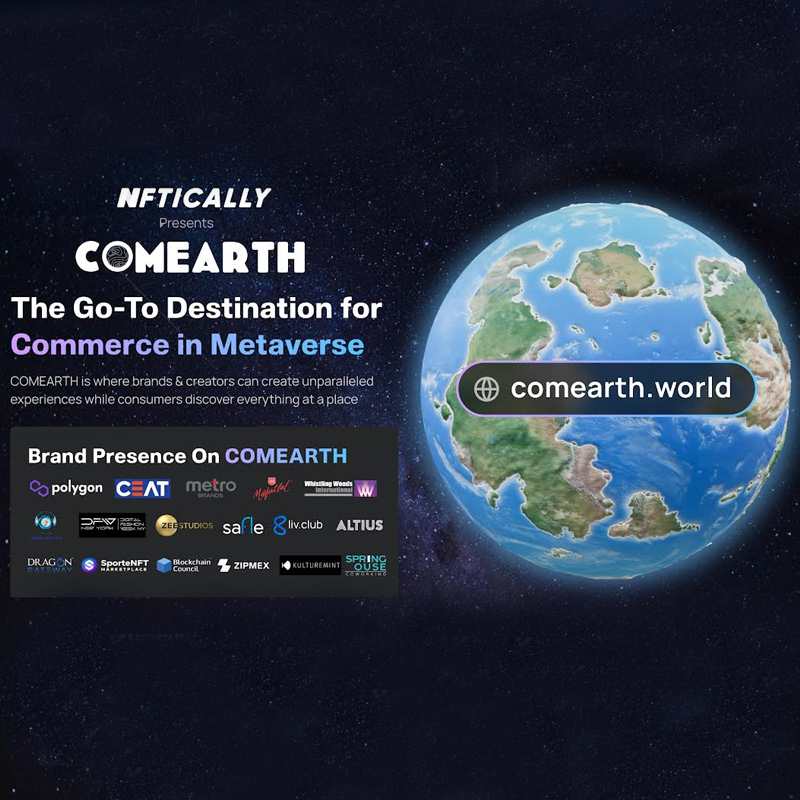
MUMBAI: Global Web3 E-Commerce SaaS platform NFTically has launched  Comearth. This is a destination for commerce in the Metaverse. Comearth, a 3D immersive virtual environment, will be powered by NFTically’s “Web3 E-Commerce Engine ” & backed by the trust and decentralization of the Polygon Blockchain. In Comearth, brands, enterprises, content creators, and celebrities will be able to purchase their virtual spaces / virtual real estate as Comearth’s “Citizens” and launch the e-commerce experiences for their customers, consumers and followers.

 The metaverse has the potential to be a $13 trillion ecosystem within a decade. The e-commerce industry also is expected to expand at a CAGR of 22.9 percent between the years 2020-2027 to size over $16.2 trillion. Exploring the intersection of two burgeoning markets, Polygon co-founders Sandeep Nailwal & Jaynti Kanani, Coinbase CPO Surojit Chatterjee, Unacademy co-founders Gaurav Munjal, and Roman Saini, Indian film-maker Subhash Ghai, Actor Kunal Kapoor, Capital X’s Cindy Bi, Nazara’s Nitish Mittersain have invested in NFTICALLY to build a 3D immersive metaverse ecosystem that would power e-commerce for 100,000 brands & individuals by 2025.

NFTically founder & CEO Toshendra Sharma said, “Web3 is the next generation of the internet, which will profoundly impact e-commerce solutions. Comearth will bring a fully-immersive DIY layer to e-commerce and enable immersive hyper-personalisation for everyone. We intend to democratise and facilitate mass Web3 adoption & bridge the gap between web3 and web2 E-Commerce.”

Advertisement

 The launch was graced by NFTICALLY’s advisors and partners including film writer-director, producer, Subhash Ghai, Mafatlal Group vice-chairman Priyavrata Mafatlal, Kulturemint director Govind Singh Sandhu and The Blockchain Council CEO Pradeep Aswal. They reflected upon the perspectives of brands getting empowered with Comearth for augmenting retail and consumer experiences.

 Comearth comprises different sizes of land parcels that cater to businesses and industries ranging from large to small enterprises, celebrities, and individuals. It will act as a global marketplace for goods (digital, physical, and phygital) and services (within and outside of the Metaverse) & facilitate e-commerce and lead generation. The land parcels can be purchased as NFTs and are governed by the smart contracts deployed on top of Polygon Blockchain. The comprehensive DIY tools empower the landowners to start their metaverse venture in minutes and will be accessible by mobile, laptops, and VR devices.

 Polygon Studios Metaverse lead Brian Trunzo said, “Polygon Studios is pleased to welcome Comearth as a valued partner into the ecosystem. Their easy-to-use and powerful suite of tooling brings brands and rights holders closer to their audiences — a key aspect of facilitating broader Web3 adoption”.


Advertisement
Click to comment

Leave a Reply

Your email address will not be published. Required fields are marked *

e-commerce

Visa report tracks rise of India’s affluent, experience-led spending

Affluent base doubles to 130 lakh, travel 58 per cent of elite spends.

Published

on

MUMBAI: In India’s new luxury playbook, it’s less about owning more and more about living better. A new whitepaper by Visa Consulting and Analytics (VCA) maps a decisive shift in India’s affluent economy, where spending is becoming more intentional, experience-led, and closely tied to personal identity rather than pure income growth.

Titled India’s Affluent Economy 2025–2026, the report draws on a Visa-commissioned Yougov study and VisaNet data across travel, dining, retail and lifestyle categories. The headline number is hard to miss: individuals earning over Rs 10 lakh annually have nearly doubled from 69 lakh to 130 lakh, significantly expanding the country’s discretionary spending base.

But it’s not just about scale, it’s about behaviour. As consumers move up the affluence ladder, discretionary categories are taking a larger share of credit card spends, positioning cards as key enablers of premium, lifestyle-driven consumption.

Advertisement

The geography of wealth is shifting too. Affluence is no longer confined to metros such as Mumbai, Delhi and Bengaluru, with cities like Ahmedabad, Surat, Jaipur and Lucknow increasingly mirroring metro consumption patterns.

The report highlights a clear pivot from ownership to access. More than 50 per cent of affluent consumers now use cards for elite memberships, while 7 in 10 are drawn to limited-edition drops and curated collections. Increasingly, luxury is defined by seamless access be it concierge-led travel or curated dining where time saved is as valuable as money spent.

Spending patterns reinforce this shift. Among the ultra-elite, travel accounts for 58 per cent of discretionary spends, far outpacing retail and luxury combined at 28 per cent. Cross-border spending penetration stands at 63 per cent, signalling a growing global outlook among India’s affluent.

Advertisement

Closer home, indulgence is becoming routine. Nearly 4 in 5 affluent consumers dine at premium establishments at least three times a year, while 1 in 4 visit luxury venues more than five times annually. Dining spends are also climbing, with Rs 20,000 emerging as a new entry-level benchmark per experience and Rs 50,000 marking premium territory.

Retail, meanwhile, is becoming more selective. Three in four affluent consumers make a high-end purchase at least once a quarter, while one in four shops premium every two weeks. Luxury retail intensity is also rising, with 2 in 5 consumers spending over Rs 5 lakh annually, and a smaller but significant segment exceeding Rs 10 lakh.

Technology and wellness are carving out new roles in this ecosystem. High-end gadgets now see average spends of Rs 60,000 or more per purchase, while ultra-elite consumers are eight times more likely to visit spas and show five times higher engagement with cosmetic stores than non-affluent groups.

Advertisement

The broader takeaway is structural. Affluent consumers are no longer buying products, they are buying ecosystems. Integrated experiences across travel, dining, wellness and payments are becoming central to how this segment lives and spends.

As India’s affluent base expands beyond metros and aligns more closely with global consumption patterns, the real opportunity lies not just in size, but in speed. For brands, the message is clear: relevance will be defined by how early and how seamlessly, they plug into this evolving lifestyle economy.

Advertisement
Continue Reading

Advertisement News18
Advertisement
Advertisement
Advertisement
Advertisement Whtasapp
Advertisement Year Enders

Indian Television Dot Com Pvt Ltd

Signup for news and special offers!

Copyright © 2026 Indian Television Dot Com PVT LTD