News Broadcasting
News Channels: Sensation-fatigue, government’s attitude and regional channels will decide future content

Why has phenomenon of unrestrained inputs developed is one question that if answered well, will rid us of taking moralistic positions. In this the points made by QW Naqvi, News Director at TV Today are pertinent.
Naqvi says that first there was none, and then there was clutter of private news channels and the clutter will increase as days go by. To cut the clutter, channels did what has been seen in Bollywood in terms of genres of films. Some channel did something, which clicked and all channels started doing the same thing, which became a wave.
Successive waves of formulae came and went, first family tension-based stories, then crime, then violence and sex and then bhoot-pret and the seemingly ridiculous, as this year the channels bent over backwards to snatch the ephemeral eyeballs from each other.

Part of the phenomenon is because Indian news channels spend relatively much less money and try to break even fast and run the shortest course, cutting at the corners, but that is only part of the story.
The other part is that over the past year, lifestyles have vastly changed and worries have shifted in the urban middle class areas from roti-kapda-makaan to a restless quest about how to best entertain themselves. The news channels have been trying to answer that quest for the viewers by experimenting with their own formulae, from serious to sensatonal.
In this process Aaj Tak itself became a victim, in the sense that it did go over to the sensational, though it did not banish serious news or socially relevant stings that shook the country.
And here comes the third point: Aaj Tak is – despite the veering away from serious news – doing the best in terms of turnover. What does that show? That advertisers are flocking for the raw hide?
Quite contrarily, Narayan Rao says that despite sticking to the hard news path, they are today not number three in ratings, but firmly sticking to the number two position in terms of revenue, so what does that show?
Perhaps the picture will become clearer if we see that despite drawbacks, IBN 7 did reach a point where it had a 14 per cent market share this year, from a lowly six a year ago, and though it could not retain that share that for too long, according to Ashutosh, “this shows that there is scope for serious news”.
Also, according to industry sources, India TV is far more disadvantaged in revenue terms than its ideological opponent IBN 7, which though it has not broken even is doing better business.
But the ethical debate in 2007 was really being driven by the fact that there has been a consistent fear in the minds of the CEOs that the vanilla channels with soaring and consistent ratings, would sooner or later bag the big brands, who could shift greater proportions of their spendings to higher rated channels.
Rating itself has been debated widely this year, especially in the captains in the news channel space, and barring India TV, which says that only those gripe about rating who get the wrong end of the stick, all major channels are today questioning various aspects of rating system of TAM, even while agreeing that it is as of date the industry standard.
The sample size has been questioned, so has been the possibility of tampering with people metre homes, and also the issue that it is a Western system that does not take into consideration the plurality of Indian society, and even the highest rated channel’s news head, Naqvi too feels that there is need for vast improvements in the system.
This year, TAM has ruled the market, creating what Sardesai has termed the ‘tyranny of the eyeball-driven marketplace’.
But then going by the above discussion, where we saw Aaj Tak stay at No. 1 with its mix of the sensational and serious in equal measure, and yet NDTV stay at No. 2 with its insistent on serious journalism, it seems that TRP is not driving revenue flows: it is after all, perceptions, and here is why.
Let us not forget that Aaj Tak had started out a decade ago as the private sector’s perfect answer to sterilised government reporting on Doordarshan and had been marked by three specific attractions: accuracy and speed and courage. The perception of Aaj Tak as a credible channel that talked a lot more things than the PMs and the CMs had made it a darling of the masses as well as the classes.
When advertisers today decide on apportioning monies from their budget, their perception of NDTV and Aaj Tak have remained the same, though one changed and the other did not.






News Broadcasting
Rajesh Sundaram joins NDTV Profit as senior editor, assignment
The 32-year newsroom veteran has launched channels on three continents and covered everything from 9/11 to South African television
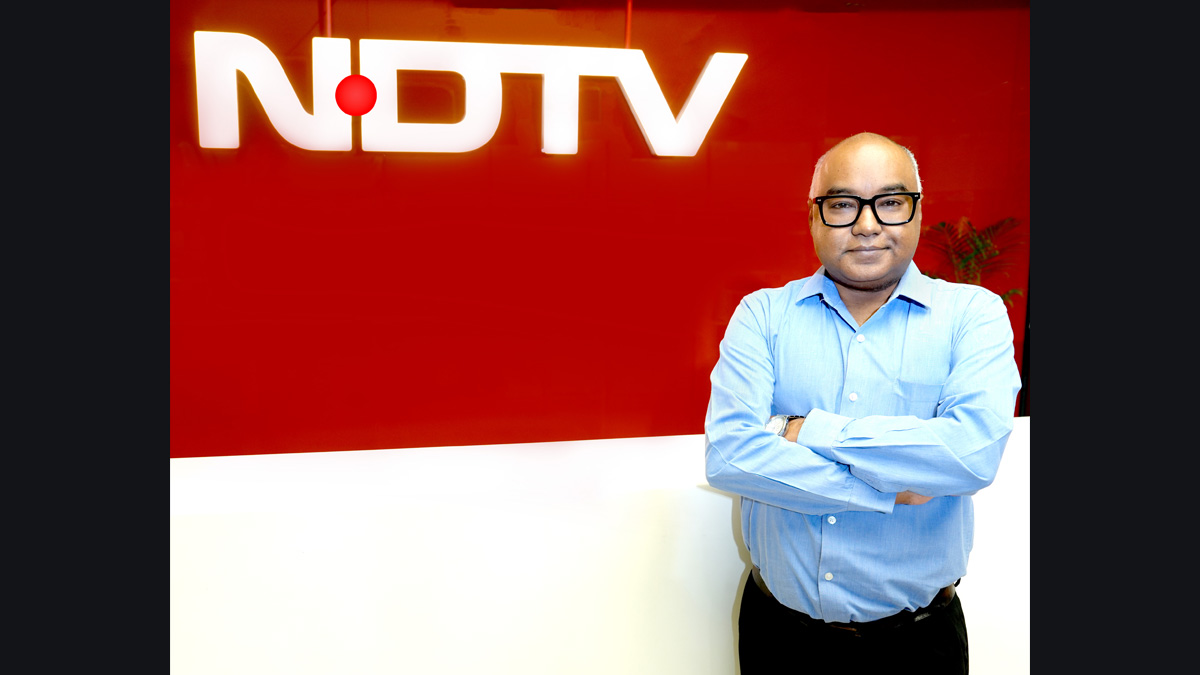
MUMBAI: NDTV Profit has bolstered its newsroom with a hire who has done rather more than most. Rajesh Sundaram, a journalist with over three decades of editorial, managerial and consultative experience across India and international markets, joins as senior editor, assignment, tasked with sharpening the network’s newsgathering and real-time response.
Sundaram’s career reads like a tour of Indian media’s most formative moments. He began at Businessworld in 1994, moved to Zee News as bureau chief across Mumbai and Chennai, then joined NDTV in 2002 as part of its political bureau during a particularly febrile period in Indian politics. A stint as India correspondent for Al Jazeera International followed, where he covered key geopolitical developments and got his first serious taste of the global newsroom.
What sets Sundaram apart, however, is his serial channel-launching habit. At NewsX, he helped get the operation off the ground. At Headlines Today, part of the India Today Group, he served as editor. At News Nation, he helped launch the Hindi news channel and its digital ecosystem. He then crossed continents to lead the launch of ANN7 in South Africa as editor-in-chief, overseeing both television and digital. Back in India, he launched Tamil news channels News7 Tamil and Cauvery News, and later served as principal consultant for the launch of Marathi channel Lokshahi. Most recently, he helped build and lead the Press Trust of India’s video service and content studio, before stints consulting for Business Today and The Himalayan Times.
Rahul Kanwal, chief executive and editor-in-chief of NDTV, left little doubt about what Sundaram is expected to deliver. “The assignment desk is where a newsroom’s intent becomes action,” he said. “Rajesh brings a rare combination of field experience and leadership in building news operations at scale.”
Sundaram has reported from across India and the world, covering elections, civil conflicts, the aftermath of the 9/11 attacks and the 2008 US presidential election.
At NDTV Profit, he will lead the assignment desk, driving editorial coordination and real-time response across markets and breaking developments. For a business news network sharpening its focus on speed and multi-platform delivery, it has hired a man who has built newsrooms from scratch on three continents. The assignment desk is in good hands.







