Cable TV
MCOF seminar aims to educate LMOs

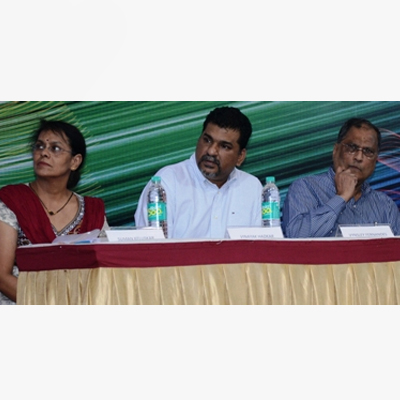
MUMBAI: Constituted just over a year ago to protect cable operators and safeguard their business, the Maharashtra Cable Operators’ Federation (MCOF), today organised its first business and education seminar in Mumbai.
Held in Hindi and English,around 400 Last Mile Operators (LMOs) travelled from neighbouring states like Gujarat, Andhra Pradesh, Goa and Karnataka for it.
The first session was to educate LMOs about the importance of customer care and enhancing the quality of service. Vishwamangal Education CEO Suman Keluskar who deals in soft skills highlighted the need for LMOs to be well groomed as well as train their subordinates to be the same to make customers feel good.
Suman Keluskar, Vynsley Fernandes and Tony D’Silva spoke about customer care, global trends in cable TV and the upcoming HITS technology respectively
“The reason why customers welcome a Pizza Hut boy is because he is nice to them,” she said, stressing that customers today were ready to pay for good service but for that to happen, LMOs needed to know the opportunities available to them as well as what customers were demanding. “Innovate in your production. Use the internet to advance yourself,” she said.
Session two discussed how while LMOs across the globe have learnt to monetise their business, back home, it continues to be a loss-making one. Addressing the session, Castle Media director Vynsley Fernandes, started off by describing how developed countries such as the US, UK and Taiwan had faced the same issues that India is currently facing. But the cable ops dealt with them through innovation and have today grown to last mile digital system providers.
“From the time the Gulf War happened and everybody wanted to watch TV, things are much different now. Multi-screen viewing is what is happening now,” he said.
Citing the example of the US, where operators have increased their revenues despite a drop in the number of TV homes, and are expecting the ARPU to go up to $40 from $21 currently in the next five years, Fernandes reasoned this was because they had adapted to using TV along with the Internet and were offering viewers a multi-screen experience.
He pointed out that concepts like Hybrid Broadband TV, second screen, catch up TV, time shift TV, TV on mobile etc. had already penetrated the US markets and helped cable operators exponentially.
“Think long term as to whether you can monetise your product. Whenever you are investing in a technology, what is its future road map?” he urged, saying that the only challenge would come from OTT services such as Netflix and Hulu where movies and channels will go directly on the Internet without the need for an MSO or LMO. However, he was quick to add that this hasn’t met with much success in India, yet.
While advertisers are approaching LMOs to target specific demographics on TV, the STBs taken up by LMOs are not so advanced, Fernandes said. Pointing out that in the US, LMOs provide a posse of services including entertainment, home monitoring, automation comfort, energy management and wellness assisted living, in India too, “an LMO should be the one-stop digital services’ stop for customers,” he concluded.
Drawing upon his experience in broadcast and DTH to present his project on Headends in the Sky (HITS), former Sun TV CEO Tony D’Silva said this was a good prospect for LMOs to think about.
D’Silva said that most consumers watch not more than 12 to 15 channels and so, it was necessary to create such packages and device-shifting technologies for the future.
“You are at the threshold of a game change. Our main threat is the DTH players and we need to be above them and have a robust system,” he said, stressing that HITS was a much better option for LMOs than taking signals from MSOs. Under HITS, the agreements are directly with broadcasters, there are no carriage fees, and it would yield higher revenue (Rs 108) as compared to dealing with an MSO (Rs 59.5) or even independently (Rs 85).
“The biggest cable company in the world today is Comcast. 17 million out of Comcast’s 22 million subscribers get supply services from HITS and Comcast gives its customers all the benefits that Fernandes spoke about,” said D’Silva, urging LMOs to adopt HITS through which they could choose and demand things as well as insert local channels, the revenue from which would be completely theirs.
A local cable operator from Goregaon, Bernadette Dsouza, said: “I have come for the seminar to know about new opportunities as well as how to save my business from MSOs’ domination.”
The good news is MCOF plans to hold such seminars in other states as well in the coming months.