News Broadcasting
Manic Monday: Media scrips join Sensex free fall


MUMBAI: It was truly a Manic Monday for Dalal Street. For the second time in the indices’ history (the first being on 17 May, 2004), trading was suspended at the BSE this morning. The Sensex fell by a whopping 1111.70 points in the morning trade below 10,000 to settle at 9,826.91.
However, it recovered substantially to close at 10,482 down 457 points. The NSE Nifty, on the other hand, closed at 3081 down 166 points. Media stocks, like the predominant market sentiment, were on a downslide.
In order to avoid pandemonium in the market, Sebi chief M Damodaran asked people not to go by rumours but to take informed decisions. According to him, Sebi was in touch with the RBI and there were no liquidity problems.

Among the entertainment and media stocks, one company that managed to beat the heat on the bourses was Times Group company Entertainment Network India Ltd (ENIL), which operates the Radio Mirchi brand. The company’s stocks opened at Rs 239.85 and closed higher at Rs 241.10, thus registering a marginal gain of 0.63 per cent.
The biggest loser today was Prannoy Roy’s NDTV Ltd. The stocks of NDTV opened at Rs 220 today and closed at Rs 190, weaker by 13.64 per cent. Mid-Day Multimedia, on the other hand, recorded a drop of 11.82 per cent and closed at Rs 61.15 (previous close Rs 69.35).
Pritish Nandy Communications shed 10.14 per cent to close at Rs 45.65 from its previous close of Rs 50.80. Hinduja TMT; which on Friday 19 May took the deepest plunge, going down by Rs 48.30 to close at Rs Rs 701.75; today dropped 3.10 per cent to close at Rs 680.
Sahara One Media and Entertainment Ltd and BAG Films both shed around eight per cent in today’s bloodbath. TV Today Network was weaker by 7.76 per cent to close at Rs 81.45 at the end of the day’s trade. K Sera Sera also lost 7.45 per cent and ended the day at Rs 36.05. Television Eighteen shed 5.18 per cent (down Rs 32.95 from yesterday closing at Rs 603.20).
Company
Last Traded Price
Previous close
Change
Per cent change
Adlabs Films
Rs 267.30
Rs 271.45
Rs -4.15
-1.53
BAG Films
Rs 9.63
Rs 10.54
Rs -0.91
-8.63
Balaji Telefilms
Rs 139.95
Rs 147.00
Rs -7.05
-4.80
Cinevistaas
Rs 21.45
Rs 22.55
Rs -1.10
-4.88
ENIL
Rs 241.10
Rs 239.60
Rs 1.50
0.63
ETC Networks
Rs 37.65
Rs 38.50
Rs -0.85
-2.21
Galaxy Ent
Rs 251.15
Rs 260.95
Rs -9.80
-3.76
Gemini Comm
Rs 420.00
Rs 433.30
Rs -13.30
-3.07
Hinduja TMT
Rs 680.00
Rs 701.75
Rs -21.75
-3.10
Jain Studios
Rs 27.60
Rs 29.00
Rs -1.40
-4.83
K Sera Sera
Rs 36.05
Rs 38.95
Rs -2.90
-7.45
Mid-Day Multimedia
Rs 61.15
Rs 69.35
Rs -8.20
-11.82
Mukta Arts
Rs 42.95
Rs 45.20
Rs -2.25
-4.98
NDTV Ltd
Rs 190.00
Rs 220.00
Rs -30.00
-13.64
Pritish Nandy
Rs 45.65
Rs 50.80
Rs -5.15
-10.14
Sahara One Media
Rs 324.00
Rs 354.00
Rs -30.00
-8.47
Saregama
Rs 241.65
Rs 254.05
Rs -12.40
-4.88
Sun TV
Rs 1159.55
Rs 1192.35
Rs -32.80
-2.75
TV Eighteen
Rs 603.20
Rs 636.15
Rs -32.95
5.18
TV Today
Rs 81.45
Rs 88.30
Rs -6.85
-7.76
UTV
Rs 176.00
Rs 183.55
Rs -7.55
-4.11
Zee Telefilms
Rs 228.20
Rs 229.60
Rs -1.40
-0.61
In the vicinity of the one – five per cent loss incurred by companies were the likes of Mukta Arts (-4.98 per cent), Cinevistaas (-4.88 per cent), Saregama (-4.88 per cent), Balaji Telefilms (-4.80 per cent), Jain Studios (-4.83 per cent), UTV (-4.11 per cent), Sun TV (-2.75 per cent), ETC Networks (-2.21 per cent), Adlabs Films (-1.53 per cent).
Media major Zee Telefilms had a relatively quiet day at the bourses, closing at Rs 228.20 down a minimal -0.61 per cent from yesterday’s last traded price of Rs 229.60. On the Nifty, meanwhile, Zee ended the day at Rs 227.40, down 1.22 per cent from yesterday’s close of Rs 230.20.
The big question on every market punter’s mind at the moment seems of course to be just how low will low go. When will the “market correction” bottom out is something no one seems to be able to hazard a guess on currently.







News Broadcasting
Network18 channels lead YouTube news viewership in March 2026
CNN-News18, News18 India and CNBC channels top categories with record views
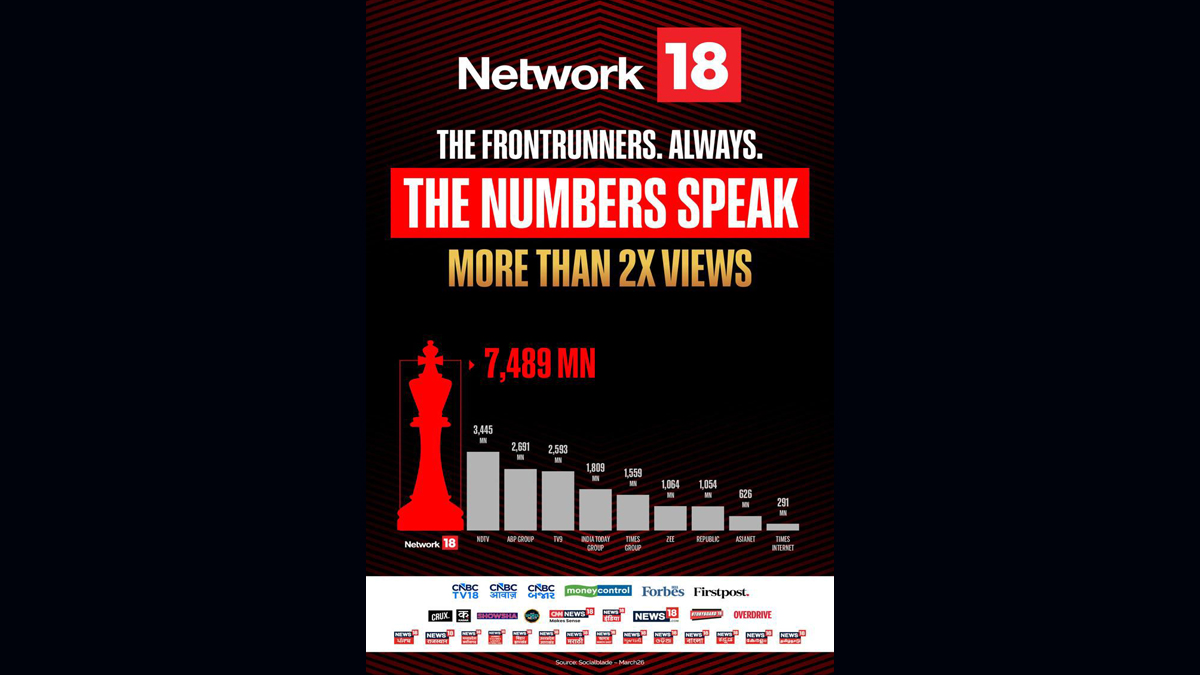
MUMBAI: When the world hit refresh on breaking news, Network18’s channels were already streaming ahead. As geopolitical tensions and war-driven headlines fuelled a surge in global news consumption, the network’s digital playbook delivered big clocking record Youtube viewership across English, Hindi and business news categories in March 2026.
At the forefront was CNN-News18, which emerged as the clear leader in the English news segment with 130 million live and video-on-demand views. The channel edged past competitors such as Times of India (126.5 million), Times Now (101.1 million), India Today (88.2 million) and NDTV (77.5 million), according to Databeings data for March.
In the Hindi news arena, News18 India delivered a commanding performance, racking up a staggering 3,297 million views on YouTube. The channel comfortably outpaced NDTV India, which recorded 3,119 million views, underlining its deep reach and consistent engagement with mass audiences, as per Playboard data.
The network’s dominance wasn’t confined to general news. In the Hindi business segment, CNBC Awaaz topped the charts with 92 million views, narrowly ahead of Zee Business (90 million) and well ahead of ET Now Swadesh (57 million). Meanwhile, its English counterpart CNBC-TV18 posted a strong 58 million views, reinforcing the network’s cross-category strength.
The spike in viewership reflects a broader shift in audience behaviour, with viewers increasingly turning to digital platforms particularly Youtube for real-time updates and in-depth coverage during high-intensity news cycles. For Network18, the numbers signal more than just scale; they underline the effectiveness of a multi-platform strategy that blends speed, credibility and continuous coverage.
In a month where the news never paused, it seems viewers chose to stay tuned where the stream never stopped.






