iWorld
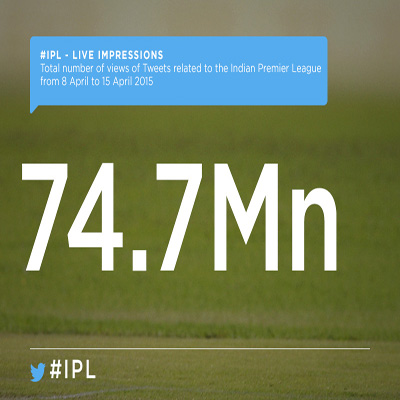
IPL opening eight days total 74.7 million live impressions: Twitter Brand index
MUMBAI: With 74.7 million live impressions during the opening eight days of the eighth season of the Indian Premier League (IPL), Twitter is abuzz with excitement. While defending champs Kolkata Knight Riders (KKR) have had a stop-start beginning, the Rajasthan Royals (RR) rushed out of the gates and the Indian captain led Chennai Super Kings (CSK) continued to be crowd favourites as there was hardly any surprise on their first match versus Delhi Daredevils (DD) being the most talked about game on Twitter between 8 – 15 April, 2015.
Below are the games ranked in descending order of the most live impressions:
1. #KKRvMI (8 April 2015)
2. #CSKvDD (9 April)
3. #KKRvRCB (11 April)
4. #CSKvSRH (11 April)
5. #RCBvSRH (11 April)
6. #MIvKXIP (12 April)
7. #RRvMI (14 April)
8. #DDvRR (12 April)
9. #KXIPvRR (10 April)
10. #KXIPvDD (15 April)
Top Moments, on the basis of Tweets Per Minute, between 8 – 15 April, 2015 were:
1. Chennai Super Kings beat Delhi Daredevils by one run.
2. Royal Challengers Bangalore defeats Kolkata Knight Riders by three wickets.
3. Kolkata Knight Riders defeats Mumbai Indians by seven wickets
4. Chennai Super Kings’ Brendon McCullum brings up his century off 56 balls against Sunrisers Hyderabad.
5. Kings XI Punjab defeats Mumbai Indians by 18 runs.
#Orangecap & #Purplecap
Most mentioned batsmen and bowlers on Twitter during the Live Match Windows with the hash tags #OrangeCap and #PurpleCap are:
Batsmen:
1. Yuvraj Singh (Orange Cap) (@YUVSTRONG12)
2. Rohit Sharma (@ImRo45)
3. Chris Gayle (@henrygayle)
Bowlers:
1. Harbhajan Singh (Purple Cap) (@harbhajan_singh)
2. Morne Morkel (@mornemorkel65)
3. Ashish Nehra
Ranking of Most Mentioned IPL Teams on Twitter from 8 – 15 April:
1. Kolkata Knight Riders
2. Chennai Super Kings
3. Mumbai Indians
4. Delhi Daredevils
5. Kings XI Punjab
6. Royal Challengers Bangalore
7. Rajasthan Royals
8. Sunrisers Hyderabad

iWorld
Telcos push for unified rules as spam shifts to OTT platforms
Over 80 per cent fraud moves online, operators seek common framework.
MUMBAI: The spam may have left your phone network but it hasn’t left you alone. India’s telecom operators are once again dialling up the pressure for a unified regulatory framework, warning that fraud is rapidly migrating to internet-based platforms where oversight remains far looser. According to industry communication, a leading operator has written to multiple arms of the government including the Department of Telecommunications, the Ministry of Electronics and Information Technology and the Ministry of Finance arguing that tighter controls on traditional telecom networks are inadvertently pushing bad actors towards over-the-top (OTT) communication platforms.
The concern is not new, but the framing has sharpened. What was once an industry grievance is now being positioned as a consumer protection issue. Operators say that tackling spam in silos no longer works, as fraudsters seamlessly shift across platforms, exploiting regulatory gaps. The result: a moving target that traditional safeguards struggle to contain.
Executives point to a clear shift in fraud patterns. OTT platforms are increasingly being used for phishing links, impersonation scams and bulk unsolicited messaging, with industry estimates suggesting that over 80 per cent of spam activity has now migrated online. In this environment, the lines between telecom networks, messaging apps and financial fraud are blurring fast.
At the heart of the industry’s demand is a call for a technology-neutral regulatory framework, one that applies consistently across telecom and internet-based communication services. Operators argue that the absence of uniform safeguards, such as sender verification systems, robust spam filters and clearly defined accountability mechanisms, has created enforcement blind spots that fraudsters are quick to exploit.
The proposal is straightforward but far-reaching. Telcos are pushing for baseline anti-fraud measures across all communication platforms, alongside faster response systems and deeper coordination between ministries. Given the interconnected nature of telecom networks, digital platforms and financial systems, they argue that fragmented oversight only weakens the overall defence.
The broader issue is regulatory arbitrage, the ability of bad actors to hop between platforms based on which is least regulated at any given time. Without harmonised rules, operators say, efforts to curb fraud risk becoming a game of whack-a-mole.
As digital communication continues to expand, the debate is shifting from who regulates what to how consistently it is regulated. For now, telecom operators are making their case clear: in a world where spam travels freely, regulation cannot afford to stay fragmented.