I&B Ministry
Govt. earmarks Rs 13 crore for DAS Phase III & IV completion

NEW DELHI: The government has earmarked a sum of Rs 13.02 crore for completion of Phase III and IV of Digital Addressable System (DAS) for cable television.
Minister of State for Information and Broadcasting Rajyavardhan Rathore informed the Parliament that the scheme ‘Mission Digitization’ had been drawn up and a sum of Rs 1 crore out of the total Plan allocation had been earmarked for the MIS Software.

A multi-lingual and multi-desk toll free call centre was established under the Mission Digitisation Project to address peoples’ queries regarding ongoing cable TV digitization in the country.
Answering a question about committees set up by the Ministry for overseeing DAS, he said a Task Force had been set up to steer the digitization of cable TV network in the country in the remaining Phase III & IV. All the stakeholders, State level nodal officers of all States/UTs, Departments of Electronics and Information and Technology, Telecommunications and others including one consumer forum from each region have been made members of the body.
Referring to other committees relating to television, the Minister said an Inter-Ministerial Committee (IMC) had been constituted to take cognisance suo moto or to look into specific complaints regarding content on private TV channels on any platform including direct to home (DTH) & FM Radio with regard to violation of the Programme and Advertising Code as defined in Rule 6 & 7 of the Cable Television Network Rules, 1994 for TV channels & applicable Content Code for Radio.
Members include the I&B, Home Affairs, Law & Justice, Women & Child Development, Health & Family Welfare, Extemal Affairs, Defence, Consumer Affairs, and Food and Public Distribution Ministries apart from a representative of the Advertising Standards Council of India (ASCI).
On a question about use of modern technology, Rathore said his Ministry and the Media Units under the administrative control of the Ministry have been consistently making efforts to use the state-of-art technology to increase their efficiency.
In a bid to modernise the Press Information Bureau (PIB), officers are being equipped with laptops and smart phones to enable them to effectively use Information Technology to disseminate information.
Rathore added that mobile applications like WhatsApp have been utilised by the Department of Field Publicity during ‘Beti Bachao Beti Padao’ campaign in Rajasthan during March 2015 and other Special Outreach Programmes.
The Minister added that MIB and most of the Media Units under its control had presence on various social media platforms like Twitter, Facebook, Blog, Google+, YouTube and Instagram. These platforms were being used to disseminate information due to easy accessibility and their wider reach.
The Ministry’s Twitter account had 425,000 followers, its Facebook account has more than 1.1 million likes, YouTube has 4,049,641 views, the blog page has 1.9 million page views and Instagram has 1040 followers.
The PIB website is being revamped and new technologies such as live streaming, smart phones, hi-speed broadband etc. are being used for this purpose.
Video conferencing facilities are also being installed to carry out the live streaming of press conferences by important news makers.







I&B Ministry
India tightens anti-piracy law, blocks sites and Telegram channels
New rules bring jail terms, fines and faster takedowns of illegal content
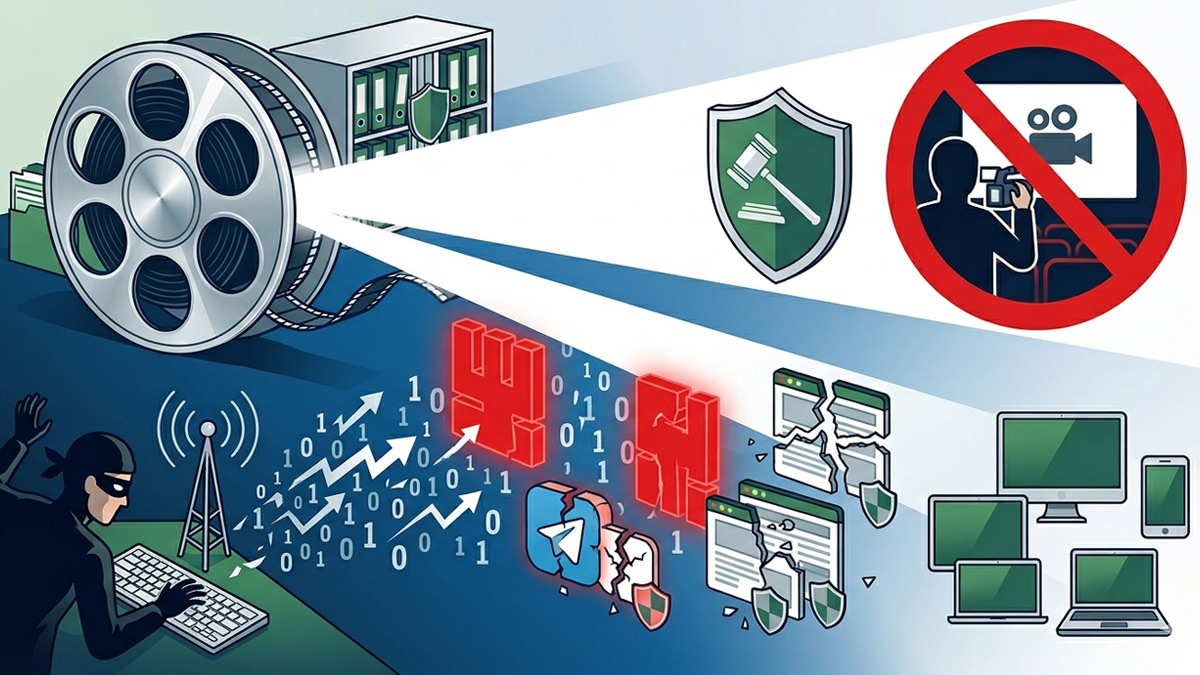
NEW DELHI: The Government of India has stepped up its fight against film piracy, invoking stricter provisions under the Cinematograph Amendment Act 2023 to crack down on unauthorised recording and distribution.
The law now imposes tougher penalties, including jail terms ranging from three months to three years and fines starting at Rs. 3 lakh, which can go up to 5 per cent of a film’s production cost. The provisions target both illegal recording in cinemas and unauthorised online transmission.
In a fresh enforcement push, authorities have notified the Telegram platform to act against piracy, leading to the identification of 3,142 channels allegedly distributing copyrighted content without permission. In parallel, access to around 800 piracy websites has been blocked through internet service providers.
The action has been taken under the Information Technology Act 2000, which empowers the government to direct intermediaries to remove unlawful content. The framework is further reinforced by the Information Technology Rules 2021, requiring platforms to act swiftly when notified of violations.
An institutional mechanism is also in place, allowing copyright holders and authorised representatives to file complaints through designated nodal officers. Once verified, these complaints trigger takedown notices to intermediaries for disabling access to infringing content.
The update was shared in Parliament by Government of India minister of state information and broadcasting l murugan in response to a query from Parimal Nathwani.
The government’s latest move signals a sharper, more coordinated approach to tackling piracy across both physical and digital channels. For the film industry, it is a step towards protecting revenues, while for viewers, it reinforces the shift towards legitimate content consumption.








