Connect with us

iWorld

Donald Trump barred from Facebook ‘indefinitely’

Published

on

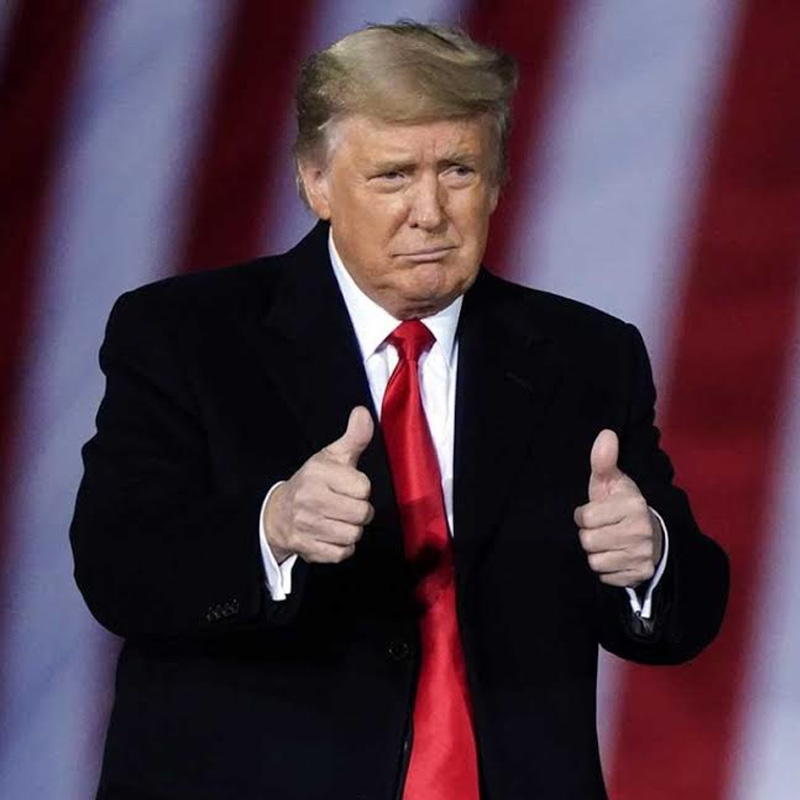
NEW DELHI: Facebook has indefinitely banned US president Donald Trump from its platform after he tried to incite violence at the US Capitol earlier this week.

Mincing no words, a far cry from the social media giant’s prior treatment of Trump with kid gloves, Facebook founder and CEO Mark Zuckerberg stated that the president intends to use his remaining time in office to undermine the peaceful and lawful transition of power to his elected successor, Joe Biden.

“We believe the risks of allowing the president to continue to use our service during this period are simply too great,” he wrote in a community post. As a result, he said, Facebook and its photo-sharing site Instagram would extend blocks on Trump’s ability to post “until the peaceful transition of power is complete.”

Advertisement
 

The shocking events of the last 24 hours clearly demonstrate that President Donald Trump intends to use his remaining…

Posted by Mark Zuckerberg on Thursday, 7 January 2021

Trump is also banned from using Instagram.

Advertisement

Earlier in the day, when Trump made false claims about election fraud and the legitimacy of the next US president Joe Biden, nearly all social media platforms – Twitter, Facebook, Instagram and Snapchat — locked his account for a brief period. Facebook imposed a ban for 24 hours and Twitter for 12 hours. The latter also asked the US president to remove three tweets for severe violation of its civic integrity policy, and failing to do so would lead to permanent suspension of his account.

Trump’s Twitter account had been unlocked at the time of filing this report.

The diverging actions showed how social media companies were still grappling with how to moderate one of their most powerful and popular users. Trump has routinely used his online mouthpieces to attack others, rile up supporters and disseminate disinformation, and these social media platforms had offered platitudes of “upholding free speech” to defend their inaction in the matter of not curtailing such provocative posts.

Advertisement

YouTube had also removed the video where Trump told his supporters who had broken into the Capitol ‘I love you’ and described the agitators as patriots. The platform also cited that the video violated its policies. 

The march was partly organised online, including on Facebook groups and pages. Facebook has mentioned that it was looking for and removing content that had incited or supported the storming of Capitol Hill. The violence at the US Capitol led to the death on one person and several injured.  

Advertisement
Click to comment

Leave a Reply

Your email address will not be published. Required fields are marked *

iWorld

Telcos push for unified rules as spam shifts to OTT platforms

Over 80 per cent fraud moves online, operators seek common framework.

Published

on

MUMBAI: The spam may have left your phone network but it hasn’t left you alone. India’s telecom operators are once again dialling up the pressure for a unified regulatory framework, warning that fraud is rapidly migrating to internet-based platforms where oversight remains far looser. According to industry communication, a leading operator has written to multiple arms of the government including the Department of Telecommunications, the Ministry of Electronics and Information Technology and the Ministry of Finance arguing that tighter controls on traditional telecom networks are inadvertently pushing bad actors towards over-the-top (OTT) communication platforms.

The concern is not new, but the framing has sharpened. What was once an industry grievance is now being positioned as a consumer protection issue. Operators say that tackling spam in silos no longer works, as fraudsters seamlessly shift across platforms, exploiting regulatory gaps. The result: a moving target that traditional safeguards struggle to contain.

Executives point to a clear shift in fraud patterns. OTT platforms are increasingly being used for phishing links, impersonation scams and bulk unsolicited messaging, with industry estimates suggesting that over 80 per cent of spam activity has now migrated online. In this environment, the lines between telecom networks, messaging apps and financial fraud are blurring fast.

Advertisement

At the heart of the industry’s demand is a call for a technology-neutral regulatory framework, one that applies consistently across telecom and internet-based communication services. Operators argue that the absence of uniform safeguards, such as sender verification systems, robust spam filters and clearly defined accountability mechanisms, has created enforcement blind spots that fraudsters are quick to exploit.

The proposal is straightforward but far-reaching. Telcos are pushing for baseline anti-fraud measures across all communication platforms, alongside faster response systems and deeper coordination between ministries. Given the interconnected nature of telecom networks, digital platforms and financial systems, they argue that fragmented oversight only weakens the overall defence.

The broader issue is regulatory arbitrage, the ability of bad actors to hop between platforms based on which is least regulated at any given time. Without harmonised rules, operators say, efforts to curb fraud risk becoming a game of whack-a-mole.

Advertisement

As digital communication continues to expand, the debate is shifting from who regulates what to how consistently it is regulated. For now, telecom operators are making their case clear: in a world where spam travels freely, regulation cannot afford to stay fragmented.

Continue Reading

Advertisement News18
Advertisement
Advertisement
Advertisement Whtasapp
Advertisement Year Enders

Indian Television Dot Com Pvt Ltd

Signup for news and special offers!

Copyright © 2026 Indian Television Dot Com PVT LTD

This will close in 10 seconds