iWorld
Content is not a commodity you can win with price war: Sameer Nair

MUMBAI: He’s been in the television space during its golden age, worked with leading broadcaster Star India and production house Balaji Telefilms and witnessed the changing landscape in the Indian media and entertainment industry. Media veteran Sameer Nair is now looking at new age content for streaming platforms as Applause Entertainment CEO.
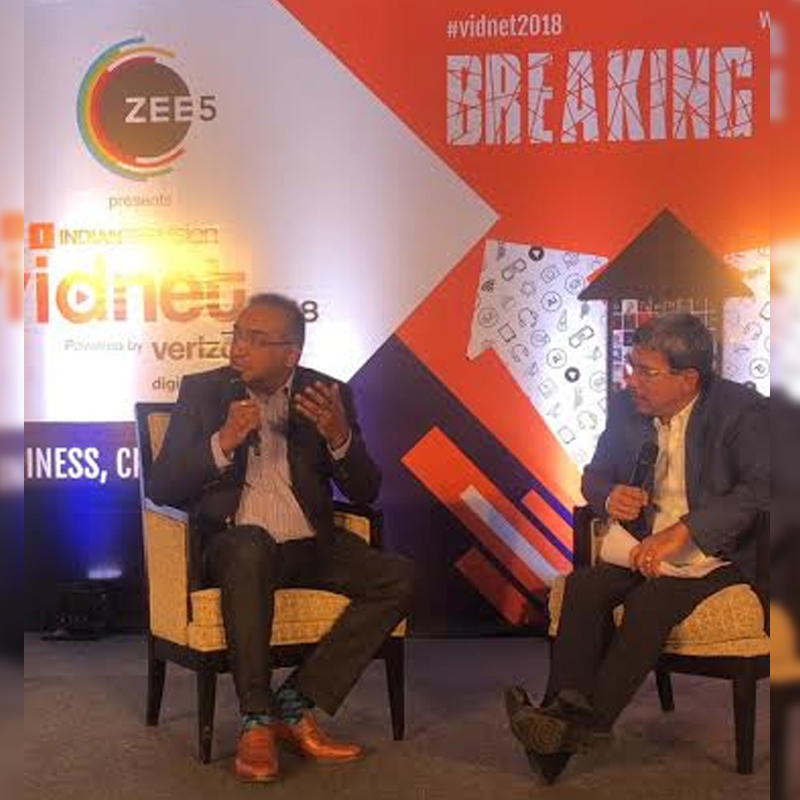
At the stage of Vidnet 2018, the Aditya Birla Group chairman Kumar Mangalam Birla’s content studio CEO spoke on the state of the industry, Applause Entertainment’s plans in a fireside chat with Indiantelevision.com founder, CEO and editor-in-chief Anil Wanvari.
187 million cable homes have made TV very powerful and matured, according to him. In addition to that, now the country has got around 500 million mobile phones leading to a flood of screens everywhere. As people are glued to these screens more than ever using in some way with a massive change in consumption habit, this creates an opportunity for everyone to be in the space.
“I come from a time where we used to have people watching 4-5 hours of television a day. It’s probably down to an hour. But in the meantime, people are finding more time on screens to consume all sorts of content. So, I think the number of hours spent, time spent, is bound to grow. If you are able to do different things, it’s a good time to be in this space,” he commented.
He saw the industry at a time when TRP was the benchmark to measure the success of a show. Now those days are gone when 10,000 boxes spread across India tried to tell what 600 million people were doing. The emergence of data gives much more accurate consumer feedback which Nair thinks is also “scarier”.
Though there is no foolproof formula for success in this business, Nair thinks one should start making content with a reasonable understanding of market and audience. Moreover, working with focus groups of few people who want to watch ‘X’ or ‘Y’ to create content would be tricky. However, after creating content, data and audience reactions play a bigger role.
Nair is vocal on the importance of finding a need gap by looking at things that are missing in the market. While drama series content on TV is dominated by daily soap opera, he thinks what India lacks is high-quality drama series. Though all the K-shows made huge money, according to him, in a diverse market like India, there should definitely be something more than just tele-novella.
“Now the opportunity is to do more stories. I mean it’s just not drama, there are short forms, animation, and there are kids, all sorts of things happening. We are currently focused on doing dramas. But when you look at the market, when you see the opportunities that are there, I think it’s a good time to be a creator, no matter what you create,” he added.
To grab more eyeballs in the burgeoning OTT space, there has been an upsurge of investment in content. Platforms with deep pockets are burning cash to make good content. Nair thinks it’s good for the industry to take up the value of content. According to him, it’s not only about monetisation but about the ability to build a business, a consumer habit. However, he also added that spending Rs 5 crore per episode cannot make that alone.
“Content is not a commodity you can win with a price war. You have to win that with a great story, you have to reach out to consumers, you have to connect with them and then you could spend Rs 300 crore making it or Rs 10 crore. In recent time you have seen the examples in Bollywood too where small budget films have done well. The focus is got to be on that,” he said.
Talking about Applause Entertainment’s near-term plan, he said it is working actively with the creative community, buying rights for international shows to adapt them into Indian context. It is also acquiring books to adapt them into series as well as original writing. They are also having conversations with platforms about who can carry these.
It bought rights of two BBC productions The Office andThe Night Of to adapt. For the former, it has already made 28 episodes. It also bought the right of Debashis Basu and Sucheta Dalal’s The Scam. It is also working with Goldy Bahel and Abhimanyu Singh.
“The way I see it is there are so many platforms, so many consumers, such a huge need gap for content, that I don’t regard myself a competitor. I am part of that mix. You are putting out ten shows, maybe you take one from me, you are putting out 100 shows, and maybe you take ten from me, that kind of thing. And we are essentially focused on helping build this industry,” he said.
He said as broadcasters have been doing the same kind of shows for last 18 long years, the whole format is sort of fixed as producers also know what they are doing. But for new age content, writing 10-12 episodes and creating season after season is new.
Nair thinks TV will be not dead in a hurry. While TV is making a lot of money, it’s not like that OTT does not have any room to grow. Moreover, even different models are emerging other than SVoD and AVoD in the OTT ecosystem. Hence, he reaffirms OTT and TV will exist together, at least in the next ten years.