I&B Ministry
CBFC mulling online methods to expedite film certification process: Nihalani


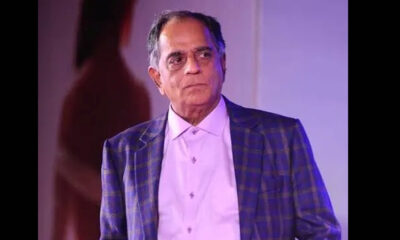
NEW DELHI: Even as the Central Board of Film Certification (CBFC) is facing flak on social media for asking singer Mihir Joshi to beep the word ‘Bombay’ from the lyrics of one of his songs from the album ‘Mumbai Blues;’ the newly appointed chairman of the Board – Pahlaj Nihalani is clear on his stance as far as certification goes.
Speaking to Indiantelevision.com, Nihalani said that one of the major tasks that he faced before him was to ensure speedy clearances of films submitted to the Board. “We will be looking at using more online methods to expedite this process with the least interference in the work of the film’s producer. The process will include introduction of an online ‘tatkal’ system to expedite the process of clearing films. The online system will be adapted to ensure that the board functions in a completely transparent manner and films can get certificates without much hassles,” he said.
What’s more, Nihalani, who has been appointed in an honorary capacity for three years from 18 January, also said that he would tender his resignation if he was unable to enforce the censorship guidelines while certifying films. “The guidelines don’t permit the use of vulgar or abusive language that I have seen in many films and it will be my attempt to stop the use of such language,” he stressed.
He went on to add that while people on the CBFC changed and the society as a whole was assuming a different profile with a greater population of younger people, Indian cultural values remained as strong as ever and would continue to guide him.
He urged filmmakers to use their freedom of expression, but “do not rape free expression.”
Nihalani said that while trailers of adult films were not being shown on television channels, he was conscious of trailers of films certified with U/A certificates being shown even during day time.
“It is unfortunate that YouTube and other media are also being used for showing films, since it makes it easier for filmmakers to use filthy language. Stars on live shows on television are using abusive language but this is a matter that should be dealt with by the Inter-Ministerial Committee of the Information and Broadcasting Ministry,” he said.
A matter that concerns Nihalani is that both social media channels and television channels were being seen by people of all ages.
Nihalani is also of the opinion that there was urgent need to amend the Cinematograph Act in view of the newer forms of screens coming up. “Although an amendment was contemplated by the previous government and put on the website, there may be need for greater change in view of fast advancements of technology,” he said.
In India, there have been cases galore when political or social bodies turn vandals and take to the streets opposing certain films that were already certified by the CBFC. Nihalani stressed that as per the Courts, “there should be no interference once a film has been cleared by the Board.”
When queried about the suggestion by actor and former chairperson Anupam Kher to permit adult films in late night hours on TV, Nihalani said, “This is a matter of policy relating to TV channels and it does not fall in the ambit of the CBFC.”
According to him, certain suggestions were being formulated, which will then be sent to the government.
Speaking about his priorities as the new CBFC chief, Nihalani said, “We need to request the Centre to implement the recommendations of the Justice Mudgal committee, which was set up in 2013 after the government felt the need to update the Cinematograph Act, 1952, in the wake of a controversy over the release of the Kamal Hasan starrer Vishwaroopam.”
Along with Nihalani, nine other members were appointed to the Board recently in the wake of the erstwhile chief Leela Samson resigning. The new members are Mihir Bhuta, Prof. Syed Abdul Bari, Ramesh Patange, George Baker, Chandra Prakash Dwivedi, Jeevitha, Vani Tripathi Tikoo, S Ve Shekhar and Ashoke Pandit. Nihalani said that the Ministry was also working towards filling vacancies in the Board.
Referring to the ‘mass resignations’ by Samson and other members, he said that their term had in any case ended several months earlier and they were continuing on extension pending new appointments.
Nihalani is a Hindi film producer since the 1980s, who produced his first film Hathkadi in 1982, starring Sanjeev Kumar, Shatrughan Sinha and Reena Roy. His last film titled Khushboo released in 2008. He was also the President of Association of Motion Pictures and TV Programs Producers for 29 years until 2009.
Claiming that he had made 24 films of which none had faced any censor problems, Nihalani said that he had taken a break from film-making in recent years. However, one of the films he is currently making is under production, while two others were in the planning stage.