iWorld
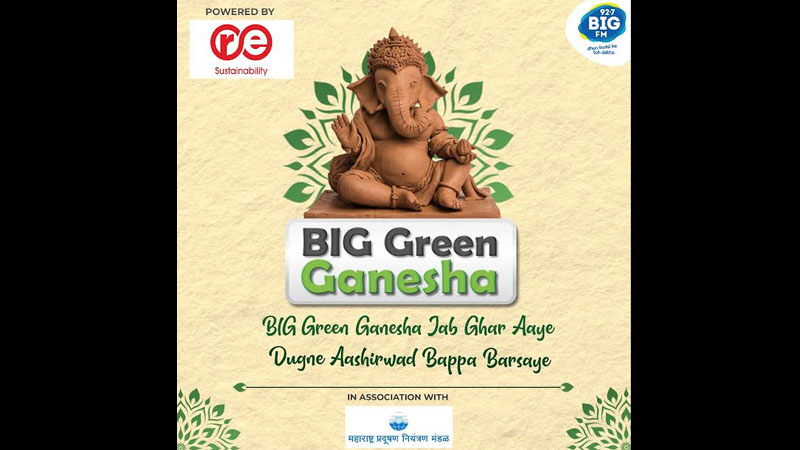
Big FM’s purpose-driven initiative Big Green Ganesha marks 17 years of sustainable festivities!
Mumbai: As the entire nation celebrates the auspicious occasion of Ganesh Chaturthi, BIG FM, one of India’s leading radio networks, marks the 17th edition of its highly acclaimed initiative – BIG Green Ganesha. Launched in 2008, this purpose-driven campaign has been continuously evolving, promoting environmental awareness and encouraging communities to celebrate Ganesh Chaturthi responsibly. This year, BIG FM, in association with the Maharashtra Pollution Control Board (MPCB) and powered by Re Sustainability and Recycling Private Limited, is making eco-friendly and plastic-free celebrations even more accessible, further solidifying its role in driving sustainable festivities for a cleaner, greener tomorrow.
The radio network will be unveiling a special BIG Green Ganesha song performed by the renowned singer Akriti Kakar, adding a festive and musical touch that inspires listeners to embrace sustainable practices. Celebrities like Rajkummar Rao, Patralekha, Sunny Leone, Esha Deol and Palak Muchhal amongst others are supporting the cause, promoting sustainable and eco-friendly celebrations nationwide.
A key highlight of this year’s campaign has been the recognition of ‘Green Heroes,’ individuals who are taking significant steps to adopt and promote eco-friendly practices during Ganesh Chaturthi. Over 10 days, BIG FM’s RJ Rani has been spotlighting these champions by visiting them at their homes, presenting each with an eco-friendly Ganesha idol and a green certificate to honour their commitment to sustainability. These Green Heroes have also been sharing their inspiring stories on air, motivating others to follow in their footsteps.
BIG FM COO Sunil Kumaran shared, “Even though awareness about environmental conservation has been growing, many people still overlook eco-friendly practices when selecting idols and decorations for Ganesh Chaturthi. With BIG Green Ganesha, we have consistently aimed to create sustainable changes in how this beloved festival is celebrated. Each year, we introduce new ways for listeners to engage in eco-friendly practice and we believe that by making sustainability more accessible and encouraging community participation, we can create a lasting, positive impact. This campaign is about fostering a culture of responsibility and care, ensuring that our celebrations respect both tradition and the environment.”
In addition to Mumbai, the BIG Green Ganesha initiative is being celebrated across Hyderabad, Gujarat, Bangalore, Pune, the Rest of Maharashtra and Goa. In these markets, the campaign is highlighting and promoting sustainable Ganesha celebrations through various on-ground activities. BIG FM’s on-air promotions, RJ advocacy and digital contests are instrumental in spreading the message. Listeners are tuning in to exclusive RJ interviews with celebrities and Eco Bhakts, who are sharing their personal stories and inspiring others to join the eco-friendly movement.

e-commerce
Visa report tracks rise of India’s affluent, experience-led spending
Affluent base doubles to 130 lakh, travel 58 per cent of elite spends.
MUMBAI: In India’s new luxury playbook, it’s less about owning more and more about living better. A new whitepaper by Visa Consulting and Analytics (VCA) maps a decisive shift in India’s affluent economy, where spending is becoming more intentional, experience-led, and closely tied to personal identity rather than pure income growth.
Titled India’s Affluent Economy 2025–2026, the report draws on a Visa-commissioned Yougov study and VisaNet data across travel, dining, retail and lifestyle categories. The headline number is hard to miss: individuals earning over Rs 10 lakh annually have nearly doubled from 69 lakh to 130 lakh, significantly expanding the country’s discretionary spending base.
But it’s not just about scale, it’s about behaviour. As consumers move up the affluence ladder, discretionary categories are taking a larger share of credit card spends, positioning cards as key enablers of premium, lifestyle-driven consumption.
The geography of wealth is shifting too. Affluence is no longer confined to metros such as Mumbai, Delhi and Bengaluru, with cities like Ahmedabad, Surat, Jaipur and Lucknow increasingly mirroring metro consumption patterns.
The report highlights a clear pivot from ownership to access. More than 50 per cent of affluent consumers now use cards for elite memberships, while 7 in 10 are drawn to limited-edition drops and curated collections. Increasingly, luxury is defined by seamless access be it concierge-led travel or curated dining where time saved is as valuable as money spent.
Spending patterns reinforce this shift. Among the ultra-elite, travel accounts for 58 per cent of discretionary spends, far outpacing retail and luxury combined at 28 per cent. Cross-border spending penetration stands at 63 per cent, signalling a growing global outlook among India’s affluent.
Closer home, indulgence is becoming routine. Nearly 4 in 5 affluent consumers dine at premium establishments at least three times a year, while 1 in 4 visit luxury venues more than five times annually. Dining spends are also climbing, with Rs 20,000 emerging as a new entry-level benchmark per experience and Rs 50,000 marking premium territory.
Retail, meanwhile, is becoming more selective. Three in four affluent consumers make a high-end purchase at least once a quarter, while one in four shops premium every two weeks. Luxury retail intensity is also rising, with 2 in 5 consumers spending over Rs 5 lakh annually, and a smaller but significant segment exceeding Rs 10 lakh.
Technology and wellness are carving out new roles in this ecosystem. High-end gadgets now see average spends of Rs 60,000 or more per purchase, while ultra-elite consumers are eight times more likely to visit spas and show five times higher engagement with cosmetic stores than non-affluent groups.
The broader takeaway is structural. Affluent consumers are no longer buying products, they are buying ecosystems. Integrated experiences across travel, dining, wellness and payments are becoming central to how this segment lives and spends.
As India’s affluent base expands beyond metros and aligns more closely with global consumption patterns, the real opportunity lies not just in size, but in speed. For brands, the message is clear: relevance will be defined by how early and how seamlessly, they plug into this evolving lifestyle economy.