Connect with us

e-commerce

Beyond the big cities, Bharat is calling the shots on India’s growth

Published

on

MUMBAI: India’s growth story is quietly changing address and it no longer reads Mumbai, Delhi or Bengaluru. A new report from Rukam Capital argues that the real momentum in consumption is now being driven by Tier 2 and Tier 3 cities, small towns and emerging urban clusters, where behaviour is shaped less by hype and more by trust, proof and relevance.

Titled Beyond Metros: The Real Story of Bharat’s Next 500 Million, the study lands at a moment when nearly 65 per cent of India’s population lives outside the metros. Backed by GST-led formalisation, rising affordability and deep digital penetration from near-universal 3G and 4G access to the everyday use of UPI, the report positions Bharat as the engine of India’s next phase of consumption-led growth.

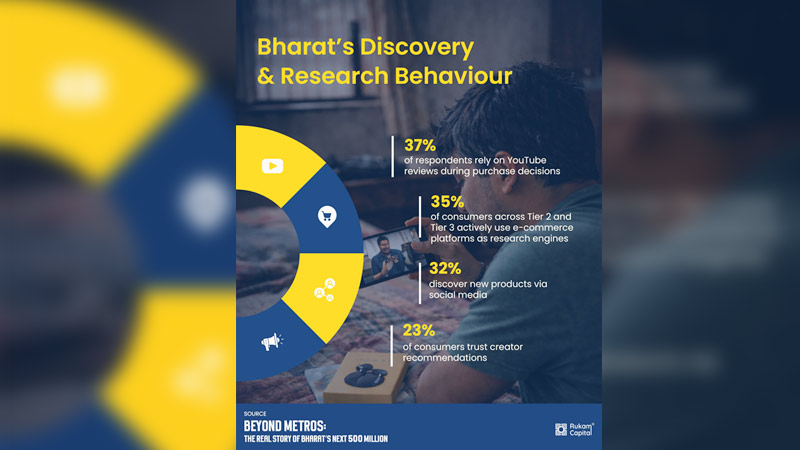
Crucially, the research overturns long-held assumptions about non-metro consumers. Far from being impulsive or easily swayed by celebrity endorsements, today’s Bharat shopper is deliberate and research-driven. Discovery is increasingly video-first and social-led, with Youtube emerging as a primary influence, 37 per cent of consumers rely on video reviews, while 32 per cent discover products via social platforms. E-commerce, too, has become a research tool, used by 35 per cent of consumers well before purchase decisions are made.

Advertisement

Trust, the report finds, is the real currency. Word-of-mouth influences 22 per cent of Tier 2 and Tier 3 buyers, while 43 per cent of Tier 3 consumers verify brands through official websites before buying. Customer service matters early, with 32 per cent factoring service interactions into pre-purchase decisions. Sustainability and safety cues also carry weight, influencing 23% of consumers but only when backed by peer reassurance rather than marketing gloss.

Spending patterns reflect discipline over impulse. UPI now powers transactions for 67 per cent of non-metro consumers, while discount tracking is common in Tier 2 cities. Festivals still drive discretionary spending in Tier 3 markets. Quick commerce adoption remains modest at 36 per cent, underscoring that instant gratification is not yet the default outside metros.

Platforms, meanwhile, are valued for utility, not noise. Whatsapp reaches close to 90 per cent penetration and functions as Bharat’s digital backbone. OTT consumption is driven by vernacular relevance, with JioHotstar leading usage at over 54 per cent across Tier 2 and Tier 3 markets. Gaming has also emerged as a serious influence channel, with over half of consumers in these regions responding to in-game advertising.

Advertisement

Commenting on the findings, Rukam Capital founder and managing partner Archana Jahagirdar said the study reveals a consumer who is confident, consistent and grounded. The opportunity for brands, she noted, lies not in aspiration-led messaging but in building trust early, designing for real use cases and staying rooted in local context.

Conducted with Yougov across more than 5,000 respondents in 18 states, the report makes one thing clear: Bharat’s next 500 million consumers are not waiting in the wings. They are already shaping demand, rewriting influence, and setting the terms for India’s trillion-dollar retail ambition.

 

Advertisement
Click to comment

Leave a Reply

Your email address will not be published. Required fields are marked *

e-commerce

Visa report tracks rise of India’s affluent, experience-led spending

Affluent base doubles to 130 lakh, travel 58 per cent of elite spends.

Published

on

MUMBAI: In India’s new luxury playbook, it’s less about owning more and more about living better. A new whitepaper by Visa Consulting and Analytics (VCA) maps a decisive shift in India’s affluent economy, where spending is becoming more intentional, experience-led, and closely tied to personal identity rather than pure income growth.

Titled India’s Affluent Economy 2025–2026, the report draws on a Visa-commissioned Yougov study and VisaNet data across travel, dining, retail and lifestyle categories. The headline number is hard to miss: individuals earning over Rs 10 lakh annually have nearly doubled from 69 lakh to 130 lakh, significantly expanding the country’s discretionary spending base.

But it’s not just about scale, it’s about behaviour. As consumers move up the affluence ladder, discretionary categories are taking a larger share of credit card spends, positioning cards as key enablers of premium, lifestyle-driven consumption.

Advertisement

The geography of wealth is shifting too. Affluence is no longer confined to metros such as Mumbai, Delhi and Bengaluru, with cities like Ahmedabad, Surat, Jaipur and Lucknow increasingly mirroring metro consumption patterns.

The report highlights a clear pivot from ownership to access. More than 50 per cent of affluent consumers now use cards for elite memberships, while 7 in 10 are drawn to limited-edition drops and curated collections. Increasingly, luxury is defined by seamless access be it concierge-led travel or curated dining where time saved is as valuable as money spent.

Spending patterns reinforce this shift. Among the ultra-elite, travel accounts for 58 per cent of discretionary spends, far outpacing retail and luxury combined at 28 per cent. Cross-border spending penetration stands at 63 per cent, signalling a growing global outlook among India’s affluent.

Advertisement

Closer home, indulgence is becoming routine. Nearly 4 in 5 affluent consumers dine at premium establishments at least three times a year, while 1 in 4 visit luxury venues more than five times annually. Dining spends are also climbing, with Rs 20,000 emerging as a new entry-level benchmark per experience and Rs 50,000 marking premium territory.

Retail, meanwhile, is becoming more selective. Three in four affluent consumers make a high-end purchase at least once a quarter, while one in four shops premium every two weeks. Luxury retail intensity is also rising, with 2 in 5 consumers spending over Rs 5 lakh annually, and a smaller but significant segment exceeding Rs 10 lakh.

Technology and wellness are carving out new roles in this ecosystem. High-end gadgets now see average spends of Rs 60,000 or more per purchase, while ultra-elite consumers are eight times more likely to visit spas and show five times higher engagement with cosmetic stores than non-affluent groups.

Advertisement

The broader takeaway is structural. Affluent consumers are no longer buying products, they are buying ecosystems. Integrated experiences across travel, dining, wellness and payments are becoming central to how this segment lives and spends.

As India’s affluent base expands beyond metros and aligns more closely with global consumption patterns, the real opportunity lies not just in size, but in speed. For brands, the message is clear: relevance will be defined by how early and how seamlessly, they plug into this evolving lifestyle economy.

Advertisement
Continue Reading

Advertisement News18
Advertisement
Advertisement
Advertisement
Advertisement Whtasapp
Advertisement Year Enders

Indian Television Dot Com Pvt Ltd

Signup for news and special offers!

Copyright © 2026 Indian Television Dot Com PVT LTD