
Hindi
AI won’t replace storytelling, says Whistling Woods’s Chaitanya Chinchlikar at Goafest 2026
Whistling Woods session maps how AI is reshaping cinema, gaming and advertising


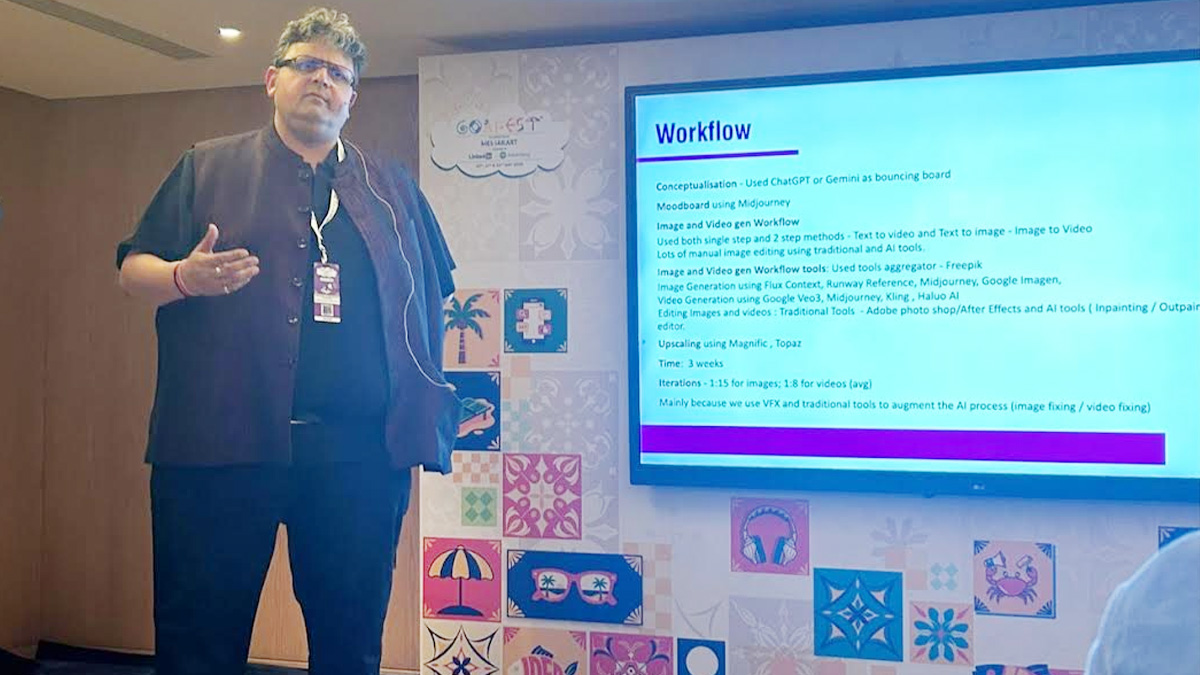
GOA: Artificial intelligence may be writing the newest chapter in filmmaking, but according to industry experts at Goafest 2026, the script is far from replacing human creativity.
At a masterclass titled “Reimagining Filmmaking in the World of Artificial Intelligence”, by Whistling Woods International, vice president, business head, chief technology officer and emerging media head Chaitanya Chinchlikar unpacked the rapidly evolving relationship between AI, storytelling and the business of entertainment.
The session steered away from doomsday narratives and instead framed AI as another technological shift in a long line of industry disruptions. From the arrival of digital editing to virtual production and computer-generated imagery, filmmaking has repeatedly reinvented itself through new tools. AI, the masterclass argued, is simply the latest and perhaps most accelerated phase of that evolution.
A major focus of the discussion was the so-called “hype cycle” surrounding artificial intelligence. The audience was walked through how emerging technologies typically move from excitement and inflated expectations to disillusionment before eventually settling into everyday utility. AI, particularly generative AI, was positioned as currently sitting somewhere between fascination and correction, with many industries still figuring out what is practical and what is merely flashy.
The session also challenged the perception that AI suddenly appeared with the rise of tools from OpenAI. Technologies such as machine learning, computer vision, conversational interfaces and automation have existed for years, quietly embedding themselves into everyday workflows. Unlocking phones with facial recognition, automatic photo tagging and recommendation engines were all highlighted as examples of AI becoming invisible infrastructure rather than futuristic novelty.
Within filmmaking, the discussion repeatedly returned to one point: technology changes workflows, not the fundamentals of storytelling. Narrative structure, emotional intelligence, audience psychology and visual language were described as timeless creative foundations that AI cannot replace. What changes instead are the tools and processes surrounding production.
The masterclass explored how AI is already being integrated across the filmmaking pipeline, from ideation and script assistance to storyboarding, editing, visual effects and distribution. Prompt engineering, AI-assisted shot design, workflow optimisation and automated quality control were described as emerging creative disciplines rather than shortcuts.
Gaming and advertising were identified as two sectors moving particularly quickly. AI-powered non-playing characters in games are becoming increasingly personalised, capable of responding differently based on user behaviour and playing style. In advertising, brands are leaning heavily into hyper-local content, behavioural targeting and user-generated content integration to produce more customised campaigns at scale.
The session also highlighted how AI is quietly powering backend systems that audiences rarely notice but heavily depend on. Captioning, encryption, compression, cloud optimisation and compliance management were described as some of the biggest real-world business applications for AI today, even if consumers barely recognise them as artificial intelligence.
Another recurring theme was the rise of “agents” or large action models. Unlike traditional language models that mainly provide information, these systems are designed to perform actions autonomously across platforms. Examples included voice assistants interacting with ecommerce systems, automated purchasing workflows and interconnected digital ecosystems capable of operating with minimal human input.
That shift, the session suggested, raises pressing questions around interoperability, governance and control. Without clearly defined rules for how AI agents interact with one another, there is growing concern that systems could begin operating in ways humans neither fully understand nor supervise.
The conversation around jobs was notably more optimistic than alarmist. AI was presented less as a destroyer of employment and more as a reshaper of tedious or repetitive tasks. Rotoscopy in VFX, manual clean-up in audio production and repetitive production workflows were cited as examples of labour-intensive work that AI could dramatically reduce.
Motion capture and performance capture were discussed as areas where actors and creators could actually gain new opportunities. The work of Andy Serkis, known for performances such as Gollum, was referenced as an example of how digital acting and body-performance skills are becoming increasingly valuable in the AI era.
The masterclass also showcased practical demonstrations developed by the emerging media lab at Whistling Woods International. One of the standout examples was a low-cost markerless motion-capture system capable of generating near real-time animation using a single smartphone camera instead of expensive studio infrastructure.
The broader message was clear: AI is rapidly lowering production barriers and democratising access to advanced creative tools. Tasks that once required multimillion-rupee studios can now increasingly be handled with lightweight software, open-source systems and compact workflows.
Still, the session cautioned creators against confusing tools with talent. While AI can automate processes, generate options and speed up production, meaningful storytelling still depends on human judgement, cultural understanding and emotional depth.
At Goafest 2026, the takeaway was less about machines replacing filmmakers and more about filmmakers learning to direct the machines. In the race between creativity and automation, the industry appears determined to keep humans in the director’s chair.






