eNews
AI dominates IFA’s ShowStoppers showcase

BERLIN: Artificial intelligence was the undisputed headline act at ShowStoppers, IFA Berlin’s official press preview held on 4 September. Over 80 exhibitors packed the three-hour session, giving journalists and influencers an early glimpse of the products set to crowd Europe’s largest tech fair. While the categories stretched from household appliances to personal devices, one theme was inescapable: the wholesale integration of AI.
Rugged garden mowers, once defined by brute force, now tout autonomous navigation and weather-proofing. Wet-and-dry vacuum cleaners use AI to map, learn and optimise cleaning routes. Gimbals offer intelligent tracking for creators on the go, while rugged smartphones double up as portable projectors. Energy-saving household devices market themselves as “self-learning”, promising to trim electricity bills through adaptive use.
Hardware makers leaned on portability as well. A 14-inch laptop weighing a mere 800 grams drew attention, billed as a featherweight workhorse. Gesture-following mini-drones pitched themselves as toys and tools in equal measure. Even the stubbornly unpopular 3D tablet resurfaced—evidence that manufacturers, though faced with consumer apathy, remain unwilling to abandon the technology. A neat surprise came in the form of badge-shaped AI translators—clip-on devices priced for the mass market and small enough to stick onto the back of a phone.

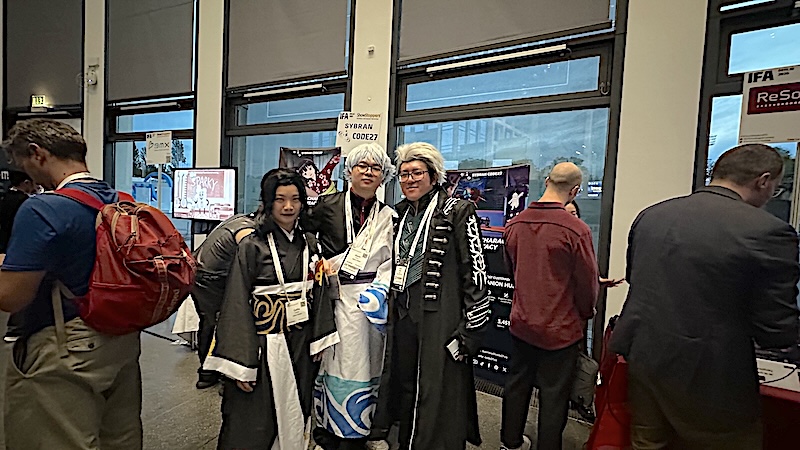
But the boldest leap was not practical utility but companionship. One company showcased devices capable of generating anime-style characters that converse with their owners, others displayed cute little creatures sold as “digital friends.” The trend hints at a market where technology is less about solving chores and more about filling social and emotional gaps. AI-driven lighting systems and solar solutions underscored how deeply the technology has permeated the design ethos: AI is no longer a bolt-on, it is the organising principle.
Beyond the gadgets themselves, the origins told their own story. By some estimates, nearly two-thirds of the exhibits could be traced back to China, with Shenzhen firms leading the charge. Their formula—affordable prices married to rapid product cycles and nimble manufacturing—has become hard to beat. For European consumer electronics firms, this dominance is a looming worry. Once the bastions of innovation, many now risk being outpriced and outpaced by their Chinese rivals.

The prevalence of Chinese exhibitors at ShowStoppers reflects a wider shift in the global electronics market, where Asia increasingly dictates both the direction and the speed of innovation. The question for Europe is whether design and brand heritage can offset the brute force of Shenzhen’s cost efficiency.
For IFA itself, the preview doubled as a stage for a strategic announcement. Organisers confirmed a fresh deal with Berlin authorities, extending the trade show’s stay in the city until 2034. That decision quells speculation that IFA might become a travelling exhibition, rotating between global capitals. Instead, Berlin remains the fair’s long-term anchor—a boon for the city’s tech ecosystem, hotels and conference economy.
The main event kicks off on 5 September and runs until 9 September. If ShowStoppers was any guide, the halls will be thick with AI, from the mundane to the fantastical.